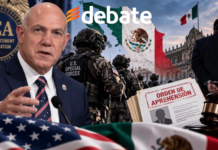
Donald Trump Calls Canada “Disgusting” and Says Mexico, China, Japan, South Korea, and Germany Took Advantage of the United States
Donald John Trump, President of the United States, described Canada as “disgusting” and argued that Mexico, China, Japan, South Korea, and Germany took advantage of the United States by imposing tariffs on U.S. goods in their markets during an event held in Las Vegas on August 5, 2026.
“They’ve hurt us for years with tariffs imposed by China, Japan, South Korea, Germany, by everybody. Canada. Canada is disgusting. Yes, yes they are. They’re disgusting. I love the people, but it’s disgusting. Disgusting leadership. And Mexico. They all did it,” the U.S. president said.
Trump added that this trade dynamic no longer benefits those countries because his administration has reversed the balance of power in trade matters.
Since the beginning of his second term in 2025, the White House has implemented a trade policy characterized by the imposition of punitive tariffs on imports from most countries around the world. In July 2026, it imposed additional duties on countries accused of failing to prevent forced labor.
The remarks came while Mexico continues trade negotiations with the United States. On July 29, 2026, Marcelo Luis Ebrard Casaubón, head of Mexico’s Ministry of Economy (Secretaría de Economía), revealed that the Mexican government proposed reducing the tariff on Mexican steel from 50 percent to approximately 10 percent, with the goal of reaching an agreement during the fourth round of negotiations scheduled for the first week of September 2026 in Washington.
“In the case of steel, we have this 50 percent tariff, and what we have proposed is that they give us treatment similar to what they are giving the United Kingdom, which is a rate of around 10 percent,” the Secretary of Economy said.
Up to that point, the Mexican government had sought either the elimination of the tariff or an exemption for Mexico. Ebrard argued that the tariff lacks justification because Mexico purchases more U.S. steel than it exports to the United States.
“You have a surplus because I buy more steel from you. Mexico buys more steel from the United States than from any other country. In fact, we are the country with which the United States has the largest steel trade surplus,” the federal official said.
The Secretary of Economy distinguished the situation of aluminum, noting that Mexico will continue to run a deficit because it lacks the necessary mineral resources and its production depends mainly on recycled scrap metal. As an example of investments aimed at increasing domestic production, he mentioned the plant that Ternium is building in Pesquería, Nuevo León, with an investment of approximately $4 billion and expected to be completed in 2027. The facility will eliminate the need to import steel slabs and other steel products while allowing more advanced materials to be produced within Mexico.
“From 2018, 2019, 2020 until now, it has been the same line of discussion with the United States. What has Mexico done? Make investments to produce more in our country, carry out the smelting processes in Mexico, and avoid having tariffs imposed on us,” he said.
The federal official added that Mexico would wait for the results of the U.S. investigation under Section 301 concerning global excess production capacity, which were expected during the first week of August 2026. Those findings would determine whether the United States imposes additional tariffs on steel and would help shape Mexico’s strategy for the September negotiations.
Previously, on July 24, 2026, it was confirmed that the 10 percent tariffs imposed by the U.S. government under Section 301 once again placed Mexico and Canada in a relatively favorable position compared to other economies, because exports that comply with the United States-Mexico-Canada Agreement (USMCA) remain exempt from those tariffs.
According to an analysis by BBVA, the tariffs create uncertainty about the future of global trade rules and generate inefficiencies across multiple economies, including that of the United States, although the impact on Mexico is comparatively smaller.
“The USMCA continues to function as the primary mechanism protecting Mexico’s preferential access to the U.S. market and also represents another action demonstrating the United States’ intention to continue with the USMCA,” the financial institution stated, adding that exporters still have an incentive to increase regional content and properly document compliance with rules of origin.
While several countries face tariffs of up to 12.5 percent over alleged forced labor practices, the Office of the United States Trade Representative (USTR) determined that Mexico has adopted a ban on imports produced with forced labor but has not enforced it effectively. Mexican goods are formally subject to a 10 percent tariff, with an exemption under the USMCA, although the measure is still considered inconsistent with the trade agreement.
“This new action confirms that the Trump administration’s trade policy will continue to be characterized by extensive use of tariffs and by seeking alternative legal grounds to maintain near-universal coverage,” BBVA concluded.
Source: zetatijuana