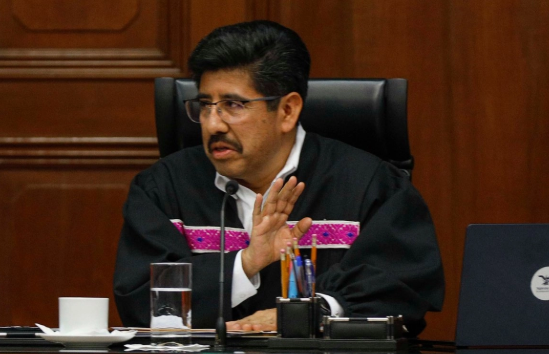

A group of business leaders has suggested that Justice Lenia Batres does not necessarily have to become president of the Supreme Court of Justice of the Nation (SCJN) starting in September of next year, President Claudia Sheinbaum Pardo reported. However, she clarified that the decision “is a matter” for the Supreme Court justices themselves.
Nevertheless, Sheinbaum considered it necessary to resolve the contradiction between Articles 94 and 97 of the Constitution, because after the judicial reform approved by Congress in September 2024, two different methods for choosing the president of the SCJN remain established.
During her morning press conference yesterday, the president was asked whether a meeting —as previously reported— actually took place between her and a group of business leaders at the National Palace about two months ago, where they allegedly expressed opposition to Batres becoming president of the Court.
The president responded:
“There are business leaders who propose one person or another, not necessarily Lenia Batres, but this is a matter for the Court, and it has to be defined there because there is a contradiction in the Constitution itself, due to how it was written, regarding who will represent the presidency of the Court. So, that issue must be resolved.”
She added:
“But my respect and recognition go to all the justices of the Court.”
Since October 2024, one month after the reform was approved, Morena acknowledged that Article 94 of the Constitution established that the president of the Court should be the candidate who receives the most votes, while at the same time Article 97 remained in effect, which states that the appointment must be made by the justices themselves.
In April 2025, Morena introduced an initiative to correct this inconsistency. The proposal was approved by the Constitutional Points Committee in May, establishing that the appointment should follow the process outlined in Article 94.
The proposal was supposed to be voted on by the full Chamber of Deputies before the judicial election; however, the document remained pending in the legislative process.
The third paragraph of Article 94 of the Constitution establishes that the presidency of the Supreme Court will be renewed every two years through a rotating system based on the number of votes obtained by each candidate for justice.
This mechanism allowed Hugo Aguilar Ortiz to become the head of the highest court, while Lenia Batres received the second-highest number of votes.
Source: jornada