
It Returned Home to Be Worshipped!
The image of Saint Rose of Lima, stolen in 2007, returned to the Santa Mónica Chapel in Epazoyucan as part of the government campaign #MiPatrimonioNoSeVende.
After nearly two decades since its theft in 2007, the sculpture of Saint Rose of Lima, dating from the 17th century, returned to the Santa Mónica Chapel, located in the municipality of Epazoyucan, in the state of Hidalgo, to be placed back in its original location inside the main altarpiece. The recovery of the piece was completed in 2024 as a result of the Mi Patrimonio No Se Vende campaign, promoted by the Government of Mexico. Subsequently, the work was transferred to the National Coordination for the Conservation of Cultural Heritage (CNCPC), of the National Institute of Anthropology and History (INAH), in March 2025, for examination by specialists from the Laboratory for the Conservation of Polychrome Sculpture (LCEP).
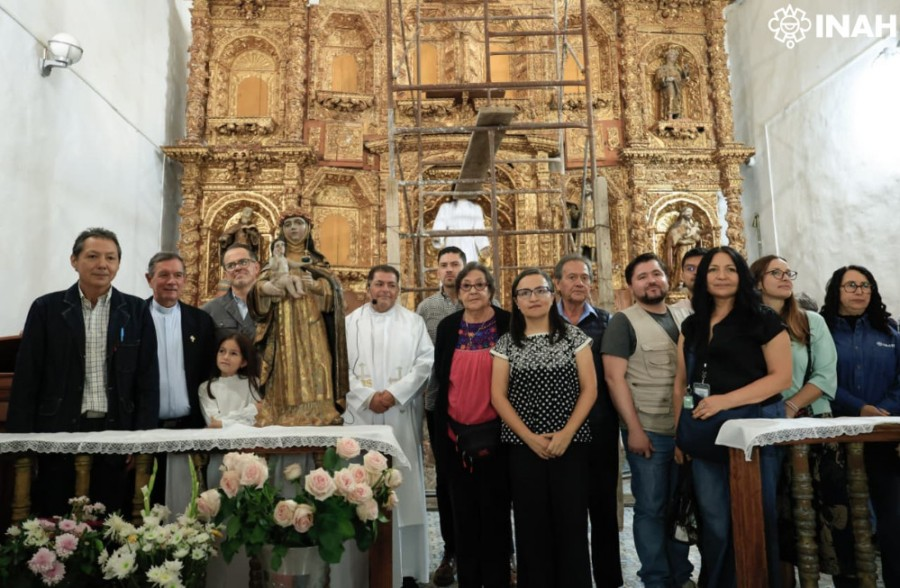
The handover of the image was attended by the INAH Technical Secretary, José Luis Perea González, representing the institute’s Director General, Omar Vázquez Herrera. During the ceremony, the official stated: “Today we celebrate an act of justice and reparation of the religious cultural heritage and the memory of this community.” Likewise, Perea González stated that “sacred art is not a commodity, but rather forms part of the identity and history of communities,” and reported that through the federal restitution program, more than 17,000 cultural assets have been repatriated from different parts of the world.
Government and Religious Authorities Celebrate the Return of the Historic Saint Rose of Lima
For her part, the head of the CNCPC, Thalía Velasco Castelán, stated that the theft of cultural heritage violates not only the material loss of the pieces, but also the historical value and meaning they hold for the inhabitants of each community. In his remarks, the director of the INAH Center in Hidalgo, Manuel Villarruel Vázquez, stated that the sculpture is a piece of incalculable value that forms part of the community’s living heritage, and therefore called on ecclesiastical authorities and the people of Epazoyucan to join efforts to protect their cultural assets.
The restoration process was carried out by specialists Érika Romo Hernández and Juan Ramírez Ponce, assigned to the LCEP and the Directorate for Comprehensive Attention to Communities of the CNCPC, respectively. The intervention began in March 2026 and lasted 10 weeks. Romo Hernández explained that the figure had two cracks in its support structure, detachments of preparatory and decorative layers, the loss of two fingers on both the saint and the infant Jesus accompanying her, as well as the infant’s detached arm. The greatest damage was found in the pictorial layer, which had flakes with loss of the original paint. Therefore, missing areas of the preparation layer, gilding, and polychromy were restored to recover continuity in the forms and designs of the decoration.
Regarding previous alterations, Ramírez Ponce detailed the presence of deterioration corresponding to elements replaced during earlier interventions, such as resins, nails, and detached pieces, which were replaced with materials consistent with those used in the original 17th-century manufacture. “With this intervention, it was possible to completely stabilize the sculpture and restore a fluid visual reading,” the specialist stated.
Characteristics of the Piece
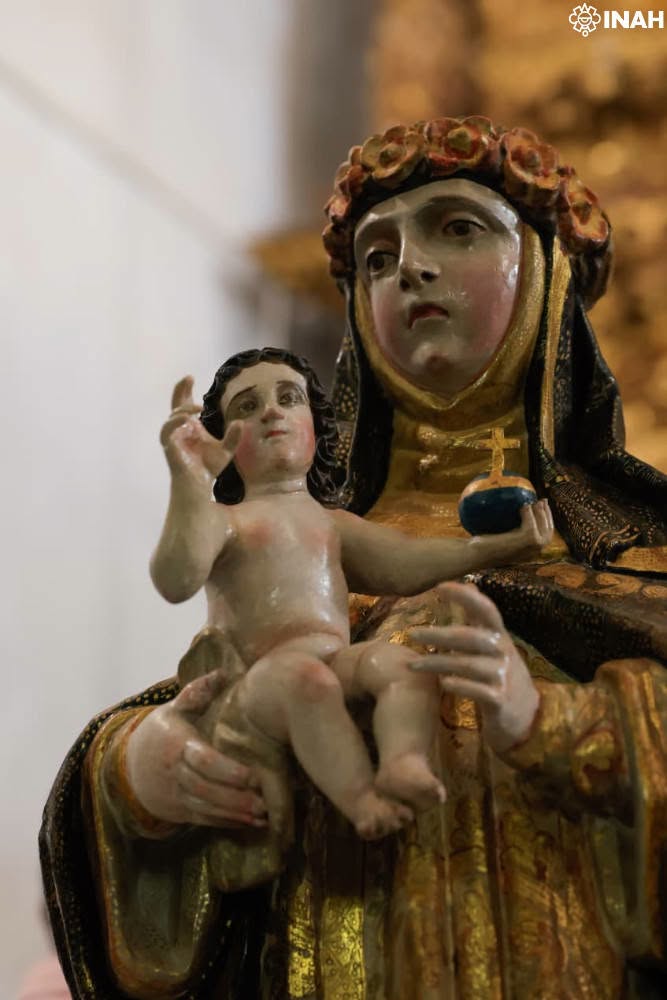
The carving measures 110 centimeters in height, 42 centimeters in width, and 33 centimeters in depth. It depicts a full female figure standing on a base, wearing a black veil, a white tunic with golden phytomorphic designs, a black mantle, and a floral crown. On her right arm, she holds a nude infant measuring 26 centimeters in height, 21 centimeters in width, and 17 centimeters in depth. The expert assessments for the repatriation of the piece were carried out in 2016 and 2017 by restorers Martha Isabel Tapia González and Ana José Ruíz Gómez. Tapia González emphasized the importance of maintaining an adequate record of movable cultural assets in inventories to facilitate their identification in the event of theft.
Also attending the handover ceremony were the Judicial Vicar of the Archdiocese of Tulancingo, Ubaldo Castaño Zapata; the priest of the Parish of Saint Andrew the Apostle, Francisco de Jesús Contreras Figueroa; and CNCPC restorer Cristina Noguera Reyes.
Source: mexicodesconocido