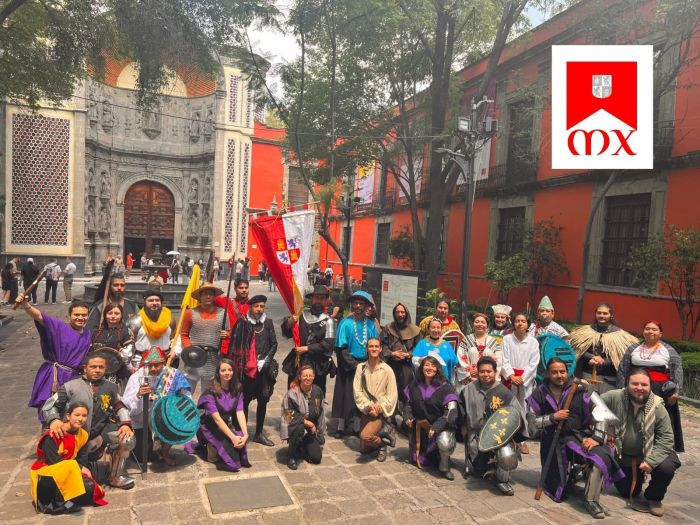

For several days, two far-right organizations that emerged from political traditions that seemed confined to the margins of Mexican history attempted to return to the public sphere. The National Sinarquist Union, heir to the counterrevolutionary Catholicism that reorganized after the Cristero War, and the Celedonio de Jarauta Traditionalist Circle, identified with Spanish monarchist Carlism, joined the call to recreate the Paseo del Pendón in Mexico City.
Their appearance drew attention not because of the political strength they represent, but because of what it revealed about a traditionalist far right that survives in small groups but remains distant from the new expressions of the right and far right that have gained public visibility in Mexico and other countries in recent years.
The two groups have different origins and projects. The National Sinarquist Union was founded in 1937, after the Cristero War, as a counterrevolutionary Catholic organization opposed to various policies of the government of Lázaro Cárdenas, and currently presents itself as an expression of the “popular right.” The Celedonio de Jarauta Traditionalist Circle, on the other hand, identifies with Carlism, a Spanish traditionalist, Catholic, and monarchist movement that advocates for a monarchy headed by a member of the Bourbon family.
The call to recreate the Paseo del Pendón, scheduled for August 14, had circulated practically unnoticed on social media until both organizations began promoting it through their own channels. Their involvement generated questions because of their conservative profile and, particularly, because of the positions of the Traditionalist Circle, which openly embraces Carlism and uses expressions such as “Viceroyalty of New Spain” to refer to Mexico City.
“They are not a very political expression, so to speak. They are so outdated that they do not manage to become a political expression,” writer Pedro Miguel explained in an interview.
In recent days, a call had begun circulating on social media that had gone practically unnoticed until both groups began spreading the invitation through their own channels to recreate the Paseo del Pendón, scheduled for August 14.
Their participation generated criticism because of their conservative profile and because the Celedonio de Jarauta Traditionalist Circle embraces the political ideology of Carlism and uses expressions such as “Viceroyalty of New Spain” to refer to Mexico City.
The event was organized by a group identified as the Paseo del Pendón Festival Committee. The initial call included organizations dedicated to history and representations of pre-Hispanic Indigenous cultures, including México Hispañon, Ehécatl, Somos Nómadas, and Cuauhocelocalli.
The controversy reached President Claudia Sheinbaum Pardo’s morning press conference. On July 24, she questioned the intention to revive the celebration and stated: “In a few words, it is the commemoration of the Conquest; part of the Mexican right already tried this by bringing Díaz Ayuso from Spain to vindicate Hernán Cortés. It did not go very well for them, and I do not think it will go well for them now.”
The event was ultimately canceled. The organizing group, identified on social media as the Cultural Paseo del Pendón Festival, but without visible public figures, sent a letter to the newspaper La Jornada, which had reported that far-right organizations had joined the call, and later shared the same statement on its social media accounts.
In the document, the organizers stated that the festival began in 2021 for cultural purposes and that its objective was to promote the participation of Indigenous peoples in what they described as the main viceregal civic celebration in Mexico City.
They also rejected any connection with political groups and stated that, from the beginning, they had established rules to prevent their participation.
“From the beginning, it was decided that the festival would be citizen-led, self-managed, self-financed, open to participation, and free of charge,” they stated.
According to their statement, the participation rules strictly prohibited the integration of political groups, as well as the use of symbols, slogans, or media of a proselytizing and ideological nature. They also stated that, when they detected attempts to do so, they took measures to prevent it.
The organizers attributed the cancellation to intolerance and polarization.
“Intolerance has reached the point of forcing the definitive cancellation of the public activities scheduled for this year because the conditions necessary to carry them out do not exist,” they stated.
The National Sinarquist Union
Following the cancellation, the National Sinarquist Union expressed regret that the recreation had been suspended and accused others of attempting to distort its meaning.
“We regret the cancellation of the Cultural Paseo del Pendón Festival in Mexico City,” the organization stated, claiming that the historical and cultural recreation commemorated “the victory of the Mesoamerican peoples together with the Spaniards against the Triple Alliance that oppressed them.”
The UNS also rejected being classified in terms of left or right and maintained that since its foundation it has fought for social justice.
However, the organization maintains a conservative profile. Among its positions are the defense of private property, opposition to abortion, and the vindication of the Cristero War, a conflict that in 2026 marks one hundred years since its beginning.
Its most prominent historical leader was writer and politician Salvador Abascal Infante, father of Carlos Abascal Carranza, who served as Secretary of the Interior during Vicente Fox’s government, and Salvador Abascal Carranza, a former congressman and candidate for Head of Government of the Federal District in 2000.
The relationship between Sinarquism and the Cristero movement is not limited to its current commemoration. After the 1929 agreements that ended the main stage of the Cristero rebellion, sectors of militant Catholicism that had participated in the confrontation with the post-revolutionary state remained organized.
Part of these networks first regrouped in the so-called Legions and later in La Base, an underground Catholic organization whose Section 11 formally gave rise to the National Sinarquist Union in León, Guanajuato, in 1937. Thus, Sinarquism incorporated part of the political and religious tradition of the Cristero movement, although it replaced armed rebellion with a strategy of organization and mass social mobilization.
This continuity also had a territorial and social dimension. The UNS found some of its main strongholds in Guanajuato and other areas of the Bajío and western regions, territories where the Cristero rebellion had had a strong presence. But the movement expanded its program: in addition to defending Catholic values, it opposed various policies of Cardenismo and sought to promote a social order inspired by Catholicism.
Writer Pedro Miguel placed Sinarquism precisely within a right historically linked to popular sectors.
“The Sinarquists were the right wing of the poor, or the poor of the right,” Pedro Miguel explained.
According to the writer, the Sinarquists shared characteristics with some sectors that later supported left-wing candidates, such as their origins among poor farmers and a deep sense of nationalism. However, he explained that their nationalism had a Catholic and anti-imperialist character because it opposed the Anglo-Saxon Protestantism of the United States.
Pedro Miguel considered that Sinarquism lost relevance during the following decades and maintained that, if this group was the most important among those who joined the call, “the others are truly insignificant.”
The National Sinarquist Union was historically the more influential of the two organizations. Pedro Miguel recalled that by the 1980s it had gathered tens of thousands of people. In 1987, during the 60th anniversary of its founding, it filled an event in León, Guanajuato, one of its main strongholds.
But that strength faded during the following decades, among other reasons after Sinarquism entered electoral politics through the Mexican Democratic Party (PDM).

The writer recalled that projects derived from this movement eventually supported the candidacy of Cuauhtémoc Cárdenas and joined a left-wing coalition. For Pedro Miguel, the shift was less paradoxical when considering the social origins of Sinarquism.
In line with the writer’s explanation, the National Sinarquist Union also sought to take its project into electoral politics through the Mexican Democratic Party, known for the “Red Rooster” emblem, which presented itself as an expression of the “right of the poor” and revived part of the social Christian tradition associated with Sinarquism and the Cristero movement, according to the descriptions published by the Sinarquists themselves.
The PDM was founded in 1971 in Irapuato, Guanajuato, after the Cristero War, with an ideology of extreme and counterrevolutionary Catholicism.
“The PDM adopted the Social Doctrine of the Church and the principles of social Christianity, often confused with Christian democracy, as its backbone,” according to the Sinarquists’ own description.
The party had presidential candidates and gained representation in Congress and in municipal governments, primarily in the Bajío and western regions of the country. In 1982, it nominated Ignacio González Gollaz, who received approximately 433,000 votes, equivalent to 1.8 percent of the vote. In 1988, Gumersindo Magaña Negrete received approximately 190,000 votes, a result that caused the party to lose its registration.

After recovering its registration, the PDM nominated Pablo Emilio Madero in 1994 and formed the National Opposition Union (UNO) coalition, but received its lowest vote total and lost its registration again. The party disappeared after the 1997 elections.
Throughout its history, the Sinarquist party also won municipal governments such as San Julián, Lagos de Moreno, San Juan de los Lagos, Guanajuato City, and Santa Ana Chiautempan, in addition to eventually having as many as 12 proportional-representation federal deputies.
The electoral journey ended with a political shift: projects that emerged from this movement became linked in 2000 with the left of Cuauhtémoc Cárdenas, an alliance that sectors of traditional Sinarquism considered a break with their roots. Afterwards, these expressions gradually lost strength.
For this reason, Pedro Miguel considered that if the National Sinarquist Union was the most influential group among those who joined the Paseo del Pendón call, the others were even less relevant.
The Circle and Carlism
The Celedonio de Jarauta Traditionalist Circle has a different profile from Sinarquism. The organization identifies with Carlism, a traditionalist, monarchist, and anti-liberal political movement that emerged in Spain in the 19th century.
Carlism defended Catholicism, the traditional laws of the regions, and a king belonging to the Bourbon family. The Circle declares itself loyal to His Royal Highness Don Sixto Enrique de Borbón and disseminates content associated with this movement.
Pedro Miguel explained that the group maintains an international connection with spaces linked to Carlism, primarily through the newspaper La Esperanza.
The writer also distinguished this movement from contemporary right-wing and far-right groups, which maintain different international positions. According to his explanation, the Circle preserves a traditionalist and monarchist vision that places it in a different position even in relation to other expressions of the contemporary far right.
The writer Pedro Miguel emphasized that these ultraconservative groups are associations that have remained isolated and have not connected with the far-right expressions that have gained greater public visibility in recent years and have sought to establish links with sectors of the Mexican right.
“They failed to articulate themselves with the far-right expressions that have resonated the most in recent times, which are these currents within the PAN, Salinas Pliego, Eduardo Verástegui, and Gilberto Lozano,” Pedro Miguel said.
The writer placed this attempt within a broader context of transnational right-wing groups approaching Mexican actors. He also recalled the presence in Mexico of Isabel Díaz Ayuso and Cayetana Álvarez de Toledo, as well as Donald Trump’s approaches to figures on the Mexican right. He also mentioned attempts from Argentina to find a Mexican counterpart with political influence.
But, in the case of the groups that joined the Paseo del Pendón call, that articulation did not occur.
“I believe these groups were left loose, they were left alone,” Pedro Miguel concluded.

Source: sinembargo