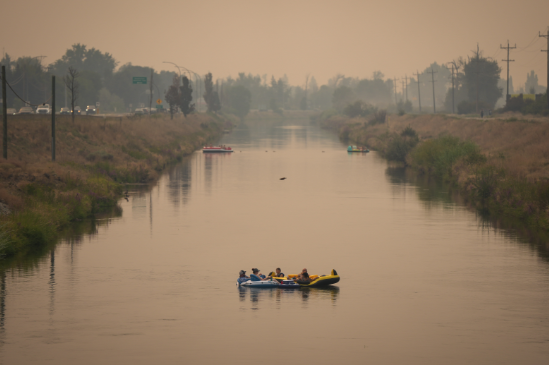

A deadly wildfire in western Canada that has forced approximately 20,000 people to evacuate grew overnight despite the absence of strong winds, making efforts to contain the blaze and fully assess the damage more difficult, authorities reported Tuesday.
One hundred firefighters from Mexico have joined the response, bringing the total number of firefighters battling the flames to 193. The fire has destroyed homes and other properties near Okanagan Lake, killed an 80-year-old woman, and advanced toward Summerland, a community of approximately 12,000 residents located about 300 kilometers (185 miles) east of Vancouver.
The fire showed “significant growth” in some areas overnight despite the lack of strong winds, said Cliff Chapman, director of provincial operations for the British Columbia Wildfire Service. He added that crews were working around the clock to establish control lines and make it safe for evacuated residents to return home.
“We recognized and heard even last night that people obviously want to go home. They want to see the extent of the damage,” Chapman said.
Provincial Officials Intensify Evacuations
Kevin Dunbar, British Columbia’s executive director for emergency response and recovery operations, described the situation as one of the largest evacuations in the province’s recent history.
British Columbia authorities said they had reserved 1,600 hotel rooms and 1,000 group accommodation spaces for evacuees in the Okanagan region after some residents experienced delays in receiving emergency assistance during the weekend evacuation.
In addition to those who have already been forced to leave, another 10,000 people have been told to be prepared to evacuate at short notice.
More than 100 wildfires were burning across the province, and authorities warned that dry lightning could spark additional fires in the Central Interior and Okanagan regions. The province has also requested federal assistance to expand accommodation for evacuees.
The Royal Canadian Mounted Police is investigating whether criminal activity played a role in the fire. Chapman said approximately 4% of wildfires in British Columbia over the past decade were suspected of being deliberately caused, although authorities have not said that the Bald Range fire was intentionally started.
Evacuated Residents Describe Their Experiences
Lucille and Gordon Beach, residents of Summerland, were in Vancouver for their granddaughter’s wedding over the weekend when they learned that the fire had started.
“We weren’t feeling very festive,” Lucille Beach said Tuesday.
The couple, who are temporarily staying in West Kelowna with their dog, have not seen their home since leaving Friday but believe it is still standing. Lucille said it took them several days to adjust to the reality of what was happening.
Carmen Bodzasy evacuated from Summerland, where she and her husband had recently moved. She had to navigate unfamiliar roads while her husband was away for work.
Before leaving, she said she “cried my eyes out for a minute” and then thought about what she would take if she had to start over. She took photographs from her parents’ wedding, pictures of her children’s families, and photographs of herself and her husband.
“I thought, if I don’t have walls to come home to, at least I have memories to hang in a new one,” she said.
On Tuesday, while holding her small dog, she was still uncertain about the condition of her home. Nevertheless, she said she intends to remain in Summerland, a place where people wave to passing drivers and stop to ask how others are doing.
“I’ll do everything I can to help that town rebuild because everyone there is so kind,” she said.
The lack of information has frustrated some Summerland residents, who have turned to photographs and videos posted online from inside the evacuated community.
Firefighters Battle Wildfires Across the United States
In the United States, firefighters in California were battling a wildfire Tuesday that had burned nearly 5 square miles (about 12 square kilometers) in the Big Sur region along the state’s rugged central coast.
Several state parks in the area have been closed and evacuation orders issued, including for an approximately 11-kilometer stretch of Highway 1, the state’s iconic coastal highway. Parts of the highway were closed Tuesday because of the fire’s spread and evacuations, according to the California Highway Patrol.
Along the Nevada-California border, a rapidly spreading wildfire north of Reno expanded to approximately 90.6 square miles (234.7 square kilometers), according to authorities. More than 4,000 people and families were displaced, and a memorial visitor center had to be evacuated, Washoe County Sheriff Darin Balaam said during a news conference.
Hot, dry, and windy conditions were increasing the wildfire threat.
The fire merged with another blaze burning on Freds Mountain. The Washoe County Sheriff’s Office arrested a 47-year-old woman accused of third-degree arson in connection with the mountain fire after she reportedly told responding crews that she had started it.
In Minnesota, a person involved in fighting a wildfire near Ely died Tuesday following an unspecified medical emergency, according to the Superior National Forest. No additional details were immediately released.
At least eight other people have died while helping fight wildfires in the United States this year, including four firefighters who became trapped in a wildfire in western Colorado, a bulldozer operator who was overtaken by flames in Oregon, two helicopter pilots who crashed while fighting fires in Utah, and another helicopter pilot in Colorado who crashed into a reservoir.
Source: aol