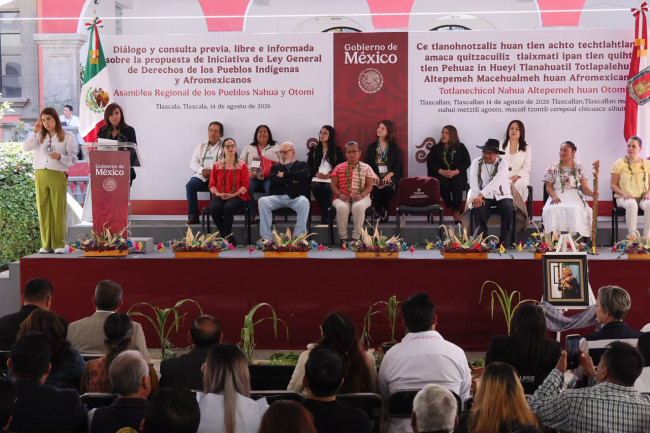

Representatives of 70 Indigenous communities in Tlaxcala, distributed across 19 municipalities, are participating in the national process to develop the new General Law on the Rights of Indigenous and Afro-Mexican Peoples, through the Prior, Free, and Informed National Consultation. The process is being led in the state by Governor Lorena Cuéllar Cisneros and the Director General of the National Institute of Indigenous Peoples (INPI), Adelfo Regino Montes.
During the assembly, attended by 69 community authorities from an equal number of Nahua and Otomi Indigenous communities in the state, the governor stated that the experiences and proposals of the communities must be reflected in the new legislation, noting that more than 27,000 people in Tlaxcala speak an Indigenous language.
“Mexico cannot be built without the voice of its Indigenous peoples,” Cuéllar Cisneros stated, calling for community authorities to be heard and for their contributions to become part of the decisions that will define the new national framework for Indigenous and Afro-Mexican rights.
The governor reported that over the past five years, her administration has allocated more than 800 million pesos to address the needs of Indigenous communities in infrastructure, education, healthcare, tourism, social welfare, sports, and economic development.
Among the initiatives she highlighted was the creation of the Intercultural University of Tlaxcala, a project she described as a fulfilled campaign commitment and an alternative for preserving the languages and knowledge of Indigenous peoples.
“Thousands of people have the opportunity to continue preserving the languages that today are a fundamental part of Tlaxcala’s history,” she stated.
She also mentioned the Indigenous Peoples’ Welfare Program, which provides seed investments of 50,000 pesos for productive projects and supports communities in developing their initiatives.
Before community authorities, women, men, young people, teachers, and researchers, Cuéllar Cisneros stated that recognizing Indigenous peoples must translate into tools that strengthen their decision-making capacity.

As part of the event, Governor Lorena Cuéllar and federal authorities held the ribbon-cutting ceremony for the INPI Coordinating Center in Tlaxcala, located at the Palace of Culture. The center will serve as a space for assistance, dialogue, and coordination with Indigenous communities.
INPI Director General Adelfo Regino Montes highlighted the Institute’s extensive territorial structure throughout the country, covering all Indigenous regions of Mexico.
He stated that the opening of this Coordinating Center responds to a request made by authorities from the Nahua and Otomi Peoples to President Claudia Sheinbaum Pardo during her visit to San Isidro de Buen Suceso, where public resources from the Contribution Fund for Social Infrastructure for Indigenous and Afro-Mexican Peoples and Communities were delivered.
“The purpose is to place our institution at your service, so that you can come here to talk, engage in dialogue, and carry out your procedures, and so that our territorial structure can be at the service of our peoples and communities,” he stated.
He explained that, following the reform of Article 2 of the Mexican Constitution, the Government of Mexico, under instructions from the President, is strengthening its relationship with Indigenous and Afro-Mexican Peoples and Communities based on respect, dialogue, and, above all, the fulfillment of their fundamental rights.

“And that is why she has instructed us to carry out this process of dialogue and consultation, so that this new General Law on the Rights of Indigenous and Afro-Mexican Peoples can be discussed and deliberated through 82 Regional Assemblies.”
In his remarks, Senator and former Governor of Tlaxcala José Antonio Álvarez Lima stated that the new legislation should go beyond legal aspects and incorporate concrete mechanisms to guarantee financial resources for communities, define their distribution, and allow each community to decide how those resources are used under systems of transparency, honesty, and community oversight.
Álvarez Lima proposed maintaining permanent dialogue with Indigenous peoples after the legislation is approved in order to monitor its implementation and ensure that public resources reach communities efficiently.
Meanwhile, federal Representative Irma Juan Carlos, a member of the 66th Legislature of Congress, stated that Tlaxcala is part of the second block of assemblies in the consultation process and highlighted the role of communities in defining policies and laws that directly affect their rights.

“Indigenous peoples are living through a new reality. They have a voice and a vote, and they have a government that works alongside them to address the historic debt owed to this sector of the population,” she stated.
The legislator said that the Chamber of Deputies will monitor the process and participate in analyzing the proposal that, according to what was stated during the meeting, President Claudia Sheinbaum will submit to Congress on October 12, with the aim of ensuring that the communities’ proposals are considered in the legislation.
Representing the communities, Antógenes Meneses Córdova, president of the La Trinidad Chimalpa community, called for participation in the consultation with freedom and respect in order to build agreements that reflect the needs of Indigenous and Afro-Mexican peoples.
He explained that the new legislation should strengthen collective rights, self-determination, autonomy, and the organizational structures of communities, while also ensuring that their proposals have a real impact on the content of the new law.
Finally, Elizabeth Hernández Moral, a state Indigenous councilor, recognized the support provided by the state administration and described Governor Lorena Cuéllar as an ally of Indigenous peoples.
“Support from the State Government has reached our homes, where there is now living hope for our Indigenous communities,” she stated.
The proposals collected in Tlaxcala will become part of the national consultation process, whose results will be incorporated into the General Law on the Rights of Indigenous and Afro-Mexican Peoples, which will be presented to Congress.

Source: gob