
Civil society organizations that are members of the Civil Observation Mission (MCO) presented this Tuesday in Mexico City the “Report on Internal Forced Displacement in Chihuahua. Results of the Civil Observation Mission,” a document that reveals a humanitarian crisis in the state’s mountainous region, characterized by the use of warfare tactics, collusion between authorities and organized crime, and an alarming level of impunity.
The MCO visited the municipalities of Parral, Delicias, and the state capital last May. There, they interviewed nearly 200 people experiencing internal forced displacement (IFD) from communities such as Atascaderos, Coloradas de la Virgen, and Sierrita in Guadalupe y Calvo, as well as from Tamazula, Durango, and San Miguel, Sinaloa.
“Territory as New Wealth” and Drone Attacks
During the press conference at the Miguel Agustín Prodh Human Rights Center, the panelists detailed the structural causes of the phenomenon.
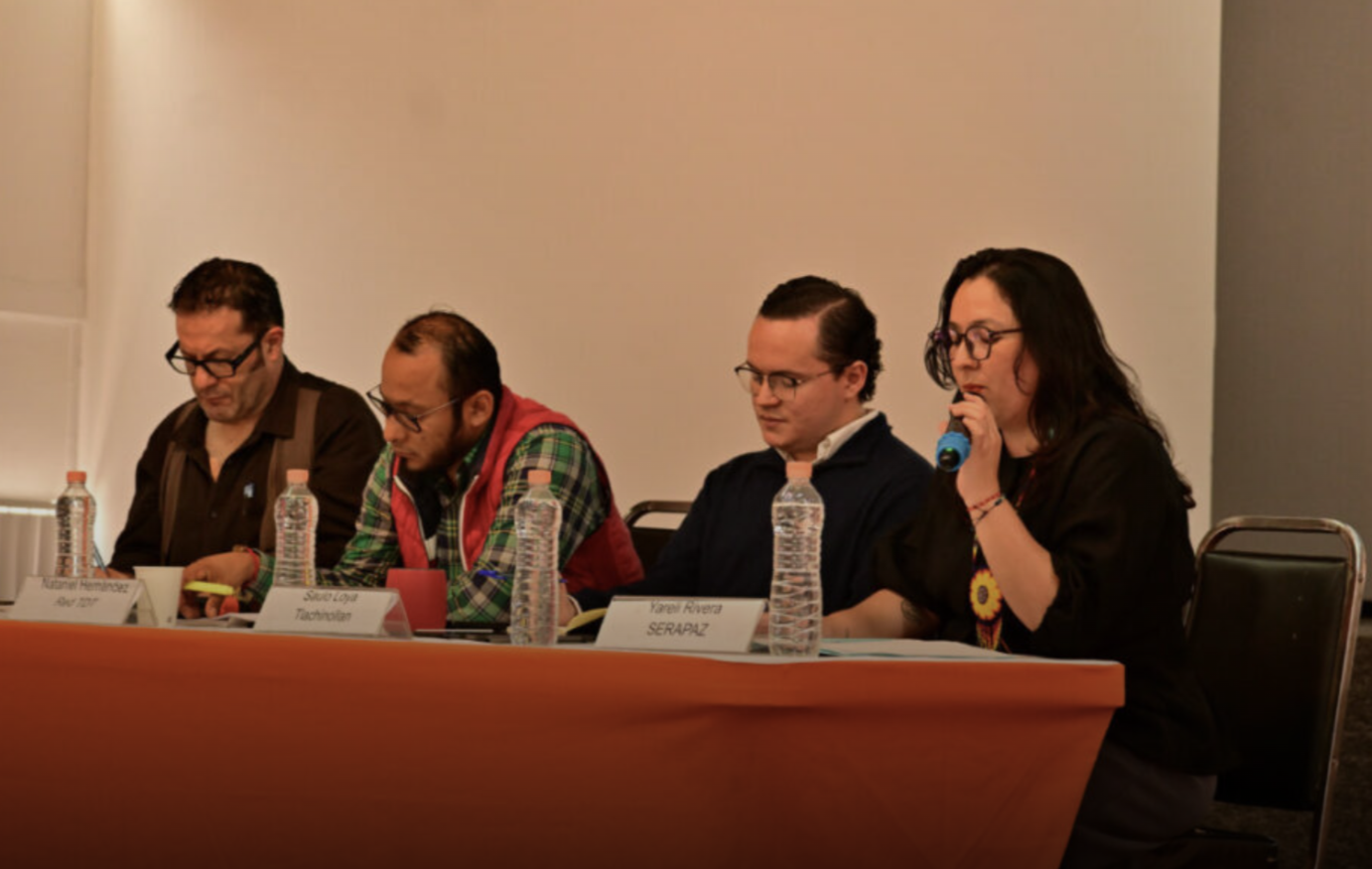
Saulo Loya, a member of Tlachinollan, a Mountain Human Rights Center based in Guerrero, explained that the displacement is the result of a dispute over territorial control in the so-called “Golden Triangle,” where organized crime seeks to take control of territories in order to operate with complete impunity, beyond controlling natural resources such as timber or water.
Saulo Loya, member of Tlachinollan. Photograph: Contec
“There is a new kind of economy and a new kind of wealth, which is the territory itself. If we take control of the territory, that gives us the possibility of doing whatever we want. Basically, if we want to travel through it, if we want to disappear, if we want to obtain supplies, whatever it may be,” Loya stated.
Many people fled due to well-founded fears of becoming victims of these attacks or because young members of their families could be forcibly recruited to participate in these criminal groups. It should be noted that there are no community self-defense groups, armed or otherwise, in this state; the people interviewed with the accompaniment of local organizations are victims of the generalized insecurity caused by organized crime: threats, murders, forced recruitment, slavery, dispossession of territories, and the co-opting of basic rights such as water, healthcare, food, protection, and the free development of their personality, among others.
The report documents a pattern of systematic violence that begins with targeted attacks against community leaders and human rights defenders—as in the cases of Isidro Baldenegro (January 15, 2017) and Julián Carrillo (October 24, 2018)—and escalates, if resistance continues, into indiscriminate attacks against the civilian population. Among the documented tactics is the use of drones carrying explosives, a technique compared with international armed conflicts.

“We Are Ignored”: Victims’ Complaint
The presentation of the report was not only a space for data, but also for the voices of those experiencing the crisis. Magdalena Gómez, a journalist with La Jornada, questioned the political polarization that obstructs attention to the issue: “It is truly dramatic what the report shows us, both the polarization that exists with the governor and the federal government… Is participation in addressing this problem being demanded, or will we have to wait until after the elections?”
Civil Observation Mission press conference
Gabino Gómez, an activist with the Center for Human Rights of Women (Cedehm), recalled the authorities’ indifference: “More than two years ago, we held a gathering of displaced families in front of the state government palace in Chihuahua for two days… We were ignored; no authority approached us. A request was made and we still have no result; we continue to be ignored.”
Bertha Ramírez, from the Nuevo Amanecer Collective in Parral, denounced the precariousness of government assistance and living conditions in shelters. “Indeed, we are ignored. If you ask the Chihuahua government, it will say that it does help us, but if you ask the family, it is different. They only give them a blanket and a food package that is not enough, and on top of that they condition it. There are families that continue sleeping on the floor; there are no conditions, not even a mattress,” she stated.
Alarming Figures and Impunity
Nataniel Hernández, from the Network All Rights for All (TDT), emphasized that children and adolescents suffer serious violations of their rights to health, education, and development. At the institutional level, the Mission documented an insufficient response from the Mexican State.
Although there have been some isolated actions by the municipality of Parral and the state government, these are not coordinated and address—on a limited basis—immediate needs. All of this is aggravated by the collusion of authorities with criminal groups and the absolute impunity experienced in the region. Despite there being 89 complaints for the crime of Internal Forced Displacement, there are only two convictions.
Nataniel Hernández, member of the TDT Network. Photograph: Contec

However, these sentences have not been fully enforced, meaning that those responsible for IFD continue operating normally without facing the consequences of their criminal actions.
Although there are various international, national, and local instruments regulating the phenomenon of IFD, the Mission found that the applicable legislation in the state of Chihuahua lacks a comprehensive approach, as it focuses on fragmented and insufficient attention to certain needs of victims of forced displacement by labeling them as a “vulnerable group.”
It was also found that there is no federal involvement in these regions. The fact that perpetrators continue to enjoy impunity is a clear indication of the lack of an effective response from the authorities responsible for law enforcement and the administration of justice.
Senator and former governor of Chihuahua Javier Corral, who was also present at the event and during whose administration forced displacement increased, also highlighted the seriousness of the impunity figures: “Despite there being 89 complaints for the crime of IFD, there are only two convictions. However, these have not been fully enforced, meaning that those responsible for Internal Forced Displacement continue operating normally without facing the consequences of their criminal actions.”
He later posted on his social media the position presented in the document, which states that a permanent interinstitutional mechanism involving the three levels of government is necessary, as well as a comprehensive long-term assistance and protection plan establishing a differentiated approach to prevention and reparation, a mechanism for closely monitoring commitments, and, of course, addressing the causes, poverty, and lack of opportunities, as well as impunity, since there are many complaints and few convictions, and even those convictions are not enforced.
“The politicization of this phenomenon, as with security issues, has no place. It is necessary for the Government of the State of Chihuahua to assume its responsibility regarding this problem, but the federal government must also turn its attention to this issue, recognize it in its full dimension, support the victims, and with determination and cooperation, both governments must coordinate and address it,” he stated on his Facebook profile.
Although there have been initiatives to classify forced displacement as a federal crime that have been stalled, the Chihuahua legislator stated that official recognition of this type of displacement cannot be postponed (…) the Legislative Branch, at the local and federal levels, also has an enormous responsibility to objectively legislate not only on the crime of forced recruitment, he said, but also on a General Law on Internal Forced Displacement and an adequate allocation of material, human, and financial resources for addressing it.
Yareli Rivera, from Serapaz, explained that the Mission identified five main causes of displacement, including territorial disputes, control of natural resources, forced recruitment of young people, direct use of violence, and collusion between authorities and criminal groups.

Recommendations and Call to the Federal Government
The organizations emphasized that none of the authorities has a plan to address the structural causes of forced displacement and create security conditions that would allow people to return to their communities and remain there safely.
This, Yareli Rivera, a member of Serapaz, said, will unfortunately become increasingly aggravated if the state continues with the logic of trying to make the phenomenon invisible and manipulate the record of IFD cases because there are no official figures. A significant increase in IFD events in Chihuahua in recent years was documented. According to estimates from civil organizations and journalistic sources, the number of displaced people would have tripled between 2021 and 2025, reflecting an increasing trend that demonstrates the insufficiency of institutional measures to prevent and address this phenomenon.
Yareli Rivera, member of Serapaz. Photograph: Contec
The state of Chihuahua, together with Michoacán and Sinaloa, is one of the three states in the country with the largest number of displaced people; in 2025, at least 4,492 displaced people were recorded.
In the absence of an official registry and a comprehensive public policy, the MCO recommended establishing a permanent interinstitutional working group, creating a public state registry of displaced people, and involving the federal government in promoting a General Law on Internal Forced Displacement. The report will be formally submitted to the Undersecretariat for Human Rights, Population, and Migration of the Secretariat of the Interior.
The MCO is made up of the following organizations: Alianza Sierra Madre (ASMAC), Center for Human Rights of Women (CEDEHM), Community Technical Consultancy (CONTEC), Commission for Solidarity and Defense of Human Rights (COSYDDHAC), Nuevo Amanecer Collective, the National Network of Civil Human Rights Organizations “All Rights for All, Everyone and All Genders” (Red TDT), Tlachinollan Mountain Human Rights Center, with the support of Peace Brigades International Mexico (PBI) and the United Nations Refugee Agency (UNHCR).

Source: laverdadjuarez