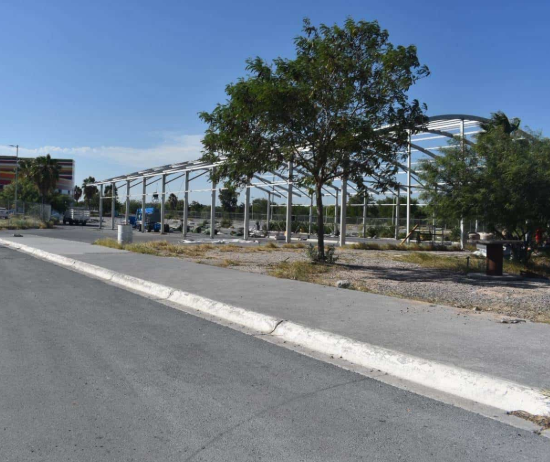

The Migrant Assistance Center was installed at the Cultural Park as part of the “Mexico Embraces You” program.
The shelter that was prepared to receive thousands of Mexicans deported by the United States in Reynosa is now being dismantled. The change in the U.S. repatriation strategy, which since April has begun sending Mexican nationals toward central and southern Mexico, has drastically reduced the flow through this border crossing and left the Assistance Center at the Cultural Park without its intended function.
How is the new repatriation strategy affecting Reynosa?
Héctor Silva, director of the Migrant House in Reynosa, explained that the new dynamic began to become apparent in April. Under this strategy, the United States has opted to transfer deported individuals to locations in central and southern Mexico, mainly Villahermosa, Tabasco, and Tapachula, Chiapas, instead of concentrating them in border cities.
“All of that did not take place, but right now the deportations being carried out by the United States are sending them toward central Mexico or to Villahermosa, Tabasco, and Tapachula,” he said.
The representative of the Migrant House considered that this strategy seeks to make it more difficult for deported people to attempt to return immediately to the United States by transferring them to areas far from the border.
Silva indicated that although the Cultural Park center no longer operates as it did previously and the structure began to be removed several weeks ago, deportations to Tamaulipas have not disappeared. Therefore, he called on the state government to remain prepared for a possible increase in the flow of repatriated people.
“We want to ask the state government to always remain attentive, in case deportations to Tamaulipas increase again,” he said.
Details on the dismantling of the shelter in Reynosa
The Migrant Assistance Center at the Cultural Park was established in January as part of the federal “Mexico Embraces You” strategy, implemented by President Claudia Sheinbaum to receive Mexicans repatriated from the United States.
Installation work began during the second half of January. The facility was designed to provide temporary accommodation, food, medical care, guidance, psychological support, and assistance with paperwork while Mexican nationals were transported to their places of origin. The complex was planned to accommodate several thousand people amid the risk of mass deportations announced by the U.S. government. Currently, due to the reduced arrival of Mexican nationals in Reynosa, the facility has ceased to serve the purpose for which it was created, and its infrastructure is being dismantled.
Impact on the Migrant House following the closure of the center
The removal of the federal center also represents a new challenge for shelters in the city. Silva reported that the Migrant House has once again begun receiving deported families. He estimated that they currently assist between 40 and 50 people per week, approximately 15 to 20 percent of whom are Mexican nationals, while the rest are people of other nationalities.
The director warned that deportations through the Tamaulipas border continue, which is why he considered it necessary to strengthen support for migrant houses and shelters that could receive families returned through this region.
Source: elmanana