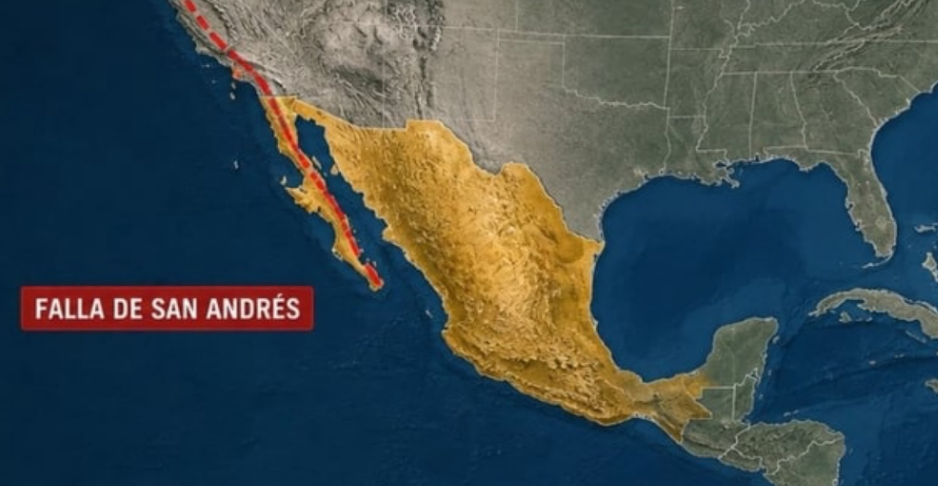

Recent earthquakes in South America have raised concerns about the San Andreas Fault and what could happen if it becomes active in the near future.
Several states in Mexico could be affected if “The Big One,” the possible megathrust earthquake in California, occurs, due to the high tension accumulated along the San Andreas Fault, which could affect areas and cities farther south of the region.
Here is everything you need to know about the San Andreas Fault, where it runs, and which location in Mexico could suffer severe damage and effects.
What is the San Andreas Fault and what happens if it becomes active?
According to the United States Geological Survey (USGS), the San Andreas Fault is a structure that marks part of the boundary between the Pacific and North American tectonic plates; it extends for approximately 1,300 kilometers through California.
Along the fault, there is primarily horizontal movement between the two plates, known as strike-slip motion.

The fault does not behave the same way along its entire length, as there are segments that remain locked and accumulate tension, while others experience slow movements that can release some of that energy without producing major earthquakes.
The term “Big One” comes from this possibility. It is used to describe a seismic event that could reach a magnitude of between 7.8 and 8 on the Richter scale, with devastating effects on cities near the fault in California, according to the BBC.
If an earthquake were to occur along the southern section of the San Andreas Fault, approximately 2,000 deaths, more than 50,000 injuries, and material damage valued at more than 200 billion dollars could be expected, according to the English outlet.

Route of the San Andreas Fault and UPDATED MAP
According to the USGS and Mexico’s National Seismological Service (SSN), the San Andreas Fault runs through California from north to south and passes near some of the state’s major cities and metropolitan areas.
- Its route begins near Shelter Cove, in Northern California. It continues through:
- San Francisco, near areas such as Daly City and Pacifica.
- The Santa Cruz Mountains.
- Hollister and Parkfield.
- The Carrizo Plain.
- Palmdale and the Mojave Desert.
- Cajon Pass.
- Palm Springs and Indio, in the Coachella Valley.
- The Salton Sea, where the main segment of the fault ends.

Where does the San Andreas Fault run in Mexico?
Although the San Andreas Fault does not continue directly into Mexico, the related tectonic system extends southward, specifically toward Baja California and the Gulf of California. In Mexican territory, the cities that could experience the most severe effects from an earthquake associated with this system include:
- Mexicali, Tijuana, and Ensenada in Baja California.
- Municipalities in Sonora such as Puerto Peñasco and San Luis Río Colorado.
- Areas of northern Sinaloa.
Cities most affected by the San Andreas Fault
If a major earthquake caused by the San Andreas Fault were to occur, these areas could experience strong effects, including one location in Mexico:
- Los Angeles and its metropolitan area
- San Bernardino
- San Francisco
- San Jose
- Mexicali and other areas of Baja California, which would receive the greatest impact in Mexico.
Source: yucatan