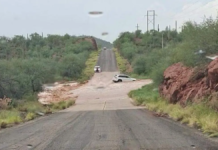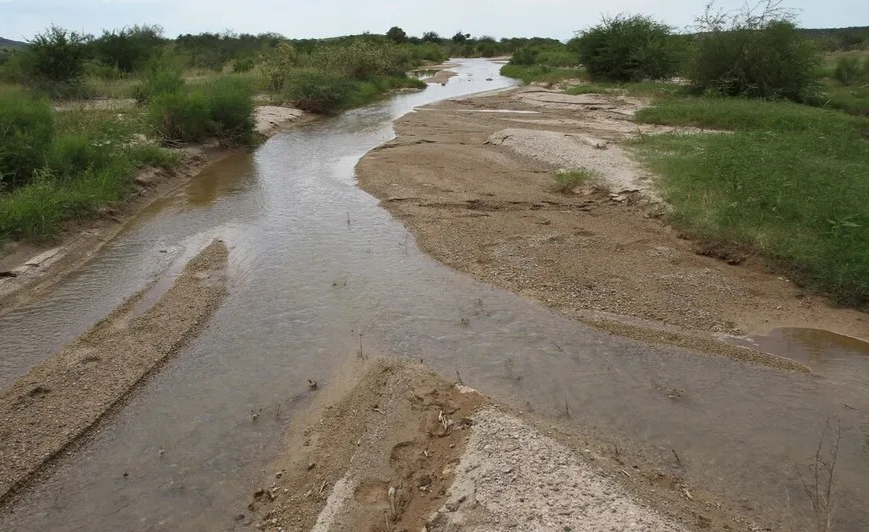

Twelve years after the spill of 40,000 cubic meters of copper sulfate from Grupo México’s Buenavista del Cobre mine, heavy metal contamination persists in the Sonora River, according to soil and water samples collected by the Secretariat of Environment and Natural Resources (Semarnat).
The samples confirmed highly toxic sites where the maximum permissible limit for arsenic is exceeded by as much as 1,172 percent, while lead exceeds the permitted level by more than 660 percent and vanadium exceeds it by as much as 104 percent.
The agency’s General Directorate for the Comprehensive Management of Materials and Risky Activities conducted the analyses during two separate visits. The first sampling took place on February 11 and 12 throughout the Sonora River basin, with the goal of identifying potentially contaminated sites containing metals and metalloids in order to establish an environmental remediation plan.
According to the results obtained by MILENIO, 30 locations were sampled during the first stage to detect arsenic (As), cadmium (Cd), lead (Pb), vanadium (V), and barium (Ba), based on the maximum permissible limits (MPL) established by Mexican Official Standard NOM-147-Semarnat/SSA1-2004.
Toxic substances were detected at all the sites. Although not every substance exceeded the standard at the same location, at least one toxic substance exceeded the maximum permissible limit by a significant amount at every site.
Contaminants Exceed Permitted Limits
For example, at the first sampling site, identified as GBW 7411, authorities found the highest concentration of lead: 3,042 milligrams per kilogram (mg/kg). This is 660 percent higher than the 400 mg/kg level considered safe under the standard.
The presence of arsenic at the same site was also among the most severe findings. Authorities detected 233 mg/kg, meaning the level exceeded the permitted limit by 959 percent. The permissible limit is 22 mg/kg.
Arsenic exceeded the maximum permitted limit by 1,172 percent in sample 22, taken in Aconchi, where 280.2 mg/kg of the toxic substance was found. Meanwhile, 220.4 mg/kg was detected in a tree root, representing 901 percent more than the level considered safe. In total, arsenic exceeded the standard at six of the 30 sampling sites.
At 28 of the 30 sampling sites, the maximum permissible limit for vanadium was exceeded. The highest level was recorded at the Rancho Janovera site, with 159.22 mg/kg, while the standard establishes a limit of 78 mg/kg.
“With these samples, we can conclude that there are concentrations above the maximum limits for*** agricultural land use****, of arsenic, cadmium, lead and vanadium. You had already told us this, but now it has been confirmed.*
“And secondly, during the second survey, levels of*** cadmium, chromium, thallium and vanadium**** were also found to be above the limits,” Alicia Bárcena, head of Semarnat, said during a working visit to Ures, Sonora, on August 12, where she announced the beginning of the Sonora River Remediation Plan.*
The second sampling was conducted on April 29 and 30 through a survey of the Sonora River basin and the El Molinito and Abelardo L. Rodríguez dams, with the purpose of conducting water and sediment sampling to analyze the presence of cadmium (Cd), selenium (Se), tantalum (Ta), vanadium (V), arsenic (As), and chromium (Cr).
A total of 36 samples were collected: at El Molinito, one water sample and two sediment samples; at the Abelardo L. Rodríguez Dam, two water samples and two sediment samples; while in the Sonora River basin, 16 sediment samples were collected at eight locations.
At nine of the 33 sites sampled, the permissible limit for cadmium was exceeded. The site identified as Mazocahui recorded the highest level, with 143 mg/kg, exceeding the MPL of 37 mg/kg by 286 percent.
Arsenic was confirmed at eight sampling sites. The highest concentration was also recorded in Mazocahui, at 72.9 mg/kg, 231 percent higher than permitted. Although chromium was detected at only three sites, its concentration was excessive. For example, 21,128 mg/kg was detected in San José de G., representing an increase of 7,444 percent above the MPL.
Regarding selenium, 14 sites exceeded the limit. In San Pedro Ures, 1,632 mg/kg was detected, 318 percent more than the level considered safe under the NOM.
The presence of tantalum was confirmed at nine locations. The highest level was again detected in Mazocahui, at 8.4 mg/kg, 61 percent above the maximum limit of 5.2 mg/kg. Vanadium was confirmed at eight sites; Mazocahui was again the most affected location, with 162 mg/kg detected, 107 percent above the MPL of 78 mg/kg.

Semarnat Will Take Action in a New Stage to Remediate Soil and Sediment
Based on these results, Semarnat announced the second stage of the Sonora River soil and sediment remediation program, which will receive 654 million pesos. During her visit to Ures, Alicia Bárcena said that restoration work in the area affected by the 2014 copper sulfate spill will begin in September and is expected to conclude in December.
“These are the metals that we need to address, these minerals, and that is why we have come to inform you*** how this remediation will be carried out starting this September****, which must last from September to December during this remediation stage.*
“By the end of December, we must already have an answer and results for you to see with your communities and, of course, in strict compliance with the applicable legislation and provisions,” she promised.
What Damage Can These Chemicals Cause?
Arsenic is a potent toxin and a confirmed carcinogen. Exposure to this contaminant can cause acute vomiting, abdominal pain, and diarrhea.
In addition, prolonged exposure damages the skin, nerves, heart, and lungs, and increases the risk of cancer.
Regarding lead, the Ministry of Health warns that there is no safe level of exposure to this toxic metal because it accumulates in the body and interferes with metabolic processes, seriously damaging the brain, nervous system, kidneys, cardiovascular system, and red blood cells. There is no safe level of exposure to this substance.
Meanwhile, vanadium is a metal that in small or experimental quantities may mimic the action of insulin and help regulate glucose, but at high doses or through industrial exposure, it can cause respiratory toxicity, irritation of the mucous membranes, stomach problems, and possible neurological damage or carcinogenic risks.

Source; milenio