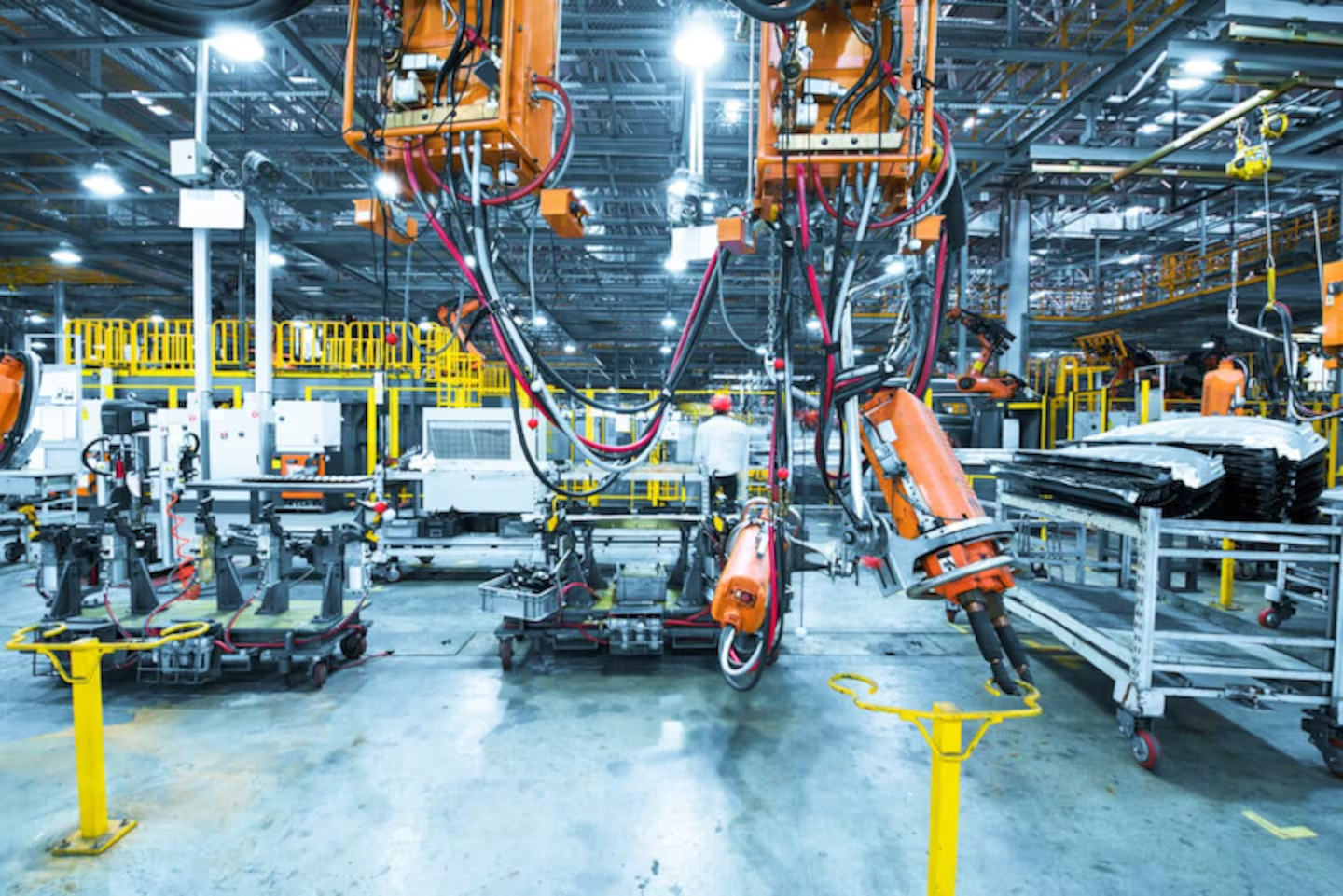

At a 450-meter-long plant in the Guadalajara metropolitan area, Mexican workers assemble the most advanced artificial intelligence servers in the world: Nvidia’s GB200s, the same servers that will power OpenAI’s Stargate project at data centers in Texas. The company that manufactures them is Foxconn, from Taiwan. The semiconductors come from TSMC, also from Taiwan. The motherboards and liquid-cooling systems arrive from Taiwan and China. Their final destination is the United States.
1,500 kilometers to the north, in Ciudad Juárez, the Taiwanese company Inventec has just laid the first stone of its $450 million expansion: 45 new production lines for servers used in artificial intelligence data centers, with supplies coming from the same Asian ecosystem. And in the municipality of García, in the Monterrey metropolitan area, Quanta Computer (another Taiwanese company) manufactures onboard computers for Tesla electric vehicles, transferring production directly from Shanghai and Taiwan.
The picture is almost perfect: Asia → Mexico → United States.
And precisely when Washington is demanding that Mexico become less dependent on Asia, the artificial intelligence and electric mobility economies are making Mexico more dependent on Asia. This is the great paradox that no one is naming clearly enough in the review of the USMCA.
The problem is not a “back door”
There is an overly simplistic way of understanding the USMCA review: the United States wants more U.S. content, Mexico wants to preserve preferential access to its main market, and both countries are trying to reach an agreement before Donald Trump’s trade policies make North American trade even more expensive. But that explanation falls short.
What is at stake is something bigger. The United States is trying to turn the USMCA into an instrument for reducing its dependence on China. Washington has placed automobiles, steel and aluminum, rules of origin, and so-called “economic security” on the table. The relevant question is not whether those objectives are legitimate—they are—but whether they can be achieved without destroying the supply chains that make North America competitive.
Washington has reasons to be concerned. The 2025 figures show that China accounted for around 20.1% of Mexico’s imports, approximately $133.271 billion, while it absorbed only 1.5% of Mexico’s exports. In the first half of 2026, the bilateral deficit was $58.167 billion.
But there is a fundamental difference between saying that China is deeply integrated into the Mexican economy and claiming that Mexico is simply a “back door” for Chinese goods.
A recent study by economists at the Federal Reserve allows us to make that distinction precisely. By analyzing what happened after the U.S. tariffs on China in 2018 and 2019, they found that direct transshipment—Chinese products that simply change labels on Mexican soil—accounted for less than 1% of the growth in Mexican exports to the United States. What they did find was that Chinese-origin production or processing in Mexico accounted for approximately 14% of that growth.
In other words, the problem is not the smuggling of labels. It is that part of Asian production is being structurally incorporated into Mexico’s manufacturing platform. And as Foxconn, Inventec, and Quanta’s operations in Jalisco, Chihuahua, and Nuevo León demonstrate, this is neither a marginal nor an illegal phenomenon: it is the business model of technological nearshoring.
The distinction is not semantic. It is fundamental to designing an intelligent trade policy.
A signal of investment that should be read carefully
Before discussing what Mexico should negotiate, it is worth examining what is happening with foreign direct investment, because the official interpretation can be misleading. Mexico received $23.591 billion in FDI during the first quarter of 2026, a historic record that the government celebrated, rightly so. But there is a fine print.
The problem lies in the composition: $22.222 billion corresponded to reinvested profits from companies already established in Mexico, while new investments amounted to only $1.705 billion—less than 8% of the total. Companies already operating in Mexico continue to bet on the country. But the new wave of factories that nearshoring promised has not appeared on the scale that had been anticipated, precisely because bottlenecks in energy, water, and infrastructure are slowing the installation of new production capacity.
This matters because Mexico cannot afford to lose the investment it already has while waiting for the investment that has yet to arrive. A policy that makes imported inputs too expensive, without a competitive North American supply capable of replacing them, could produce exactly the opposite of what it intends: less new investment and more uncertainty for existing investment.
The automobile industry demonstrates the cost
The automotive industry confirms that this is not a theoretical risk. This week, the three major Detroit automakers warned that the new requirements being discussed for the USMCA could increase their costs by more than $2 billion annually per manufacturer. General Motors estimates that its tariff costs will reach between $2.5 billion and $3.5 billion this year; Ford estimates around $1 billion. The U.S. International Trade Commission itself calculated that sourcing changes required to comply with the rules of origin in effect between 2020 and 2024 had already increased the variable cost of the identified components by an average of $199.63 per vehicle.
Rules of origin work: they can shift purchases toward North American suppliers. But they are not free. Industrial policy has a price, and someone ultimately pays it: the manufacturer, the consumer, or both. And Detroit knows this, which is why Mexico and Detroit currently have more interests in common than Washington would publicly like to acknowledge.
The right question
The United States is fundamentally right about one thing: it cannot claim to reduce its dependence on China while allowing an increasing share of Chinese production to move to third countries. The Federal Reserve found that approximately 53% of the growth in Mexican exports to the United States was related to trade diversion caused by tariffs on China. But only 14 percentage points of the total growth were associated with Chinese production or processing in Mexico; the remainder resulted from other forms of trade diversion.
That is why it is important not to fall into oversimplification. Mexico is not China. Nor is it its back door. It is a manufacturing economy that has become competitive because it combines domestic production, foreign capital, Asian technology, global inputs, and privileged access to the U.S. market. That is exactly what is at risk.
The USMCA discussion should not be about whether Mexico has to choose between the United States and China. It should be about how Mexico can become a more integrated North American platform without destroying the global supply chains that explain much of its competitiveness.
That requires concrete negotiation, not declarations of principle.
One example illustrates the difference. Foxconn’s plants in Guadalajara and Inventec’s in Juárez export servers to the United States using Taiwanese processors and Korean memory chips. Washington wants less Asia in that supply chain. But there is currently no North American supply capable of replacing those components in terms of volume and price.
The intelligent response is neither to resist the change nor to capitulate to it: it is to negotiate a gradual substitution schedule tied to real and verifiable investment. If TSMC or Intel builds capacity in Arizona or Nuevo León, that substitution becomes possible and desirable. If they do not build it, requiring it on paper only makes production more expensive without generating new capacity.
Mexico should propose regional-content commitments linked to verifiable North American investment, rather than arbitrary deadlines that generate costs without generating capacity. It can commit to combating transshipment, improving traceability, and strengthening rules of origin where there is evidence of circumvention. But it must negotiate realistic timelines, justified exceptions, and, above all, a transition that allows North American production to gradually replace external suppliers without making manufacturing so expensive that North America loses competitiveness against the very China it claims to want to contain.
Because there is an uncomfortable truth for both governments: Washington wants a North America less dependent on China. Mexico needs a more integrated and competitive North America. Those two things can coincide, but only if industrial policy first creates the productive capacity it intends to demand later.
What Foxconn is assembling in Guadalajara with Taiwanese chips for data centers in Texas is not the problem. Paradoxically, it is part of the solution, provided Mexico understands that its role is not to be Trump’s commercial border against China, but the platform the United States needs to compete with it.
Analysis by specialists from Universidad Iberoamericana is presented to our readers every 15 days in a space coordinated by the Department of Economics of Universidad Iberoamericana, Mexico City.
Source: cronica