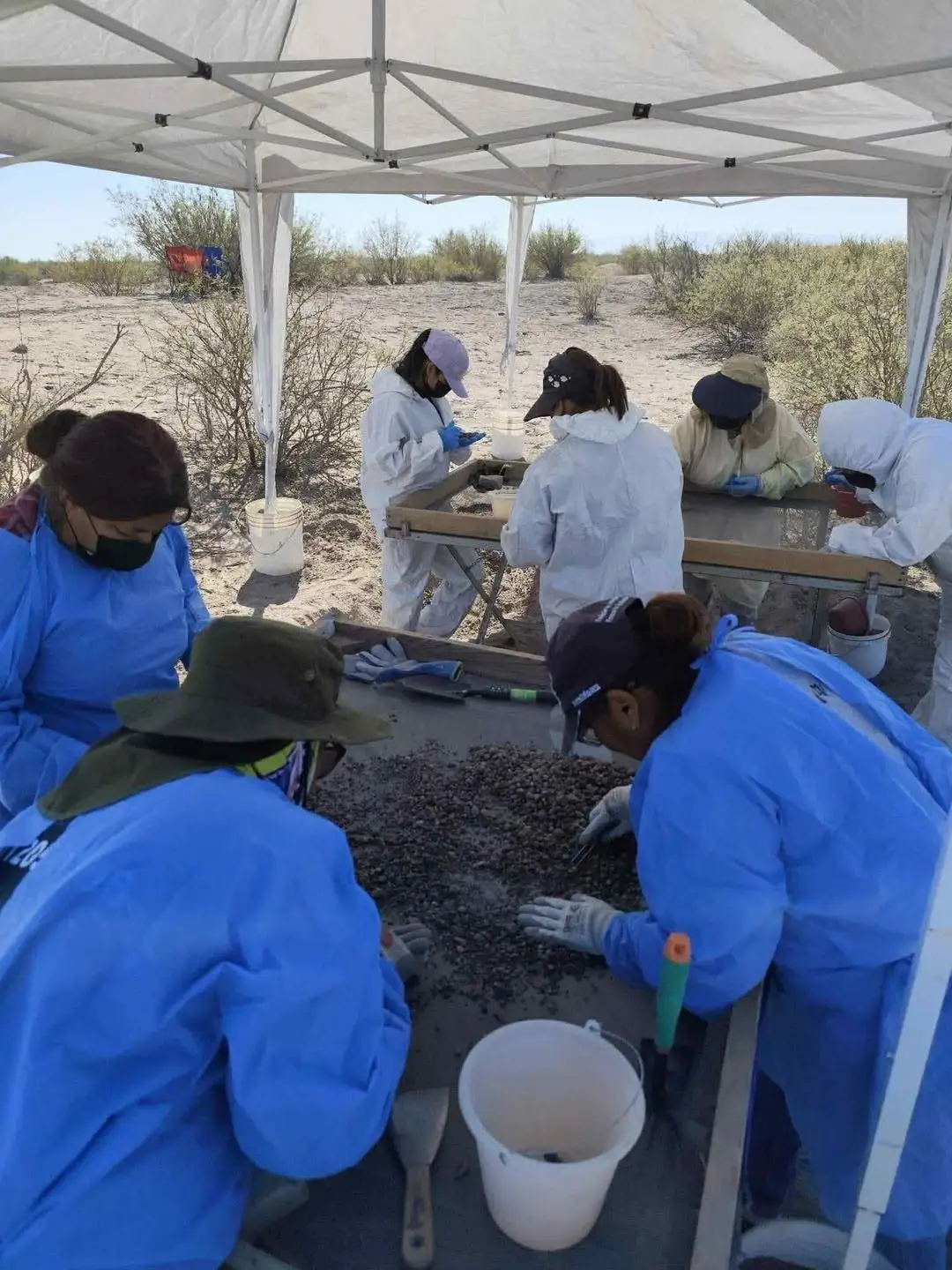

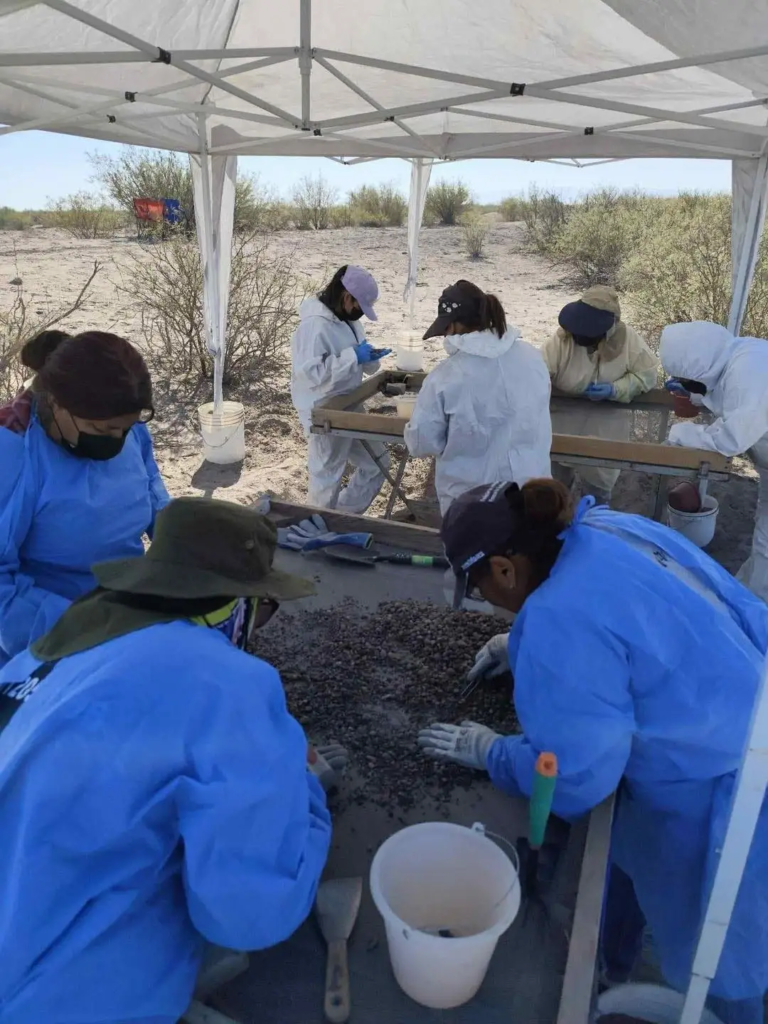
Over the last three six-year presidential terms, prosecutors’ offices across Mexico have located more than 5,000 clandestine graves, with 64% of the discoveries occurring during the administration of Andrés Manuel López Obrador, according to a report by the Human Rights Program of Universidad Iberoamericana.
The document, titled “Tracing Absence, Walking Hope: Analysis of Clandestine Grave Discoveries in Mexico (2006–2024)”, presented Thursday, is based on freedom-of-information requests submitted to Mexico’s 32 state prosecutors’ offices and the Attorney General’s Office (FGR), as well as a review of reports published by local, national, and international media.
The report was presented by researchers Andrea Horcasitas and Mariana Marchand. Also participating were relatives of missing people and searchers, Olimpia Montoya from Guanajuato and Eduardo Ramírez from Mexico City, as well as Denise González, representing the Mexico office of the United Nations Office of the High Commissioner for Human Rights (OHCHR).
Researchers from the Human Rights Program at Universidad Iberoamericana highlighted differences between official and media records. While prosecutors’ offices reported 5,152 graves containing 5,718 bodies, media outlets reported the discovery of 3,516 clandestine graves and 8,341 people during the three presidential terms.
Highlighting a considerable discrepancy of at least 1,600 bodies between prosecutors’ and media reports, Andrea Horcasitas noted that, “although it must be said that when discoveries are made in the field, it is difficult to later determine how many people there are or how many people the human remains correspond to, it is striking that there is a 46% discrepancy in the reports.”
After comparing the sources of information, the document found that “all states have reported discoveries of clandestine graves in recent years,” with the states reporting the most graves being Guerrero, Veracruz, Sonora, Guanajuato, and Jalisco.
During the administration of Felipe Calderón Hinojosa (2006–2012), 524 clandestine graves were documented, particularly in northern states such as Coahuila, with 56 graves; Chihuahua, with 55; Nuevo León, with 49; and Tamaulipas, with 43.
It should be recalled that Calderón declared the “war on drugs” and deployed the Armed Forces to combat organized crime. This security policy continued under Enrique Peña Nieto and was intensified under Andrés Manuel López Obrador, who dissolved the Federal Police and replaced it with the National Guard, a militarized institution attached to the Secretariat of National Defense (Sedena).
The report detailed that during the administration of Peña Nieto (2012–2018), 1,336 graves were documented. The states with the highest numbers were Veracruz, with 210 graves; Guerrero, with 205; and Jalisco, with 69.
It added that under López Obrador (2018–2024), the discovery of clandestine graves increased significantly, reaching 3,292 graves during that period. The states with the highest number of clandestine burial sites were Sonora, with 361 graves; Guanajuato, with 283; and Colima, with 217.
The research highlighted that the municipalities with the highest number of clandestine graves over the past 18 years were Acapulco, Guerrero (189); Tecomán, Colima (184); Hermosillo, Sonora (110); Veracruz, Veracruz (101); and Ciudad Juárez, Chihuahua (96). Together, these municipalities account for 19% of clandestine graves nationwide.
During the press conference, Andrea Horcasitas clarified that the graves do not necessarily correspond to the presidential term in which they were discovered. However, she warned of an increase in clandestine graves located on privately owned properties, not necessarily in remote areas or places hidden from cities, as well as in community spaces.
“We do not have an answer as to why there has been an increase, but what we could consider is that impunity is one of the reasons why things are increasing, especially cases involving private individuals.”
“What message does more than 5,000 clandestine graves and more than 135,000 missing people leave for citizens, while the official number of investigation files reported by the Executive Branch is 4,000? From there, we can see that impunity sends the message that you can bury a person and nothing will happen,” said the researcher from the Human Rights Program at Universidad Iberoamericana.
Mariana Marchand pointed out that “the discovery of graves at these sites does not appear to be the result of isolated incidents, but rather of broader practices, whether systematic negligence or deliberate omission by authorities.”
Denise González of the OHCHR recalled that since 2015, the Human Rights Program at Universidad Iberoamericana has reviewed discoveries of clandestine graves as part of a project that “sought to bring academic efforts together with civil society to build a picture of the phenomenon of clandestine burial of people and its relationship with disappearance.”
For the OHCHR representative, the report reflects “an academic community that does not limit itself to observing reality, but seeks to actively engage with it and put knowledge and science at the service of truth and justice (…) It does not merely record the discovery of clandestine graves, but allows us to observe the evolution of the phenomenon and its diversification.”
She added that the document highlights “the diversity of spaces in which clandestine burial takes place, not only trails and remote areas, as we usually imagine, but also, as we now know, private properties, roads, ravines, ranches, estates, water wells, and other locations,” as well as the possibility of “linking different perpetrators to the places where victims are clandestinely buried, considering their logistical capabilities and the objectives they seek to achieve.”
Olimpia Montoya and Eduardo Ramírez shared some of their experiences searching for their brothers, Marco Antonio and Ángel Gerardo, respectively.
Marco Antonio disappeared in Guanajuato in 2017, while Ángel Gerardo disappeared in 2019 while he was accompanied by Jesús Armando Reyes Escobar and Leonel Báez Martínez.
Ramírez, a member of the Hasta Encontrarles collective, said that while searching for his brother, he encountered the families of his friends. They now join together in searching for the young men, particularly in the Sierra de Guadalupe, where they believe they may be located. They share the belief that “if we find one, we will find all three. Unfortunately, we are now like a searching family that cannot stop, and what hurts me the most is that feeling of helplessness, when I have a bad day and we cannot find someone who can tell us where they are.”
Olimpia Montoya, who has turned to the Federal Judiciary to demand that the Attorney General’s Office (FGR) establish the National Forensic Data Bank and the National Grave Bank, reflected on the “hope” of searching families.
“Walking hope is everything that we families do, supporting one another through faith and through our fellow searchers, through the organizations that also become like brothers and sisters, and even without being in our shoes, they feel part of the pain that affects all of us who are searching,” Montoya concluded.
Source: proceso