
Mexico and China are holding talks to bring major Chinese archaeological exhibitions to Mexican territory, as part of a cultural heritage exchange that has so far taken Mexican artifacts to three exhibitions in Chinese cities, reported this Friday the director general of the National Institute of Anthropology and History (INAH), Joel Omar Vázquez Herrera, during the morning press conference at the National Palace.
Vázquez Herrera explained that the three Mexican archaeological exhibitions held in China since 2024 have attracted a combined total of nearly 2.9 million visitors.
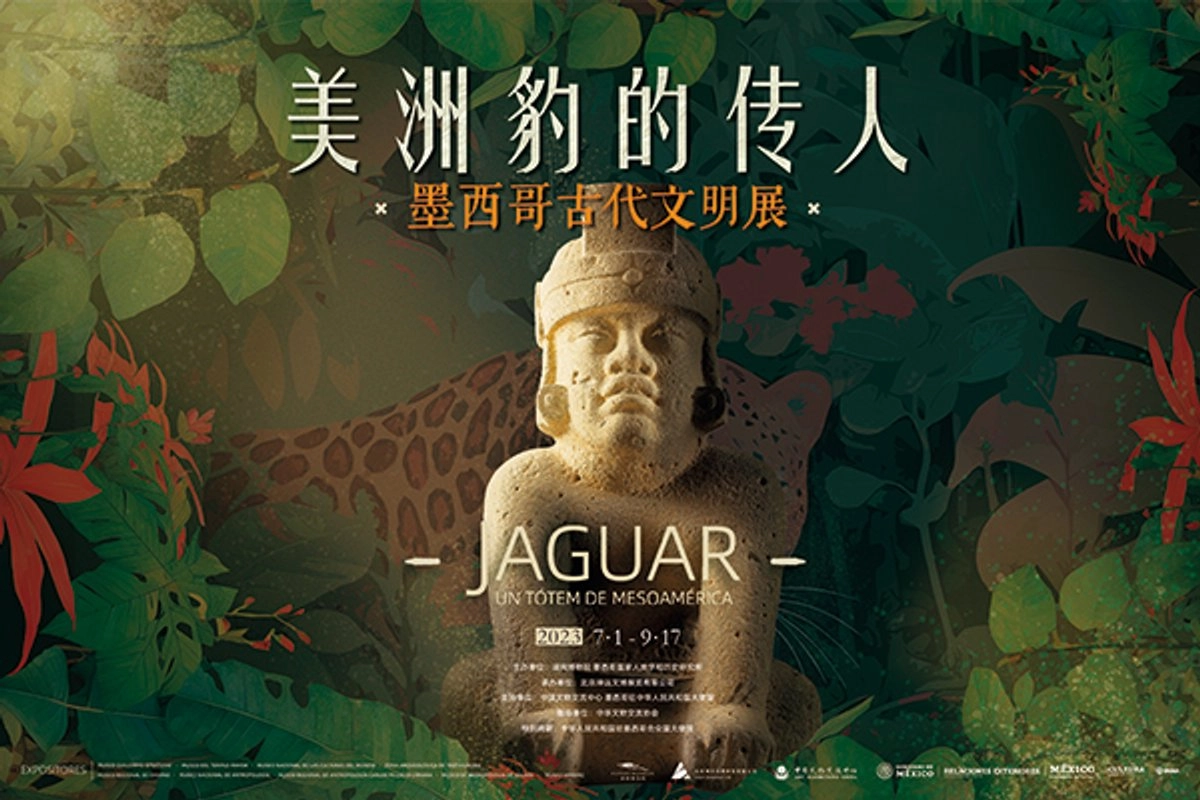
The first, titled Ancient Mesoamerica, Nature and Art, was presented in Beijing in 2026 and attracted 200,000 visitors, the official explained. The second, titled Ceiba and Cosmos, dedicated to the Maya people, was displayed in three Chinese cities between 2025 and 2026, attracting 1.5 million visitors, the highest attendance among the three exhibitions. The third, The Jaguar, Totem of Mesoamerica, also held in those three Chinese cities, took place in 2024 and attracted 1.2 million visitors.
The director of INAH added that the exhibition Sacred Spaces is currently on display at the Shanghai Museum. It opened on July 8 and has received 300,000 visitors so far in August 2026. It will remain open until November 2027. The exhibition brings together 804 pieces from the Olmec, Teotihuacan, Maya, and Mexica cultures: 745 come from INAH collections, 46 from the Archaeological Museum of Xalapa in Veracruz, and 13 from the Amparo Museum in Puebla.
Among the pieces sent to Shanghai, Vázquez Herrera highlighted the Mexica sculpture of Mictlantecutli, discovered in 1994 at the House of the Eagles of the Templo Mayor and made of clay with the deity’s skeletal face; the Lord of the Limas, an Olmec greenstone carving discovered in the 1960s in the municipality of Jesús Carranza, Veracruz; the funerary regalia of Pakal the Great, discovered in 1952 at the Temple of the Inscriptions in Palenque, Chiapas, made of jade and consisting of a funerary mask, ceremonial belt, necklace, and chest ornament; and a Teotihuacan sculpture of a founding ancestor, made of greenstone and estimated to date from between 200 and 250 A.D., discovered in 2014 in the tunnel beneath the Temple of the Feathered Serpent at Teotihuacan.
The official described the exchange with China as “a diplomatic and cultural relations strategy that allows us, especially in this case with another ancient culture such as China, to engage in heritage exchanges that will allow us, above all, to showcase Mexico’s great wealth abroad, in this case in China.” He specified that, in parallel, “we are in talks for major exhibitions from China to come to Mexican territory.”
Vázquez Herrera stated that, when the three exhibitions in China are added to two others already concluded in Spain and France, as well as the current exhibition in Shanghai, the total attendance at Mexican archaeological exhibitions abroad reaches 3.8 million visitors.
Source: jornada