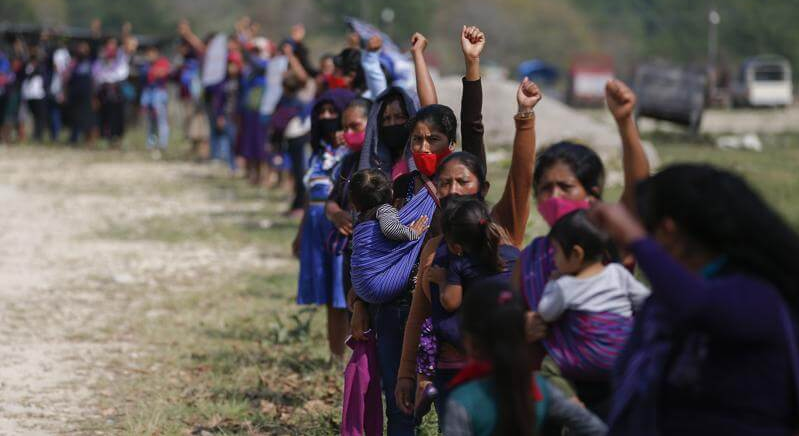

The Indigenous and Afro-Mexican Rights Law Initiative “was not created for Indigenous peoples, but to facilitate access by large capital interests to our territories,” stated the National Indigenous Congress (CNI) in a position statement rejecting the federal government’s proposal, which it says “continues the neoliberal project of dispossessing and privatizing the lands and territories of the country’s Indigenous peoples.”
In the statement, the CNI rejected “the mockery” that the initiative represents for Indigenous peoples because it is an instrument to “plunder, destroy, and commodify” the common, natural, and cultural resources of communities, “attacking and repressing peoples resisting the capitalist, patriarchal, extractivist, and colonial assault.”
It explained that the proposed law conditions access to rights on registration in a catalog evaluated by the National Institute of Indigenous Peoples (INPI), under a series of articles that, “although they vaguely recognize the right to self-identification, their wording opens the door for the INPI to obstruct or reject the registration of an Indigenous people or community, based on its own assessment that the requirements for registration have not been met.”
Among the points it criticized, the CNI highlighted that the proposed law establishes a series of “strategic omissions regarding the right of peoples to self-determination over their territory,” while confirming the continuation of Mexico’s neoliberal legal framework by stating that strategic areas for the exploitation of water, oil, fracking, lithium, minerals, and other resources will be administered directly by the State.
“In these cases, self-determination does not exist, since we will only be able to express our opinions about these destructive and highly polluting projects, but not decide whether they are developed in our territories; the government of the Fourth Transformation is not interested in our lives or in the future of our daughters and sons,” it stated.
The CNI also rejected the Indigenous consultation process for the initiative and accused authorities of conducting a “simulation” that does not follow “even the requirements established in its own proposed law,” since there has been no stage for prior agreements or sufficient information, deliberation, consultation, and follow-up on agreements.
“The process is flawed from its origin; this simulated consultation is only intended to administratively justify the proposed Indigenous and Afro-Mexican Rights Law, just as has been done with the false consultations for the approval of State megaprojects such as the so-called Maya Train, the Interoceanic Corridor, the Morelos Integral Project, the Dos Bocas Refinery, and all those that have destroyed and contaminated our territories,” the CNI criticized.
POSITION OF THE CONGRESS
As the NATIONAL INDIGENOUS CONGRESS, walking the path of dignity left to us by our earliest grandfathers and grandmothers, which was born 30 years ago through the call of our Zapatista sisters and brothers to bring together all the Indigenous peoples of the country to discuss which Indigenous rights should be recognized by the Mexican State, giving rise to the San Andrés Accords, the historic March of the Color of the Earth by the Zapatista Army of National Liberation, and later the betrayal by the bad government through the reduced rights incorporated into Article 2 of the Constitution.
Today we reject the mockery represented by the Indigenous consultation process and the Proposed Initiative for an Indigenous and Afro-Mexican Rights Law promoted by President Claudia Sheinbaum Pardo and implemented by the National Institute of Indigenous Peoples (INPI), whose head, Adelfo Regino Montes, has betrayed Indigenous peoples and communities, Mother Nature, and historical memory.
This proposal contains 453 articles addressing different issues related to our peoples, including autonomy, self-determination, jurisdiction, consultation, territory, Indigenous legal protection, heritage, health, culture, and recognition as subjects of public law, among other issues that are causing more confusion than clarity.
We reject this law because it continues the neoliberal project of dispossessing and privatizing the lands and territories of the country’s Indigenous peoples. Since the reform of Article 27 of the Constitution in 1992, Mexican law has done nothing but open the way for the dispossession of our territories and attempt to destroy the legacy left to us by our General Emiliano Zapata and the Mexican Revolution. This law was drafted by a group close to the President of the Republic; it was not created for Indigenous peoples, but to facilitate access by large capital interests to our territories; to plunder, destroy, and commodify our common, natural, and cultural resources, attacking and repressing peoples resisting the capitalist, patriarchal, extractivist, and colonial assault that we endure.
The proposed law gives a colonial, degrading, and racist treatment to the Indigenous peoples and communities of the country by conditioning access to our rights on registration in a catalog of peoples evaluated by the INPI, under a series of articles that, although they vaguely recognize the right to self-identification, open the door for the INPI to obstruct or reject the registration of an Indigenous people or community because, according to its own assessment, it does not meet the requirements for registration.
The proposed law states that if we do not register, we do not lose our status as subjects of rights, but legally we cannot exercise them. This legal and deceptive aberration profoundly restricts the exercise of Indigenous peoples’ autonomy, interferes in the internal life of communities, and destroys the principle of self-identification. This law exists so that transnational corporations can have what they call “legal certainty” to invest in their megaprojects, treating us as commodities or products for sale that must be registered so companies can meet the requirements allowing them to plunder our peoples.
The content of this law is DECEPTIVE, because some of its articles propose recognizing legal pluralism within the Mexican State, granting equal value to the State’s legal system and the Indigenous peoples’ normative systems, giving preference within Indigenous territories to normative systems based on customs and traditions, but entangling them in a process of jurisdictional conflicts with every authority that may assert a claim. In practice, it is the State, through the INPI and the Ministry of the Interior, that decides what is consulted and what is not, what affects Indigenous peoples and communities and what does not. Now it turns out that the doctor is the only one who can say what is wrong with the patient.
The proposed law establishes a series of strategic omissions regarding the right of peoples to self-determination over their territory. Instead, it confirms the continuation of Mexico’s neoliberal legal framework by stating that strategic areas for the exploitation of water, oil, fracking, lithium, minerals, and others will be administered directly by the State. In these cases, self-determination does not exist, since we will only be able to express our opinions about these destructive and highly polluting projects, but not decide whether they are developed in our territories; the government of the Fourth Transformation is not interested in our lives or the future of our daughters and sons.
In the betrayals that have occurred in the struggle for recognition of the rights of Indigenous peoples and communities, Article 2 of the Constitution states that we have no right to decide over resources considered strategic for the nation. Yet their strategic nature does not prevent them from being granted in concessions for the endless profit of foreign companies, including water, a vital element for survival. Thus, this represents a racist and criminal treatment of the natural resources of our country: they are taken away from Indigenous peoples, leaving their territories destroyed by plunder, and handed over to transnational corporations for commercialization, without the right to self-determination.
Self-determination means that we can decide over the lives and destiny of our peoples, territories, and the normative systems we have. We can decide whether a project is developed or not and under what conditions, without distinction; whether a measure should be subject to consultation or not; and whether we should consult ourselves. No one has the right to come into our territories to organize how we dialogue and consult with one another according to our customs, traditions, and own normative systems. As peoples, we are the only ones who can say and decide what affects us and what does not, not a study conducted from behind a desk by the INPI and the Ministry of the Interior.
It is false that the proposal is a mixture of contradictory provisions, as some analysts have claimed. In our view, it is a coherent proposal in its objectives that expresses all its perversity by establishing the “formal constitution” of ancient peoples and the bureaucratic validation of the self-identification of communities. From this point and from the approach taken toward territories, this neoliberal law becomes understandable and coherent.
We denounce the simulated consultation of this proposed law, which is being carried out throughout the country during August and September, where rejection of the process is becoming increasingly large and evident. Will a law containing 453 articles really be able to be explained, understood, analyzed, and discussed during a regional meeting lasting three to five hours? In two months, will all Indigenous peoples in the country be consulted, with translations into each language? Once the forums have ended, will 15 days be enough to systematize the information and make the necessary changes so that the President can present it to Congress on October 12? Is the law not already prepared? Once it reaches Congress, what guarantees that the law supposedly consulted with “all” Indigenous peoples and communities in the country will not have the articles benefiting Indigenous peoples removed or be modified, as happened with the San Andrés Accords in 2001?
This consultation does not even follow the requirements established in the law being proposed for consultation. There is no stage for prior agreements, sufficient information, deliberation, consultation, or follow-up on agreements. The process is flawed from its origin; this simulated consultation is only intended to administratively justify the proposed Indigenous and Afro-Mexican Rights Law, just as has been done with the false consultations for the approval of State megaprojects such as the so-called Maya Train, the Interoceanic Corridor, the Morelos Integral Project, the Dos Bocas Refinery, and all those that have destroyed and contaminated our territories.
As peoples and communities organized in resistance and guided by the dignified words and memory of our earliest grandfathers and grandmothers, WE EXPRESS OUR REJECTION OF THE PROPOSED INITIATIVE FOR AN INDIGENOUS AND AFRO-MEXICAN RIGHTS LAW AND ITS SIMULATED CONSULTATION, AND WE DEMAND THAT THE HARASSMENT, REPRESSION, AND WAR THROUGH ORGANIZED CRIME AGAINST THE INDIGENOUS PEOPLES OF THE COUNTRY WHO RESIST AND EXERCISE THEIR RIGHT TO AUTONOMY AND SELF-DETERMINATION CEASE IMMEDIATELY. WE DEMAND THE IMMEDIATE RELEASE OF OUR BROTHER JESÚS PLÁCIDO GALINDO. AN INDIGENOUS CONSULTATION WITH INDIGENOUS POLITICAL PRISONERS IS NOT FREE OR CONDUCTED IN GOOD FAITH.
FOR THE INTEGRAL RECONSTITUTION OF OUR PEOPLES.
NEVER AGAIN A MEXICO WITHOUT US.
NATIONAL INDIGENOUS CONGRESS
Source: resumenlatinoamericano