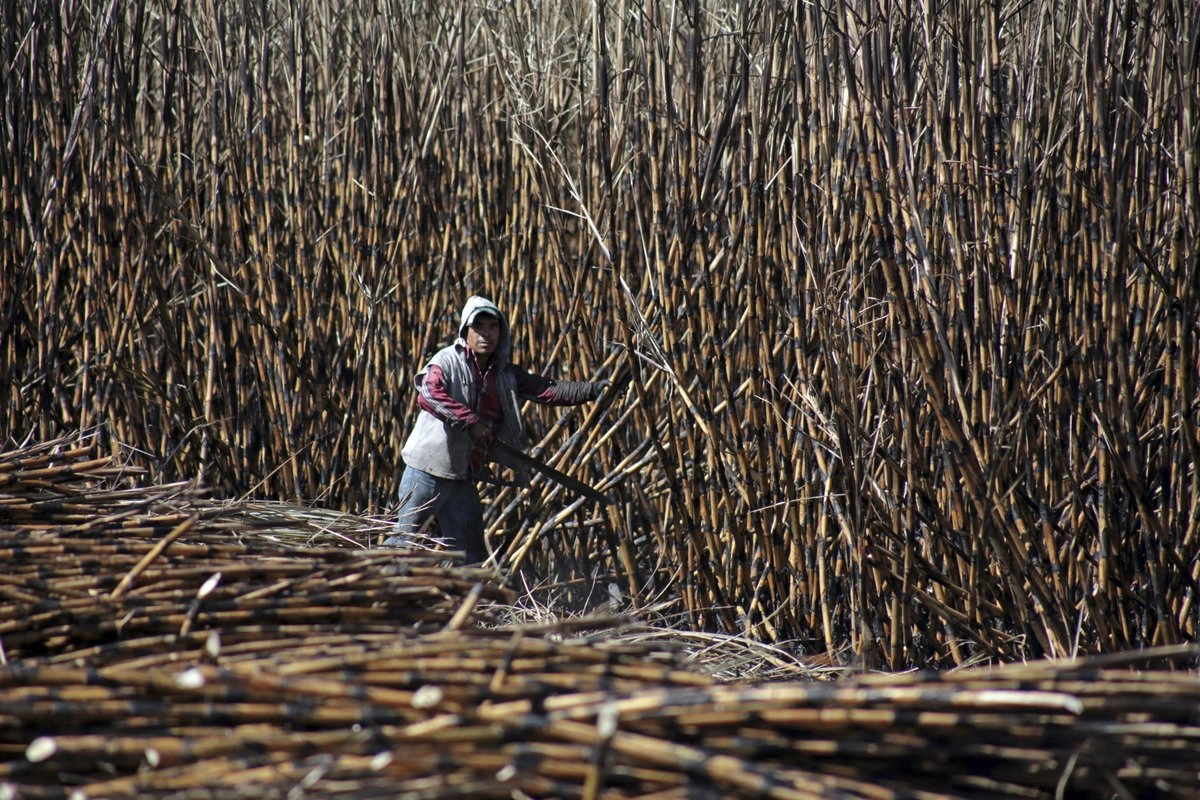

Mexico closed the 2025-26 sugarcane harvest with production of 5.325 million tons of sugar, an increase of 11.6 percent compared with the previous cycle, according to official data. The growth is explained by the processing of 49.6 million tons of sugarcane, 8.4 percent more than in the previous cycle, across an industrialized area of 735,000 hectares.
According to data from the National Committee for the Sustainable Development of Sugarcane, Mexico ranks as the eighth-largest sugar producer in the world and holds the same position among exporters. Veracruz is the country’s largest-producing state, with 1.96 million tons, equivalent to 36.8 percent of national production.
However, specialists point out that the problem is that, although there is more cane sugar available, Mexico cannot sell or consume all of the surplus at the same pace at which it is produced. This has caused inventories to grow and the prices paid for sugarcane to fall, directly affecting farmers’ income.
The National Confederation of Rural Property Owners (CNPR) says the sector faces a difficult outlook because a larger volume of sugar will have to be sent to the global market, where prices are lower than those offered by the preferential U.S. market, hurting farmers’ economic expectations.
According to calculations by the Agricultural Markets Consulting Group (GCMA), during the 2025-26 cycle, Mexico consumed approximately 3.8 million tons of sugar. Because production exceeded that demand, and there were also imports of 42,000 tons, it was necessary to export 1.33 million tons to prevent the surplus from accumulating even further. Nevertheless, an inventory of 1.35 million tons remained unsold.
The exported surplus was distributed mainly among three destinations: 188,000 tons went to the United States, 350,000 tons were exported under the IMMEX program, which allows exports without paying taxes when the ingredient is used to manufacture other products that are subsequently exported, and 800,000 tons were sold to other destinations.
In the domestic market, the price paid per ton of sugar at the end of the 2024-25 cycle was 16,100 pesos, 25 percent less than a year earlier. For the 2025-26 cycle, an initial price of 14,000 pesos per ton was agreed upon, confirming that the downward trend is continuing, this time by at least 15 percent.
The United States represents an opportunity for Mexico because its own production is insufficient to meet domestic consumption. For the 2026-27 cycle, the country is expected to produce 8.12 million tons of sugar, while demand is projected at 11.40 million tons, meaning it will have to import approximately 3.25 million tons.
Mexico has already secured part of those sales. For the 2026-27 cycle, it has an initial authorization to export 576,000 tons to the United States, of which an initial 346,000 tons have already been released.
Selling to the U.S. importer is also more profitable than selling on the international market. In August, the average U.S. price was $805 per ton, while the international market price was $355 per ton—less than half the U.S. price.
For the next cycle, GCMA expects Mexican production to rise to 5.3 million tons and exports to reach 1.5 million tons, of which up to 900,000 tons would go to the United States. Even with this increase in foreign sales, the unsold inventory would remain high, at approximately 1.37 million tons.
Source: jornada