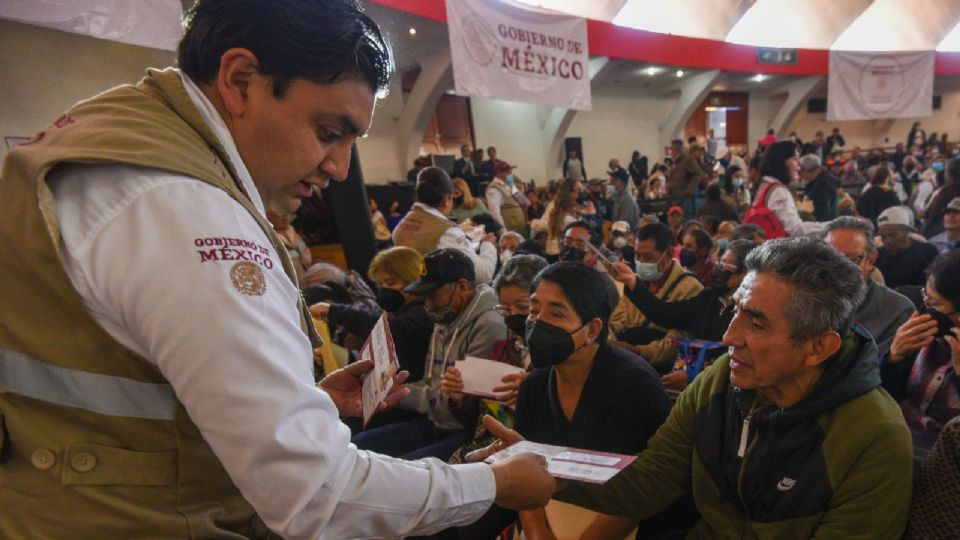

Government spending on pensions reached a record 1.13 trillion pesos during the first half of 2026, representing a 1.2% real increase compared with the same period the previous year. This marks the seventh consecutive year in which spending has remained above one trillion pesos and is equivalent to 33.8% of programmable spending, according to figures from the Ministry of Finance and Public Credit (SHCP).
The total pension expenditure of 1.13 trillion pesos has two components. The first consists of contributory pensions, which totaled 831.735 billion pesos, while non-contributory pensions amounted to 298.788 billion pesos. The former stand out as one of the government’s most significant liabilities, recording a real annual increase of 2.7%, while non-contributory pensions recorded a real annual decline of 2.8%.
Contributory pensions are obligations linked to workers in the formal sector of the economy who made contributions throughout their working lives. They represent 74% of total pension spending and, from 2017 to 2026, recorded a 56% real increase. Non-contributory pensions refer to those provided universally by the State, such as the Universal Pension for Older Adults, or to a specific population group whose beneficiaries did not contribute to the pension system in order to receive them.
From 2017 to 2026, total pension spending increased 31% in real terms and represents 33.8% of programmable spending, which covers the government’s direct operations and the delivery of services to the population. The contrast is that while spending commitments and promises continue to grow, government revenues show marked stagnation, and in some areas even a pronounced downward trend.
On the revenue side, Income Tax (ISR) collection fell 6.2% in real terms during the first half of 2026. Although this was offset by a 10.6% increase in value-added tax collection, the result was that total tax revenue increased by only 0.4% in real terms. Thus, pension spending consumes 38% of the category that generates the government’s most important revenues.
The persistent stagnation in government revenues naturally reflects the country’s economic context in which tax collection takes place. While an external environment characterized by armed conflicts in strategic regions of the world is acknowledged, disruptions in the supply chains of strategic goods generate speculation that drives inflation and encourages higher interest rates, while in Mexico spending commitments continue to grow.
The 31% real increase in pension spending from 2017 to 2026 is the same increase recorded in tax revenues. In other words, pension spending growth has reached the point where it has become synchronized with the growth of the government’s main source of revenue. It is also important to consider the spending associated with the country’s high level of indebtedness. As of the end of June, the financial cost of the debt stood at 693.471 billion pesos and had increased 62% in real terms over the previous nine years.
The government’s room for spending growth is also constrained by the limitations on additional borrowing. According to the Finance Ministry’s report for the first half of 2026, the Historical Balance of the Public Sector’s Financial Requirements, the broadest measure of the country’s debt, reached a record 19 trillion pesos, equivalent to 51% of the country’s GDP.
The situation has reached a point where there is increasingly less room for budget modifications as obligations continue to increase. The government has a constitutional obligation both to workers who contributed throughout their working lives and to those with social rights financed through fiscal resources, while at the same time it needs to increase, or at least preserve, sufficient revenues to meet its commitments to the different sectors of the population.
Source: latinus.us