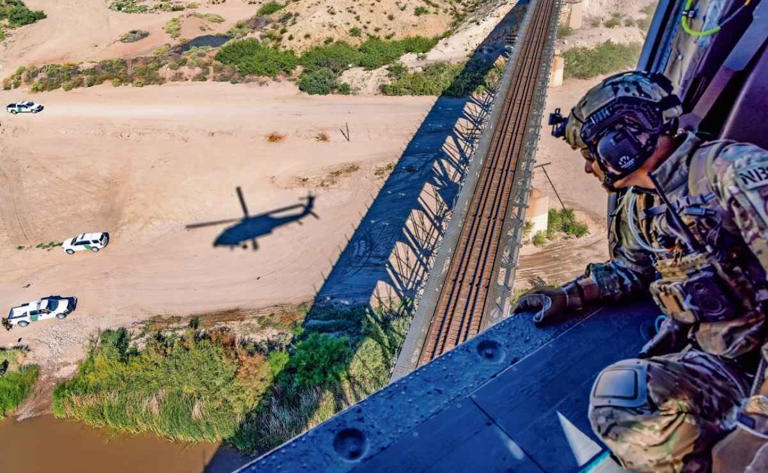

The U.S. Army used a laser system to shoot down three drones linked to Mexican drug cartels that were flying near the Texas-Mexico border, according to military officials.
The operation took place between Tuesday night and early Wednesday morning, during which the Army’s Multi-Mission High Energy Laser (AMP-HEL) was used, according to a statement from the North American Aerospace Defense Command and the U.S. Northern Command.
The intercepted drones had been classified as a physical threat to military personnel and agents of the Customs and Border Protection (CBP).
“The successful neutralization of these hostile drones is a direct test of the Joint Task Force’s readiness, vigilance, and technological advantage,” said Major General Curtis Taylor, commander of the Joint Task Force – Southern Border (JTF-SB).
The operation marked the first time the AMP-HEL system has been used to neutralize drones linked to cartels along the southern border.
Taylor stated that cartels are increasingly using unmanned aircraft systems to facilitate the illegal trafficking of people and actively spy on military personnel and CBP agents.
U.S. Thanks the Mexican Army for Its Support
The major general thanked the Mexican Army for its support.
“We greatly appreciate the support of our Mexican Army partners as we work together to combat this threat in the border region,” Curtis said.
When asked whether the drones had been shot down over U.S. or Mexican airspace, a spokesperson for Northern Command told CBS News that “the engagements were conducted in coordination with all partners operating along the border.” Due to operational security concerns and ongoing operations against cartels and drones, the spokesperson said that no further details could be provided at that time.
Mexican President Claudia Sheinbaum has stated that any unilateral action by the United States on Mexican soil would constitute a serious violation of her country’s sovereignty.
Border Patrol and Cartels Wage a Drone War
EL UNIVERSAL reported on August 19 that U.S. Border Patrol spokesman for the Tucson Sector, Jesús Vasavilbaso, had observed how human smugglers—who are now part of the Sinaloa Cartel—have diversified through the use of new technologies, including drones, along the southern border with Mexico.
During a vehicle tour along the Arizona-Sonora border wall, in which EL UNIVERSAL participated alongside media outlets from other countries, the outlet observed how lookouts hidden in the area track agents’ movements in an attempt to evade them and facilitate the crossing of people, drugs, and weapons.
The “threat” is no longer limited to the ground, as authorities must now also monitor the air. However, this has not prevented Border Patrol from responding. Vasavilbaso said the agency has acquired technology to combat these unmanned aircraft, although further details were withheld for security reasons.
Border Patrol warned: “No matter how much technology they use, we are going to be here defending the border.”
“That’s something we have always seen in Border Patrol: the surveillance by coyotes and traffickers watching our movements, now with technology. They also use drones to monitor our movements. Most of the time, those drones are at the border; they do not cross to this side. But if they do cross, then we also have technology, and we have helicopters to be able to counter those threats,” Vasavilbaso told El Gran Diario de México at the time.
Border Patrol in this area supports the technological wall reinforcing the administration of President Donald Trump, equipped with sensors, state-of-the-art video surveillance cameras, and additional barbed wire. This serves as the first line of containment.
Collaboration
For John Morris, chief of the Border Patrol’s Tucson Sector, cooperation with Mexican authorities has always been good. He said they understand what both countries are trying to accomplish together in terms of border security.
At the Tucson Sector headquarters, Morris confirmed to this outlet that the Sinaloa Cartel operates primarily along the Arizona-Sonora border, employing new strategies on social media to attract more people and even making greater use of technology.
Morris began his professional career in 1996 in the Rio Grande Sector and said he has always had very good cooperation with Mexican authorities along the border, not necessarily because of recent changes in government.
“Among people who live along the border, we understand what we’re trying to accomplish together, and we work well with one another. I wouldn’t necessarily say it’s better now, because in my experience it has always been good. If they need anything from us, we do everything possible to support them, and when we need something from them, they always do everything possible to support us.”
Source: msn