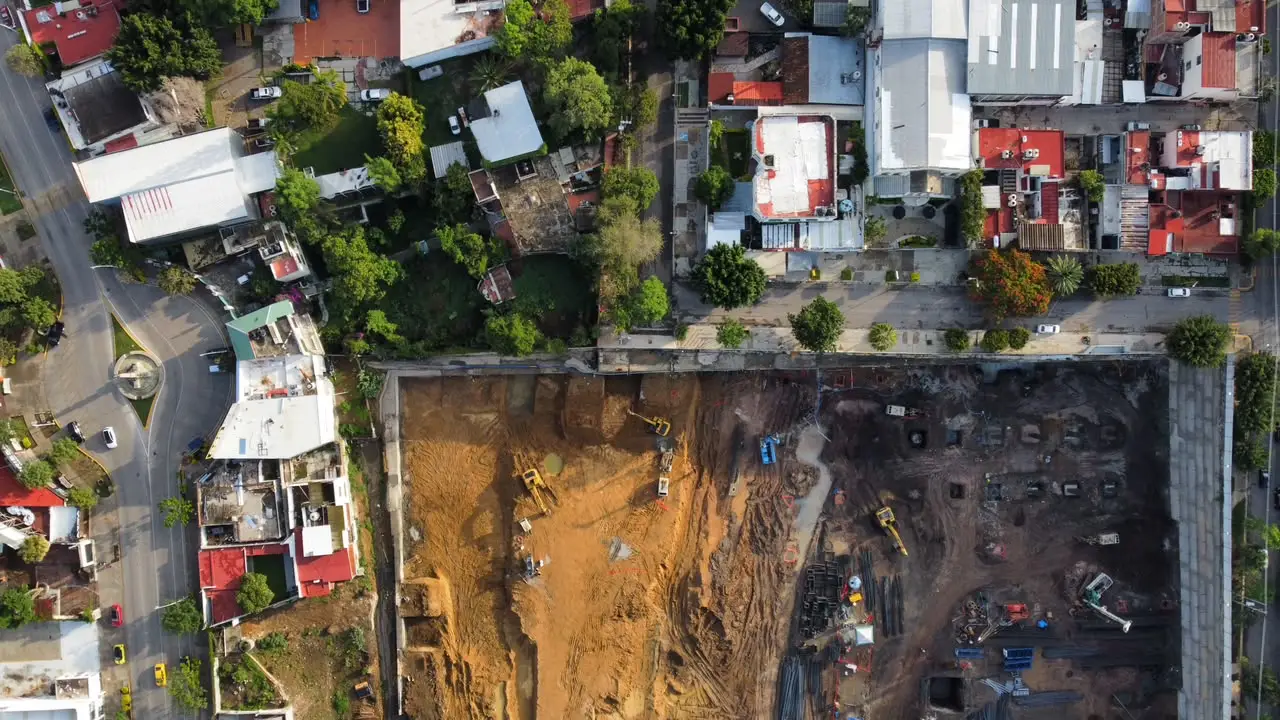

The collapse at the Fibra Danhos construction site in the Reforma neighborhood has exposed, according to specialists, a lack of planning in the project, violations of construction regulations, and omissions by state and municipal governments.
“It is not permissible for a private development to have so many irregularities.” Architect Gerardo Corres Tenorio, an expert in the restoration of public and historic spaces and a critic of the projects being carried out in the city, maintains that “the municipal government is definitely the only one responsible, through the Secretariat of Public Works and Urban Development, since it is responsible for overseeing the application of the construction regulations and structural safety regulations in Oaxaca.”
With more than 25 years of promoting Cultural Conservation in World Heritage Cities, Oaxacan architect Gerardo Corres states that any construction project, large or small, must meet certain requirements, primarily that it be compatible with the municipal development plan.
Then, a Construction Project Responsible Director (DRO) is also required. But to date, no one knows who it is in the case of the Plaza Parque Oaxaca project. “The DRO is responsible for creating the technical file. Given the size of the project, an urban project is required in which roads and other elements are reviewed. But that is precisely where the first problem begins,” he warns: “The project began without a construction license and by stripping the land.”
“Everyone knows that there were a considerable number of trees, some spectacular ones. We knew the site; now there is absolutely nothing. There is already a very serious violation of the city’s ecosystem. Those trees were also stopover points for migratory birds that arrived there and, together with other species, helped regulate the temperature,” the architect elaborates.
Regarding the trees, it is pointed out to him that the city government stated that the company was fined 3.5 million pesos and ordered to replace 1,000 trees.
“But stripping that land like that… they will not be able to mitigate it with anything. You cannot mitigate the impact of such an important urban space by donating trees for a hill.”
Who gave the permit, what study was conducted to strip the property, and then carry out such deep excavations?
The architect, recognized for promoting Cultural Conservation in World Heritage Cities, explains that in the construction license, which is the document that gives the project its legal status, it is confirmed that the project complies with the regulations of the territorial planning and land-use plan. In addition, an urban impact assessment, an environmental impact assessment, a traffic impact assessment, and a civil protection assessment are required.
“They are essential. Before starting any construction project, they are used to conduct a situational analysis and then determine how to mitigate the impact it will generate. That is the reason for these studies,” he explains.
They also began without the street being officially removed from public use
As of July 8 of this year, the developer of this shopping center still did not have a construction license. After months of controversy caused by the lack of information and attention to residents in the area, organized through the Reforma Neighborhood Collective, Mayor Raymundo Chagoya himself admitted that the Trust only had permits to demolish or excavate, which the architect considers irresponsible.

“There are no studies; therefore, the project should not have started. Requesting licenses partially is a completely corrupt strategy. It is the same thing they did at the stadium. They wanted to do the same thing with the Convention Center, everywhere. It is an arbitrary and irresponsible way of allowing construction projects to begin,” Corres Tenorio maintains.
Regarding the removal of Las Rosas Street from public use, approved on June 26 by the Oaxaca City Council during an extraordinary virtual session, the architect can only say: “It is even worse. They include occupying a street in the project, hold a city council session over Zoom, and approve it unanimously. If the legislators go ahead with this process of removing it from public use, they will be accomplices to the entire project.”
To date, the state congress has not issued a ruling regarding the street, which, according to the capital’s mayor, would cost the company 24 million pesos.
What matters least to them is sustainability and the future. The city is a complete mess in general. They probably will not live to see the consequences of these projects, but those of us who live in the city will suffer from them every day.
They excavated deeper than the soil can withstand
Amid the controversy and public concern over the irregular construction of this project, a fundamental element that stands out is the soil mechanics study. The architect explains that this study is required to determine where the project will be built and what construction system will be used; however, that study is also unknown.
“They excavated to depths greater than what the soil can withstand, they put up a skin because it is not a retaining wall; it is a surface, a covering so that the soil cannot be seen—meaning it does not even have any structural reinforcement—and it collapsed.”
Corres explains that the surface where the construction is taking place consists of sandstone and river deposits, which is why he considers it irresponsible for the project to continue. “I passed by there; they patched the cracks, apparently so that people would not see that it is crumbling because they removed all the support from the perimeter of the property.”
The architect warns that it will continue collapsing, “unless they build very, very strong retaining walls” capable of holding all that soil in place.
So, he says, on the one hand, there are legal irregularities, and on the other, complicity between the government and the company. It is unfortunate that they are allowing it to continue, that it keeps advancing, and that they also know it is not being done properly. “I do not understand why they have not shut down the construction site. The complicity is enormous.”
The project began in October 2025 with a promise that has been repeated throughout successive administrations: a new vision of development involving investment and thousands of temporary and permanent jobs. They promised inclusion, security, identity, and well-being. None of that has happened. The project has disregarded the opinions and demands of local residents. Specialists interviewed agree that this project currently represents an imminent danger.

Source: oaxaca.media