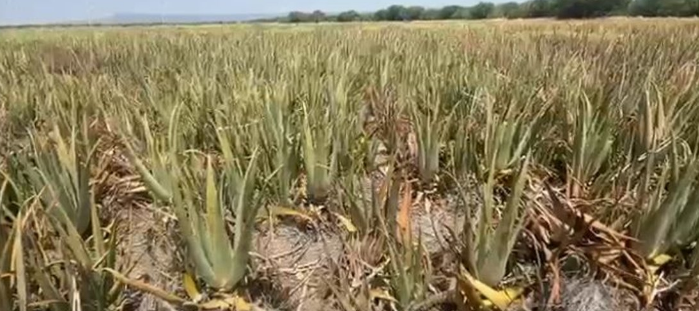

Tamaulipas has established itself as the undisputed leader in aloe vera (Aloe vera) production nationwide and, in the current growing cycle, is positioning itself as the epicenter of the world’s main cluster for this crop.
According to records from the Tamaulipas Secretariat of Rural Development and the Agri-Food and Fisheries Information Service (SIAP), annual production ranges between 126,000 and 130,000 tons, with an active cultivated area of approximately 3,500 to 4,200 hectares.
The main producing municipalities form the González, Jaumave, Llera, and Ciudad Victoria axis, where soil and climate conditions have allowed the crop to become a highly profitable alternative to other traditional crops.
The commercialization of Tamaulipas aloe vera is experiencing a period of high demand and international growth.
The only problem faced by producers is market monopolization. Since there is little competition, prices are subject to the few buyers who concentrate virtually all commercialization in three or four companies in the state.
More than 80 percent of production is destined for foreign markets, mainly the United States and Europe.
Unlike other regions that only sell leaves in bulk, Tamaulipas has managed to consolidate a cluster and industrialization model. It has local processing plants, such as those in the Victoria-Zaragoza and Jaumave areas, which allow added value to be generated through the commercialization of filleted pulp, juices, concentrated gels, and purified raw materials for the pharmaceutical, cosmetic, and food industries.
To obtain better prices in the international market, a large portion of commercialization requires prior contracts and international organic certifications, a requirement that producers in the state have begun meeting in order to consolidate exports.
The success of aloe vera lies in the fact that it is a highly resilient crop, highly resistant to droughts and pests, and requires relatively low investment compared with other agricultural sectors.
Among the essential activities for its development is drip irrigation. Although the plant survives well under rain-fed conditions, this system optimizes yields, increasing production to as much as 50 or 60 tons per hectare.
Weed control during the first months is also critical to prevent competition for nutrients. Priority should be given to organic fertilizers or compost to maintain the crop’s commercial properties and comply with export standards.
The first commercial harvest takes place between 8 and 18 months after planting. The technique is manual and consists of using a sharp knife to separate only the largest and outermost leaves from the base, without damaging the center of the plant.
After the first harvest, continuous harvests can be carried out every 3 or 4 months, provided that the leaves are transported immediately to processing plants to prevent oxidation of the gel inside.
Source: elhorizonte