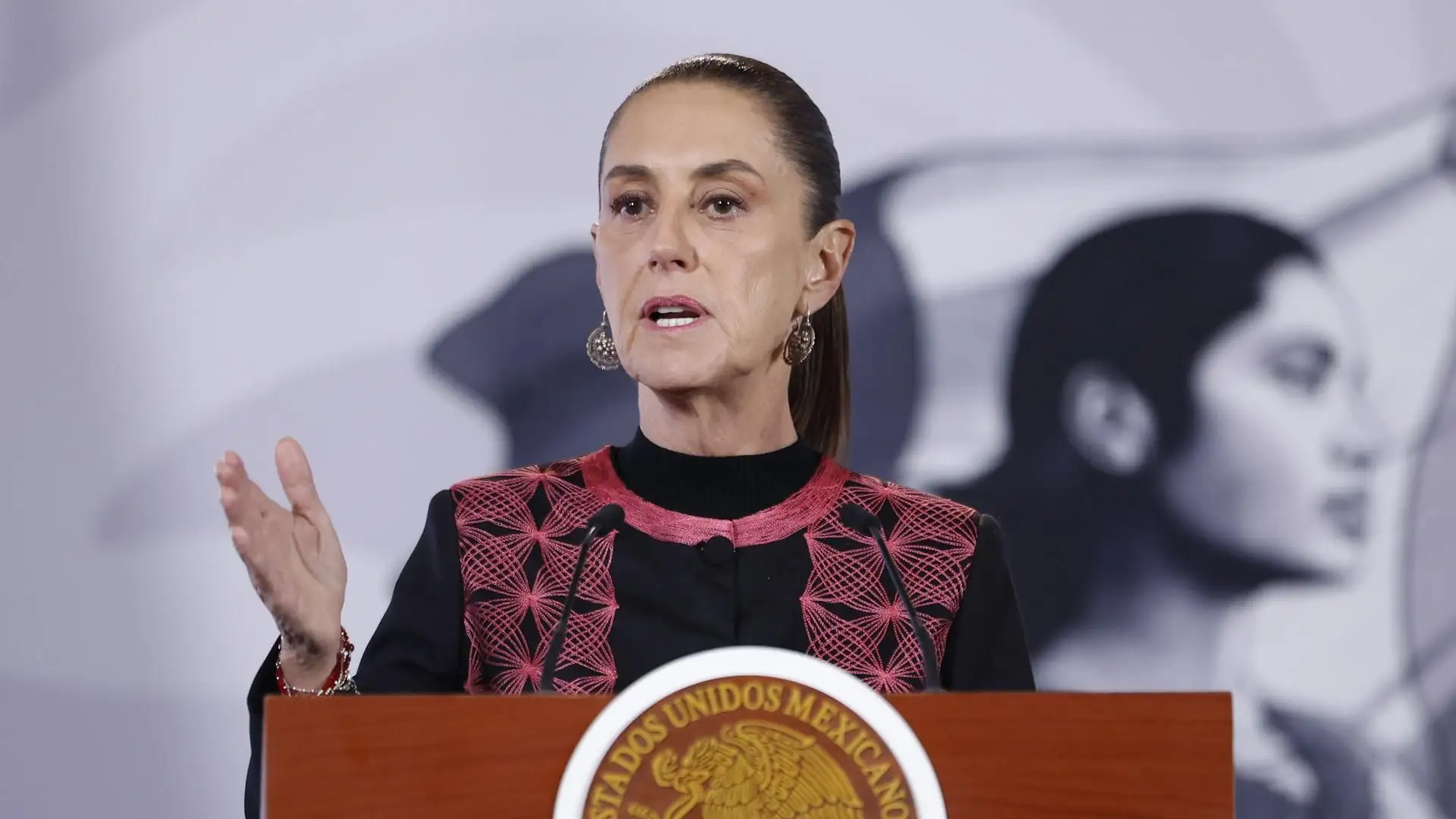

In the digital era, public opinion is no longer measured solely through in-home surveys or traditional focus groups. The real conversation, with its nuances, contradictions, and distinctive local humor, takes place in the digital sphere.
In an interview with Noticias MVS and Pamela Cerdeira, Augusto El Río, a data science specialist and CEO of the firm Dinamic, shared how an innovative computational system developed in Mexico is managing to decode the pulse of digital conversation, revealing surprising data about perceptions of the president ahead of her second government report, the decline of bot farms, and the level of neuroticism among Mexican internet users.
Radiograph of the President: 58% Rejection Compared with 39% Sympathy
According to Dinamic’s most recent measurements, the digital conversation surrounding the president is currently divided as follows:
- 58% of comments have a hostile or negative tone.
- 39% express support and sympathy.
- 3% remain in an undetermined status.
Although rejection accounts for more than half of the conversation, Augusto El Río clarified that, in the hostile ecosystem of social media, these figures do not represent an entirely unfavorable scenario for a political figure.
“I want to emphasize that for a political figure, the numbers are not bad. In other words, if we compare them with the perception of certain governors, the perception of certain political figures in the country, or even in Latin America, having almost 40 percent is very high, because conversations on social media also tend to be very hostile,” the specialist explained.
The Roller Coaster of Perception: How Digital Sentiment Has Changed
The president’s approval in the digital sphere has experienced significant variations over the past several months, linked to specific circumstances:
- Beginning of 2025: At the beginning of that year, sympathy stood at 45 percent, while rejection reached 50 percent, representing a very balanced scenario.
- Third Quarter of 2025 (Summer): An increase in digital rejection was recorded. The main trigger was not directly related to the president, but rather the circulation of photographs of Morena political figures traveling, which generated annoyance among users because they were perceived as inconsistent with the official discourse.
- December 2025: The perception of the president recovered substantially, reducing her level of rejection and increasing sympathy. This positive rebound was driven by three key factors celebrated by internet users: the early distribution of social benefits, the narrative of a reduction in homicides, and record employment-generation figures.
- Current Situation (Ahead of the Second Report): The current peak in digital rejection (58 percent) is strongly influenced by external factors unrelated to her direct agenda or personal attributes. In particular, the negative conversation is based on the case of Rubén Rocha Moya and questions regarding alleged corruption links and connections to organized crime involving other political figures.
“We see, then, that the president’s weakness is not necessarily related to an attribute or public policy that she has promoted, but rather to how she manages the perception of everything else,” the CEO of Dinamic explained.
Beyond Traditional “Social Listening”: Decoding Mexican Sarcasm and Language
The major limitation of traditional social listening tools is that they are usually designed in the United States or Europe for purely commercial and marketing purposes. This restricts them to categorizing opinions simply as positive, negative, or neutral, overlooking cultural and linguistic complexity.
What does neutrality really mean to a Mexican? To address this, Dinamic’s team trained a computational model specifically adapted to the context of Mexico and Latin America. This technological development makes it possible to:
- Interpret sarcasm and double meanings.
- Recognize “slang” (idiomatic expressions) and regional profanity.
- Micro-segment audiences by gender, age groups, and geographic location by state.
- Predict personality traits using the international Big Five model (neuroticism, extraversion, openness, and conscientiousness).
Under this personality analysis model, El Río revealed that the level of neuroticism among Mexican internet users is generally above 50 percent, fluctuating depending on the time period, the time of year, and the nature of the day’s news to which users react.
The Decline of “Bot Farms” in Political Strategy
One of the recurring topics in digital public opinion is the alleged mass manipulation of conversation through automated accounts or “bots.” However, the data science specialist pointed out that this practice is clearly declining due to the increasing sophistication of digital platforms in detecting and penalizing this behavior.
“As of today, using bots is one of the worst alternatives for a political digital strategy,” Augusto El Río stated, emphasizing that platforms have sophisticated their detection systems and impose severe penalties.
How Does Artificial Intelligence Detect a Fake Account?
Dinamic’s system has a parameterized algorithm capable of isolating artificial conversation by detecting specific behavioral patterns in fake accounts:
- Repetitive linguistic structure: Use of highly similar words, punctuation, and sentence structures.
- Incomplete profiles: Accounts with little or no biographical information in their profiles.
- Temporal synchronization: Mass activation of multiple accounts at exactly the same time to induce a conversation.
By identifying these interconnected patterns, the firm’s computational system can filter and exclude these accounts from the analysis database, ensuring that the resulting pulse faithfully reflects the opinions of real citizens.
The data analysis presented on MVS Noticias demonstrates that governing in the 21st century goes beyond simply implementing public policies; it fundamentally involves the strategic management of public perception, which is highly sensitive to events in the political environment.
Ultimately, the president’s digital strength or weakness does not depend solely on her own agenda, but on her ability to manage the impact of external conversations and the national narrative.
Source: mvsnoticias