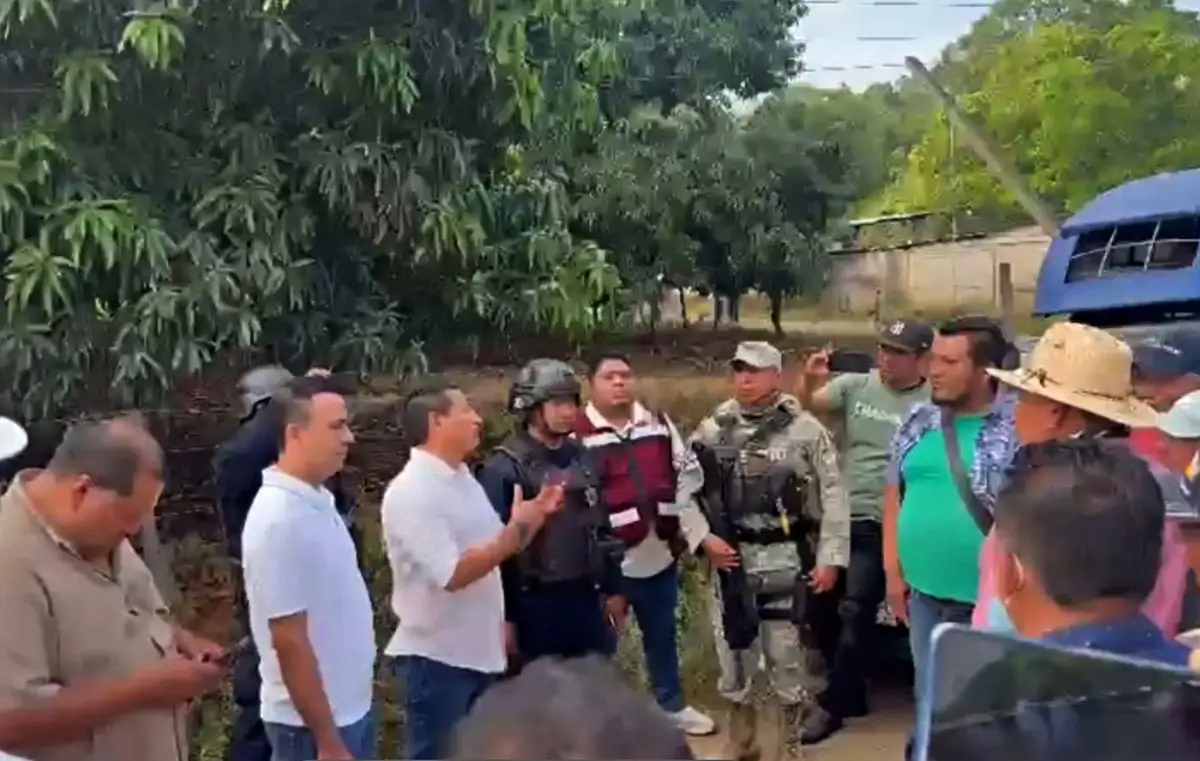

At least 600 members of the Pakal Immediate Reaction Force of Chiapas, an elite police force known as “Los Pakales,” aboard approximately 40 units, entered Oaxacan territory on Friday morning, generating an atmosphere of tension in the Los Chimalapas area, Zoque community members reported.
This police action comes after agrarian and municipal authorities of San Miguel Chimalapa announced that today, September 4, they had peacefully recovered their lands, located in the Chiapas ejido of Gustavo Díaz Ordaz, which was irregularly created half a century ago in a strip of territory that for decades had been disputed between Oaxaca and Chiapas and was ultimately recognized by the Supreme Court of Justice of the Nation (SCJN) as Oaxacan territory.
The community members announced that the recovery of their lands does not involve a violent eviction or dispossession, but rather seeks to voluntarily dissolve, given its irregular and illegal agrarian origin, the “Díaz Ordaz Ejido” and incorporate it into the communal lands of San Miguel Chimalapa, within Oaxacan territory.
Since August 4, community members, supported by their communal authorities, determined in an assembly to recover 4,975 hectares of the so-called “Díaz Ordaz Ejido.” Half a century ago, in 1967, these lands were taken from the Indigenous Zoque people of Oaxaca with the direct participation of the Sánchez Monroy timber company.
On the eve of this meeting, the communal and municipal authorities of San Miguel Chimalapa announced that, since Monday, August 31, they had begun a new attempt at direct dialogue with the Díaz Ordaz community to explain that there is no intention to evict those currently living in the territory, but rather that they maintain their homes while accepting that they are living in Oaxacan territory.
They indicated that the intention is not to leave them to fend for themselves, but for each farmer, as well as Indigenous families who depend on the land, to be able to keep their homes and their livelihoods, “as long as they recognize that they are in communal territory and comply with the regulations of the Communal Statute of San Miguel Chimalapa.”
They added that this territorial struggle and defense is being carried out peacefully and without violence, with the purpose of maintaining dialogue and establishing a working group to continue the reconciliation process.
Oaxaca Protects Its Territory
Regarding the situation, the government of Oaxaca announced that personnel from the Secretariat of Government, through the Coordination of Social Peace Delegates, are participating in the dialogue, as well as the Agrarian Conciliation Board and personnel from the Human Rights Ombudsman’s Office of the People of Oaxaca (DDHPO).
Likewise, an institutional operation involving State Police officers was activated to safeguard the territory and build social peace through peaceful dialogue.
Governor Salomón Jara Cruz announced that communication is being maintained with the Secretariat of the Interior and the government of Chiapas, “reiterating his commitment to building peaceful solutions.”
This came after the Chiapas State Human Rights Commission warned yesterday about possible acts of violence against families in the Díaz Ordaz ejido over an alleged eviction, which the Oaxacan community members have clarified they do not intend to carry out.
The organization urged the governments of both states—Oaxaca and Chiapas—to act immediately and in a coordinated manner to protect the lives of those living there.
“We Seek Peace”
The Oaxacan Zoque community members have also stated that, once their territory has been recovered, they will continue with other irregular Chiapas agrarian communities located on their lands, including Rodulfo Figueroa, Ramón E. Balboa, and La Flor de Chiapas.
“For our part, we are waiting for the legal procedures to be resolved; specifically, for the boundary coordinates between Oaxaca and Chiapas to be corrected, a matter under the jurisdiction of the SCJN, whose representative stated that the process will take approximately three months,” they reported.
Finally, they emphasized that dialogue and peace prevail in this struggle, stating that they have historical justification and that all the background supports their position.
An example of this is the case of the “El Quebrachal” communal settlement, made up of Indigenous Tzotzil and Zoque families from Chiapas, originating from the Ramón E. Balboa agrarian community, who voluntarily joined the communal lands of San Miguel Chimalapa just five years ago and have lived peacefully alongside the people of Los Chimalapas ever since.
Source: lasillarota