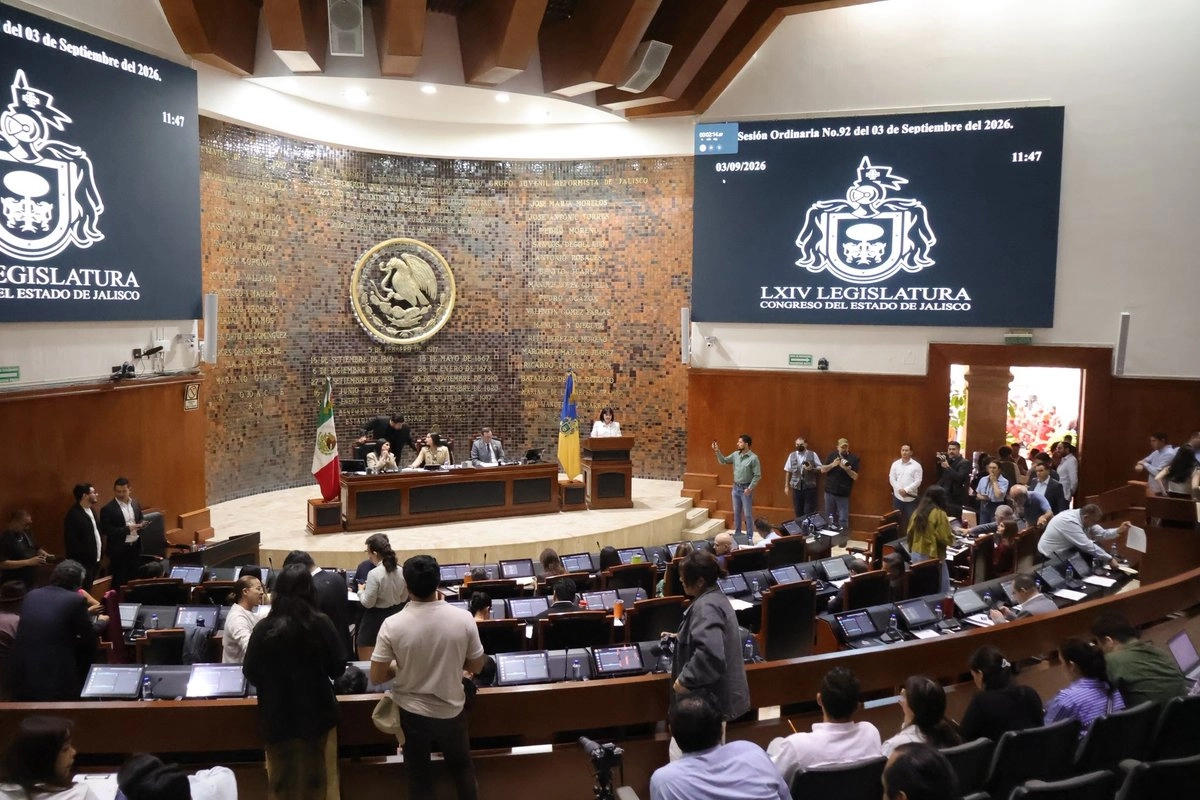

For the fourth time, the Jalisco Congress rejected the order issued by the Supreme Court of Justice of the Nation to harmonize the Civil Registry Law and allow minors, with their parents’ permission, to formalize their preferred gender identity on their birth certificates.
With 20 votes against, the decree bill was rejected by lawmakers from the Citizens’ Movement party, with all 11 of its legislators voting against it; four PAN lawmakers, while a fifth female legislator abstained from voting; three from the Institutional Revolutionary Party; and two of the four Green Party lawmakers, whose caucus also had one abstention and another legislator who did not vote.
The entire Morena caucus of eight lawmakers, Hagamos (3), and Futuro (2) voted in favor.
“Human rights are not subject to consultation; they must be exercised. Once again, opposing the initiative, the State Congress and the right wing represented here decided to maintain the barrier preventing girls and boys in Jalisco from freely exercising their right to their identity,” said Mariana Casillas, of the Futuro party.
Despite the Congress’s repeated refusal to comply with the Court’s mandate regarding the reform of the Civil Registry Law, since late 2020 hundreds of minors have formalized recognition of their gender identity on birth certificates, following a decree issued by then-Governor Enrique Alfaro to allow it.
The SCJN’s new requirement for the Jalisco legislature stems from Constitutional Challenge 72/2022, filed by the National Human Rights Commission and the Jalisco State Human Rights Commission before the country’s highest court.
In its ruling, the SCJN emphasized that compliance with the mandate is not subject to legislative discretion or the discretionary judgment of local lawmakers, but constitutes mandatory compliance with a constitutional review judgment.
The order requires simplifying the process through the creation of a summary administrative procedure to correct birth certificates based on self-perceived gender identity, prioritizing the best interests of children.
Likewise, the Court rejected the extension requested by the local legislature and warned that it had issued a formal warning with fines of up to 120 Units of Measurement and Updating (UMA) if compliance reports are not submitted.
Despite the judicial notifications, the Jalisco Congress plenary had previously rejected the corresponding bills on three occasions (October 2024, March 2025, and January 2026), in addition to what occurred this Thursday.
Civil Registry statistics indicate that between the issuance of the government decree in 2020 and 2023, a total of 1,708 people completed the identity-correction procedure, of whom nearly 300 were minors accompanied by their legal guardians and 33 involved non-binary registrations.
Local lawmaker Enrique Velázquez, of the Hagamos party, who promoted compliance with the Court’s ruling and questioned during the session the procedures followed by the presiding board in conducting the assembly and votes, also stated that the position of the legislative majority violates fundamental rights based on erroneous arguments regarding alleged bodily modifications.
“This is not about transforming oneself or undergoing surgeries, as those who oppose it maintain; the ruling seeks only to ensure that administrative documentation corresponds with self-perceived identity in order to prevent situations of discrimination and social exclusion,” Velázquez emphasized.
Source: jornada