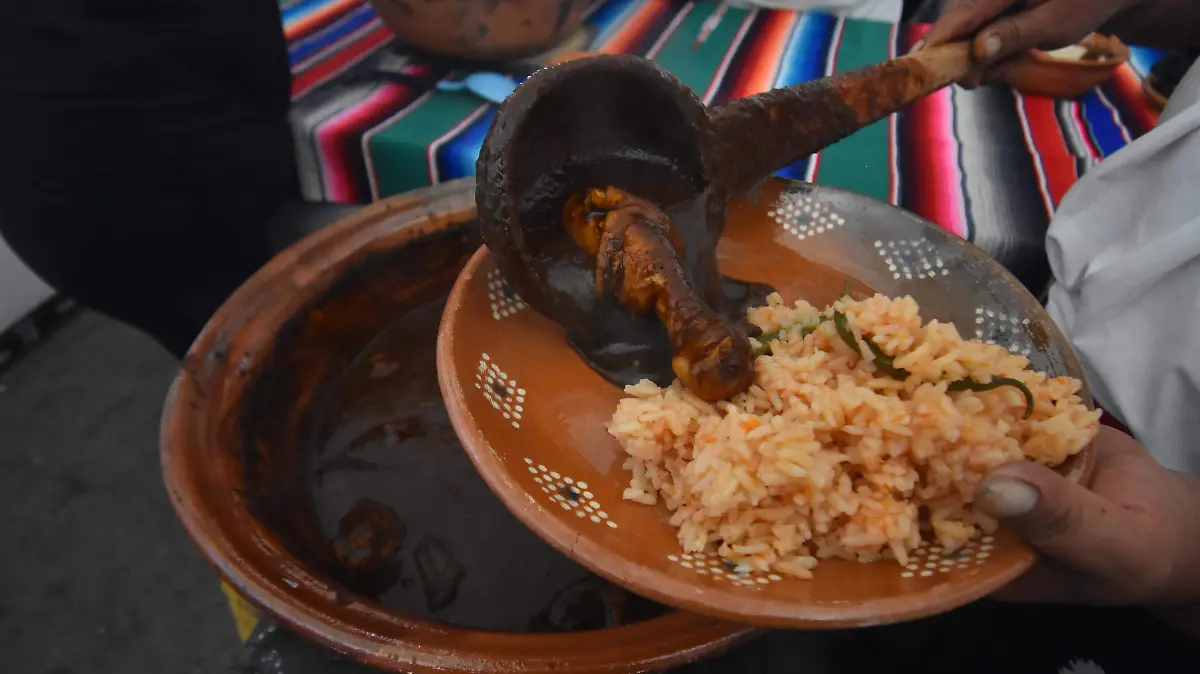

During the ninth month of the year, dozens of communities in Tlaxcala open the doors of their homes so that their guests can enjoy the beloved mole during the patron saint festivities.
It is a tradition that brings families, friends, and visitors together around the table, but it is also an opportunity to discover archaeological sites, ancient temples, artisan workshops, and landscapes that often go unnoticed.
On the traditional Tlaxcalan table, mole is usually served with red rice, freshly made corn tortillas, anise tamales, and pot beans. Sharing these foods symbolizes hospitality and gratitude, which is why it is common for homes to remain open throughout the day to welcome relatives, friends, and visitors.
It is important to remember that although the saints’ calendar establishes the official date for each patron saint, tradition dictates that the “day of the mole” be celebrated on the Sunday closest to that festivity. This allows more people to gather and participate in both the religious activities and the communal meal, which is why the great feast does not always coincide with the exact date on the September liturgical calendar.
However, in some communities, the celebration does take place on the date indicated by the saints’ calendar, as it is a deeply rooted tradition.
September 8
The first major date of the month corresponds to the celebration of Santa María Nativitas, one of the most heavily attended religious festivities in the southern part of the state.
Those who are invited to the traditional mole can spend part of the day visiting Xochitécatl and Cacaxtla, located facing each other on two natural elevations. Both archaeological sites preserve remains of the ancient cultures that inhabited the Puebla-Tlaxcala Valley centuries before our era.
While Cacaxtla is internationally recognized for its polychrome murals, Xochitécatl is notable for its large ceremonial platforms and panoramic view of the valley.
That same day, Our Lady of Loreto, in Españita, is also celebrated, in a municipality where the pottery tradition remains alive. Visiting its workshops allows visitors to observe how clay is transformed into cooking pots, large pots, pitchers, plates, molcajetes, and flowerpots using techniques passed down from generation to generation.
If the invitation is to Axotla del Río, in the municipality of Tlaxcala, the recommendation is to walk around the community and enjoy the festive atmosphere that characterizes the patron saint celebrations.
September 10
In San Nicolás, municipality of Terrenate, the celebration revolves around the parish dedicated to Saint Nicholas of Tolentino.
For several days, novenas, processions, the traditional lowering of the saint’s image, solemn Masses, and cultural activities are held, bringing together both local residents and people originally from the municipality who return to celebrate their patron saint.
It is a good opportunity to learn about one of the regions of the state with the strongest agricultural tradition and to enjoy the hospitality characteristic of communities in eastern Tlaxcala.
September 21
The patron saint festival of San Mateo Huexoyucan, belonging to the municipality of Panotla, offers one of the most unique natural excursions in Tlaxcala.
Very close to the community are the old chalk mines, a site that over time has become a tourist attraction because of its enormous white walls and trails.
Admission costs 20 pesos. The visit involves walking downhill for approximately ten minutes until reaching the bottom of the mine, where the landscape seems to have come from somewhere else.
Visiting hours are from 9:00 a.m. to 6:00 p.m. throughout the week, making it an excellent option to complement a visit to the traditional mole served during the patron saint festival.
September 26
Santa Justina celebrates its patron saint festival in the municipality of Ixtacuixtla.
September 27
In San Cosme and San Damián Texoloc, in addition to visiting the main square, one of the must-try experiences is tasting the traditional ice creams from the town center accompanied by festival bread, a combination highly appreciated by locals.
That same day, celebrations are also held in San Damián Tlacocalpan and San Cosme Atlamaxac, a community belonging to the municipality of Tepeyanco.
September 29
In San Miguel Tenancingo, in addition to the traditional mole, it is worth visiting the temple built during the 18th century and exploring some of the historic buildings in nearby communities such as San Juan Ixcoalco and San Pedro Teocingo. One of the most anticipated activities is the nighttime walk organized during the festivities.
Another must-visit destination is San Miguel del Milagro, in the municipality of Nativitas, considered one of Tlaxcala’s main religious pilgrimage centers.
During these days, hundreds of merchants set up stands offering religious items, flower crowns, traditional foods, and souvenirs for those visiting the sanctuary. Many people arrive to take holy water home or to ask the saint for a miracle.
The celebrations also extend to San Miguel Xochitecatitla, in Nativitas; San Miguel Pipiyola, in Españita; San Miguel Tlamahuco, in Totolac; San Miguel Contla, in Santa Cruz Tlaxcala; and San Miguel Xaltipa, in Contla. Those who visit the latter community can take the opportunity to learn about the textile wealth of the municipality of Contla de Juan Cuamatzi, famous for the production of serapes, woolen capes, blankets, and cloaks woven on treadle looms, a craft that has given the region its identity for generations.
September 30
The final major gastronomic gathering takes place in San Jerónimo Zacualpan. As occurs throughout much of Tlaxcala, the patron saint festival brings together religious tradition, gastronomy, and family gatherings in a single celebration.
For those born outside the state, receiving an invitation to eat mole at the home of people they may barely know can seem unusual. In Tlaxcala, however, this practice is one of the most authentic expressions of hospitality.
Source: oem