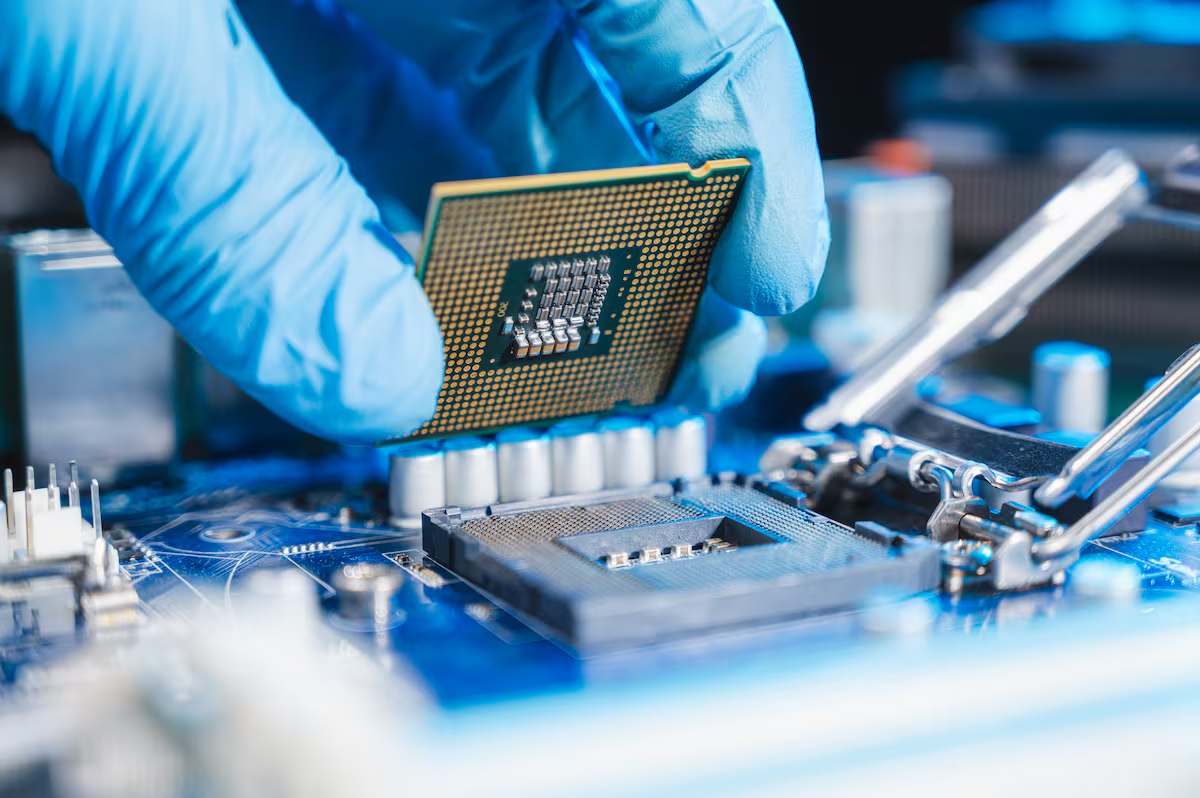

Across the northern border of Sonora, the expansion of the United States semiconductor industry is taking shape. Since 2022, the U.S. government has thrown its support behind an ambitious project to establish a cluster in the Arizona desert to develop and manufacture these products, which are essential to the production of the latest technology. Mexico has been watching its northern neighbor’s plans and has decided that it does not want to be left out of the momentum behind the emerging and growing sector. Participating in this business would allow the Latin American country to diversify and transform its industry alongside its main trading partner. The foundations of this connection have recently been strengthened by a visit from Mexico’s Economy Secretary, Marcelo Ebrard, to Phoenix, the heart of the strategy.
Near Arizona’s major cities, the development of several semiconductor manufacturing plants has already begun. Following the signing of the Chips Act in 2022, the United States allocated 280 billion dollars to the expansion and technological research necessary to boost the sector in the southern state. Mexico has observed the progress of the U.S. industry and has sought a way to fit into the production chain, taking advantage of its status as a trading partner and its membership in the free trade agreement with the United States and Canada (USMCA). “We know that these large plants will need suppliers, which could allow us to develop joint semiconductor investment projects,” explains Diego Flores, head of the Electronics and Digital Industry sector at Mexico’s Secretariat of Economy.
Flores says that the Mexican government is studying potential candidates to become part of the supply chain in various states across Mexico, mainly those along the border, and that one of the current administration’s objectives is to “think long term and establish” a lasting integration with the U.S. sector. Since the creation of production chains between Mexico and the United States following the opening to free trade more than 30 years ago, various goods have found a way to be produced in North America. The most successful over time has been the automotive industry, which in some cases involves all three USMCA countries in the manufacture of its final product. The semiconductor case is a project anchored in medium-term perspectives regarding North America’s technological needs.
Mexico is at an “incipient stage in advanced manufacturing” in the semiconductor industry, says economist and public policy consultant Jorge Sánchez Tello, but he points to several areas of opportunity, such as the assembly, testing, design, and validation of these products. “Mexico’s ambition is economically viable and strategic, as long as it does not seek to manufacture chips from scratch, but rather become the natural link for advanced packaging, testing, and design within the Arizona cluster,” the economist explains. Although Mexico has the critical minerals necessary to produce some chips, Sánchez Tello points out that the country lacks the refining chain required to transform the metals. The Arizona cluster also represents an opportunity for Mexico to move from basic maquiladora manufacturing toward higher value-added industry at a time when the global economy is undergoing transformation.
In the Arizona desert, a significant portion of the emerging semiconductor industry has been driven by Taiwan Semiconductor Manufacturing Company (TSMC). The Taiwanese company, the world leader in chip production, has planned investments of up to 265 billion dollars to build 12 plants in the southern United States. Ebrard’s visit to Arizona allowed the Mexican government to assess the role Mexico could play, recognizing that a large portion of the industry is dominated by Asian producers. Flores, from the Secretariat of Economy, indicates that as a starting point, Mexico can take advantage of the border supply and production chains already used by the automotive and electronics industries. “We want to add our value proposition to the supply chain,” he adds.
The mission also includes a forward-looking component aimed at stimulating the growth of semiconductor-related projects. During his brief tour, Ebrard met with Arizona State University President Michael M. Crow to establish an alliance with the U.S. university for both research and development of new semiconductor technologies and the certification of components that could be integrated into Arizona’s industry. The Mexican government is also seeking to increase the capacity of the Mexican workforce through programs at the U.S. university. Sánchez Tello says there is a significant shortage of specialists trained in areas such as microelectronics, nanotechnology, and materials science, who will be needed for the semiconductor boom in the years ahead.
Although the plan is still in an early stage, the Mexican government aims to consolidate the first supply chains within the next two years. The Mexico Plan, Claudia Sheinbaum’s administration’s strategy for growing the Mexican economy, has among its goals increasing the value of what is produced in Mexico in order to place the country among the world’s 10 largest economies. Achieving this objective will require the transformation of certain industries and the planning of projects that take advantage of Mexico’s geographic proximity to the Arizona cluster and its productive capabilities in the sector. “Nearshoring in semiconductors is not a game based on cheap labor, but rather deliberate public policy: it requires regulatory certainty, guaranteed clean energy, and aggressive investment in specialized human capital,” Sánchez Tello argues.
Source: elpais