
The government of Coahuila has raised concerns over a new Tourist Pass that Nuevo León will require for vehicles with out-of-state license plates. The measure is scheduled to become mandatory on October 21, 2026, and has generated criticism in Coahuila because of the large number of people who travel between the two states every day for work, business, tourism, medical appointments and access to Monterrey International Airport.
Coahuila Governor Manolo Jiménez Salinas has strongly questioned the measure, describing it as potentially unconstitutional and warning that it could create problems for the constant movement between the two states. He said the administration had initially believed the proposal was almost a joke, given the intense economic and social relationship between Coahuila and Nuevo León.
The issue is especially important for residents of Saltillo and Ramos Arizpe, where there is a continuous flow of workers and other travelers toward Monterrey and surrounding municipalities. Thousands of people cross the state border regularly, meaning the new requirement could affect people who do not consider themselves tourists but simply commute or travel for everyday activities.
The Tourist Pass Will Be Required Starting in October
The measure was created following a reform to Nuevo León’s Mobility Law approved by the state Congress on April 21, 2026. Nuevo León’s Institute of Vehicle Control (ICV) subsequently published the regulations establishing how the pass will operate. Authorities say the objective is to strengthen road safety, administrative control and legal certainty for vehicles temporarily circulating in the state.
The pass will be free and processed online. According to the regulations, it will allow vehicles with license plates from another Mexican state or from abroad to circulate in Nuevo León for a maximum accumulated period of 30 days per year.
Drivers must provide information and documents including:
- The vehicle’s current registration card.
- A valid driver’s license belonging to the vehicle owner.
- A valid insurance policy.
- A telephone contact number.
The permit is issued digitally, and authorities have established procedures for its verification.
If a vehicle needs to remain in Nuevo León for longer than the permitted period, its owner would have to obtain a long-term stay registration and comply with the corresponding vehicle-registration requirements.
Why Coahuila Is Concerned
The main concern in Coahuila is that the measure does not affect only tourists.
Officials and business representatives have emphasized that the connection between the two states is much deeper. People living in Coahuila frequently travel to Nuevo León for employment, commercial activities, education, medical appointments and air travel.
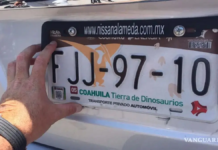
For example, a person from Saltillo may have a vehicle registered in Coahuila but travel to Monterrey several times a week. Under the new system, that vehicle would be considered a foreign-plated vehicle and would fall under the new regulations.
Coahuila’s Tourism Department had already expressed concerns months ago. In May, acting Tourism Secretary Martha Moncada said she did not believe the system would be particularly functional because of the permanent movement between Saltillo and Monterrey. She warned that the measure could make daily transportation more complicated.
The hotel and tourism industry in Coahuila has also criticized the measure. Héctor Horacio Dávila Rodríguez, vice president of the State Association of Hotels and Motels, argued that the requirement could affect regional tourism, commerce and mobility and described the proposal as potentially unconstitutional.
Possible Impact on Tourism and Commerce
Business representatives are concerned that additional administrative requirements could discourage some visitors from traveling to Nuevo León, particularly people who make spontaneous or short trips.
The issue could also affect regional tourism because Coahuila and Nuevo León operate as part of an interconnected economic area. Visitors may cross the state border several times during a single trip, while businesses depend on customers, workers and suppliers moving between the two states.
The concern became even more relevant during preparations for major international events in Nuevo León, when authorities were expecting significant numbers of visitors from outside the state. Earlier in the year, Coahuila officials questioned whether the system could complicate transportation for people traveling to Monterrey.
Coahuilenses Living in Monterrey Also Face Uncertainty
The controversy is not limited to people who travel temporarily from Coahuila.
There are also Coahuilenses who live permanently in Monterrey but continue to use vehicles with Coahuila license plates.
Recent reports have highlighted concern among residents who have maintained their Coahuila registration despite living in Nuevo León for years. Their families and visitors could also be affected when they enter Nuevo León with vehicles registered outside the state.
This has created questions about how authorities will distinguish between tourists, commuters, residents and people who simply maintain a vehicle registered in another state.
What Happens If a Driver Does Not Have the Pass?
The regulations give state and municipal authorities the power to verify whether a foreign-plated vehicle has the required tourist pass or long-term-stay registration when applicable.
The regulations state that failure to carry, display or maintain a valid permit can result in sanctions according to the respective authorities’ powers.
The physical version of the permit is also supposed to be printed and displayed on the vehicle’s front windshield and rear window.
Nuevo León Defends the Measure
Nuevo León authorities maintain that the system is intended to improve road safety, administrative control and legal certainty, rather than prevent visitors from entering the state.
The ICV has emphasized that the pass will be free and that the system was developed through coordination with state and municipal authorities as well as sectors related to mobility, security, tourism and economic development.
The regulations were formally published in September, meaning the measure has moved beyond the planning stage and is now scheduled for implementation.
A Growing Dispute Between Neighboring States
The controversy has therefore evolved from a discussion about a vehicle-registration procedure into a broader debate over regional mobility.
For Coahuila authorities, the central problem is that Nuevo León’s system treats vehicles with foreign plates as a category that requires additional control even though thousands of those vehicles belong to people who participate daily in the economic and social life of Nuevo León.
For Nuevo León, the pass is presented as an administrative and security mechanism intended to identify vehicles from outside the state and provide greater control over their circulation.
The key issue now is how the system will be enforced after October 21, particularly along the heavily traveled routes connecting Saltillo, Ramos Arizpe and Monterrey.
The controversy could continue to grow if Coahuila residents begin receiving sanctions or experiencing difficulties while commuting between the two states. At the same time, Coahuila officials and business groups are expected to continue pressing Nuevo León to reconsider how the requirement is applied to people who cross the border regularly rather than visiting as traditional tourists.
Source: elnorte