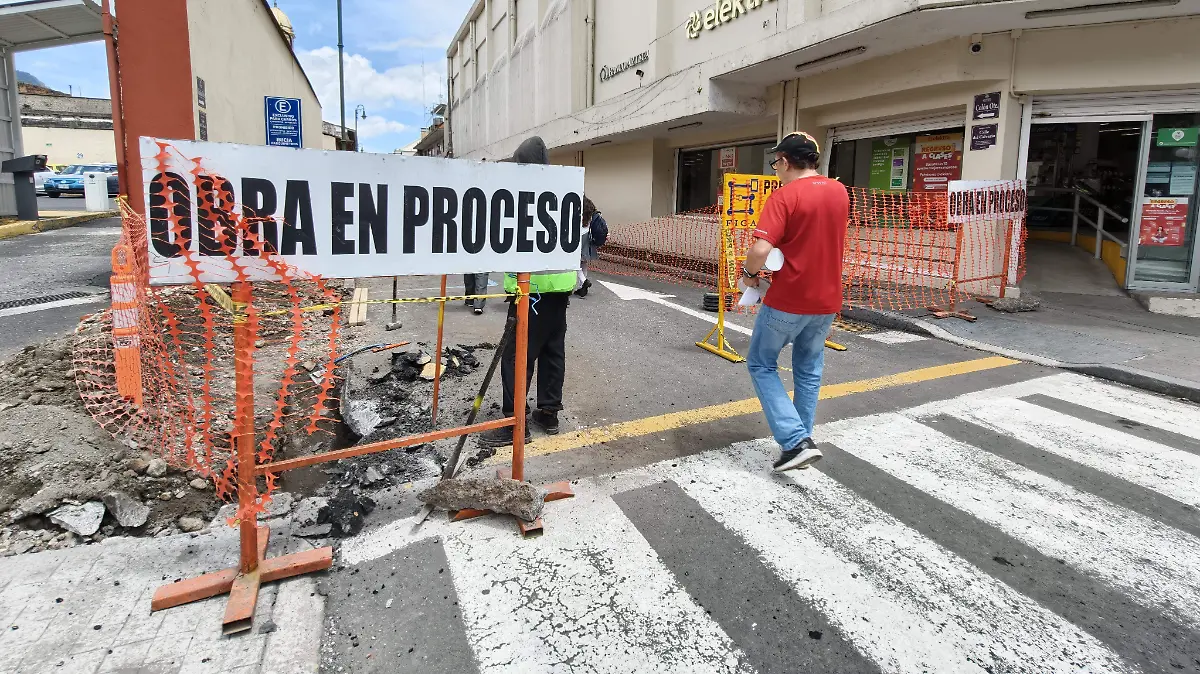

The municipality of Orizaba, Veracruz, has begun work on a project to install underground electrical and telecommunications infrastructure in part of the city’s Historic Center, with the objective of improving the area’s urban appearance and removing the large amount of overhead cabling currently visible in the streets.
The first stage of the project is focused on the area surrounding the churches of El Calvario and Santa María. The municipal government previously announced that the work would begin on September 7 and is scheduled to continue until December 5, 2026.
The project covers Oriente 3 and Oriente 4 avenues, between Norte 2-Sur 3 and Norte 8-Sur 9, in the downtown area. The work includes civil construction necessary to place the cabling underground and reorganize infrastructure currently installed above street level.
Traffic Closures and Restrictions
The construction will affect vehicle circulation in the area, although municipal authorities have indicated that the streets will not be completely closed at the same time.
The work will be carried out in stages and in specific sections, allowing authorities to maintain circulation whenever possible and reduce the impact on residents, businesses and motorists.
Business owners in the affected area were reportedly informed in advance so they could make arrangements for the construction period. Authorities acknowledged that the work could temporarily cause inconvenience, particularly for traffic and commercial activity, but said the gradual approach is intended to minimize those effects.
Removing Unused and Excess Cabling
One of the main objectives is to address the accumulation of overhead wires in the Historic Center.
Municipal authorities said there are large quantities of cables belonging to different telecommunications companies, including cables that are no longer in service. Removing unused infrastructure and relocating active cables underground is expected to reduce visual pollution and create a more orderly urban environment.
The project is therefore not limited to placing new cables underground. It also involves removing obsolete infrastructure that has accumulated over the years.
First Stage of a Larger Urban Improvement Project
The municipality formally put the first stage out to public tender in August. The project was identified as OP/LPN/2026301180520 and was described as an urban improvement project for the city’s central area, including underground cabling in the zone of the El Calvario and Santa María churches. The contract was awarded on September 4.
The project is part of a broader effort to improve the appearance and infrastructure of Orizaba’s Historic Center. Similar proposals for underground infrastructure have appeared in the city’s long-term urban planning documents, which have identified the replacement of overhead electrical and telephone installations as a way to protect and improve the historic urban environment.
Impact on Residents and Businesses
Because the work requires excavation and construction in streets and sidewalks, residents and businesses in the affected blocks can expect temporary disruptions.
The municipality has emphasized that the construction will be coordinated by sections rather than closing the entire area, with the goal of maintaining access and reducing congestion as much as possible.
The project is particularly relevant for the Historic Center because Orizaba has invested heavily in improving its urban image and tourism infrastructure. The city has held Pueblo Mágico status since 2015, making the appearance of its historic areas an important part of its tourism identity.
Once completed, the first stage is expected to leave the area around El Calvario and Santa María with fewer visible cables, a more organized telecommunications and electrical network, and an improved streetscape.
The municipality’s broader objective is to combine infrastructure modernization with the preservation and improvement of one of the city’s most important historic areas.
Source: oem