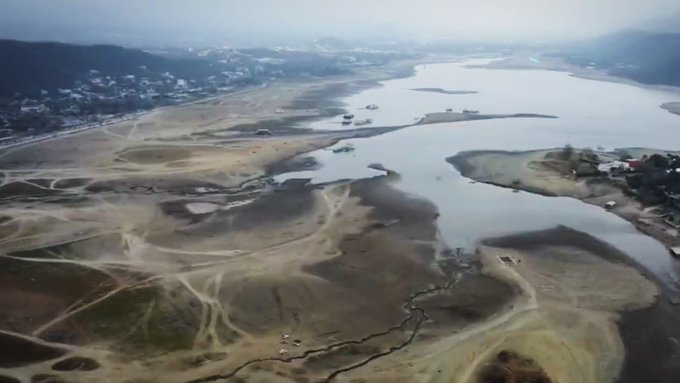

Sonora’s water reserves have decreased since July due to the extreme drought facing the state.
:quality(70)/cloudfront-us-east-1.images.arcpublishing.com/elfinanciero/CFLMNDLENBC7LFJUXJ2UJJJM2U.jpeg)
The Sonora dam system is at 10.2 percent of its storage capacity, according to technical data from the Northwest Basin Organization (OCNO) as of May 17, 2024.
As a whole, Sonora’s reservoirs have a reserve of 878.2 million cubic meters of water resources as of the date of the report, which have been decreasing since July 2023.
In total, Sonora’s dams have the capacity to store 8,630.5 million cubic meters of water, of which 6,560.1 million correspond to reservoirs of the dam system that is fed by the Yaqui River, which are at 12.7 percent of its capacity and accumulate 831.6 million cubic meters, 94.5 percent of the 878.2 million available throughout the entity.
At least two dams are at 0 percent and they are Abelardo L. Rodríguez de Hermosillo and the Ignacio R. Alatorre dam, on the Mátape River, while the Adolfo Ruiz Cortinez dam, on the Mayo River, is at 0.9 percent capacity.
What are the dams in Sonora that have less than 10% storage?
The other reservoirs that have less than 10 percent of storage are the Cuauhtemoc dam (2.3 percent), Bicentenario (2.9 percent) and Rodolfo Félix Valdez (6.4 percent). While the El Novillo dam is at 11.2% and El Oviachic, the largest in the system, is at 13.1 percent.
From January to March 2024, the rate of water loss in the system was around 5 percent per month on average, a figure that dropped to just 2.5 percent compared to the level the dams had on March 20 against the data of April 20.
The loss became less intense between April and May, since in just a few weeks the reservoir level fell only 0.6 percent.
:quality(70)/cloudfront-us-east-1.images.arcpublishing.com/elfinanciero/QV4S4J64VZG5BEVCLKLRC6GJWU.jpg)
As of January 8, the Sonora dam system was at 27.19 percent of its storage capacity; The figure dropped to 20.9 percent on February 8 and on March 8, the data released was 15.4 percent of the storage level of the entity’s 10 dams.
Sonora maintains extreme drought conditions
However, the problem is that the entity has 94 percent of its territory in drought conditions, from exceptional drought to severe drought, for a period of more than six months, according to the Conagua Drought Monitor.
It is worth mentioning that 30 percent of the water supplied to Hermosillo, the capital of Sonora, comes from the El Novillo and El Molinito dams.
In 2023, Hermosillo consumed 126 million cubic meters of water and in 2022 it was 130 million cubic meters, of which the El Novillo dam contributed 30 million cubic meters (approximately 25 percent) while El Molinito supplies 15 million meters. cubic per year.
The remaining 70 percent of the water, around 80 million cubic meters per year, that the people of Hermosillo consume come from the groundwater, that is, from the groundwater or aquifers that exist in the Mesa del Seri, La Victoria and that catchment area. .
The president of the Association of Agricultural Organizations of Southern Sonora, Álvaro Bours Cabrera, indicated that they are asking for technical tables to be opened, as well as the budget necessary to fundamentally resolve the agricultural problem.
“The outlook is desperate due to the drought, the lack of prices and the elimination of everything that worked before,” he indicated.
The agricultural leader said that a rearrangement of crops is necessary to include in those with low demand for water, a guaranteed price for oilseeds such as safflower that is in demand, to guarantee the profitability of the field.
“This year the problem was not resolved, but with that budget that was used last year, we ask that it be given to Aserca and return to contract cultivation to solve the problem, also establish coverage to protect the producers and the Government itself. ”he demanded.
Source: elfinanciero