
In addition to the control in the Federal Legislative, Morena and Allies control most local congresses

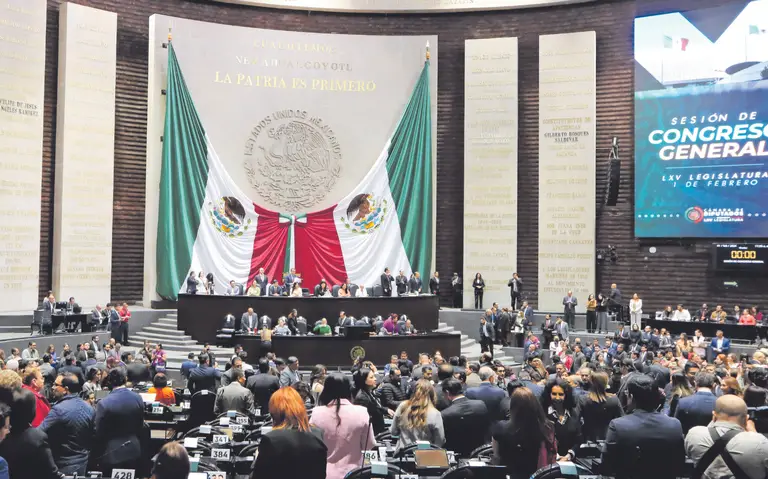
Morena and her allies are emerging to reach the majority qualified in the Congress of the Union, so that the official bloc may reform the Constitution, secondary laws and approve the Federation Expenditure Budget (PEF) without the need to negotiate votes with The opposition at least for the next three years.
According to estimates of the Presidency of the Republic based on the Preliminary Electoral Results Program (PREP), Morena, the Green Party and Labor Party will reach 82 senadurías and 365 deputations. In both cases, more than two thirds – qualified most – that marks the law to approve a constitutional reform.
The next legislature starts on September 1, date on which Andrés Manuel López Obrador presented last February could be approved. Among these initiatives is to reduce federal deputations and 64 senadurías to 300.
There is also the reform to the Judiciary, which states that the designation of ministers and magistrates is through universal and direct vote, the elimination of autonomous organisms (such as INAI, which forces to transparent government information) or the prohibition of fracking in fracking in Mining, in addition to the electoral reform, which would transform the INE and the method of designation of the electoral advisors, which is currently negotiated between the banks in the Chamber of Deputies.
Sheinbaum devastates; It will be the first president of Mexico
In addition, it may approve reforms that in the current legislature the opposition managed to block, such as that the Ministry of National Defense assumed the command of the National Guard, the electrical reform so that the Federal Electricity Commission has preference in the electricity market, or The electoral reform to reduce the powers of the INE.
Morena with their allies can approve the PEF they want, that is, allocate money to Pemex, to the strategic projects of the 4T such as AIFA, Maya Train or the two mouth refinery, and even, if you consider it, increase the deficit.
The legislative control of the CuatTé will extend to the local congresses, of which, also half one more (17) to approve constitutional reforms.
Morena and Allies are out of 25 congresses of the 31 that were chosen on Sunday. Only Aguascalientes, Guanajuato, Coahuila and Nuevo León remain with a majority of opposition matches, while Durango and Querétaro are divided.
The current coordinator of Morena in the Chamber of Deputies, Ignacio Mier celebrated that in the next legislature there will be plan C of the constitutional reforms, which were not achieved in this ending in August.
New pluris arrives
The new composition of the Senate of the Republic will have at least six national and local leaders or local leaders of the country’s political forces, who will reach their legislative position by the multinominal route.
According to the official count of the National Electoral Institute (INE) in the elections to elect 128 senators who make up the upper house, politicians such as Adam Augusto López Hernández, former secretary of the Interior.
The cases of national presidents of the parties that integrated the Force and Heart Coalition by Mexico: Alejandro Moreno Cárdenas, of the PRI; Marko Cortés Mendoza, of the PAN, and Jesús Zambrano Grijalva, of the PRD, a political institute that possibly loses his registration.
Other national leaders or former leaders who already tied a seat in the Senate for the next six years are the vital national president of the Labor Party (PT), Alberto Anaya Gutiérrez, as well as the former national coordinator of Citizen Movement (MC), Clemente Castañeda Hoeflich .
Manlio Fabio Beltrones Rivera, former president of the PRI between 2015 and 2016, former governor of Sonora and innumerable times Federal Legislator, also has a site assured in the new composition of the Chamber of Senators. The same happens with Ricardo Anaya Cortés, national leader of the PAN 2015 to 2017 and presidential candidate of National Action in the 2018 elections.
Alejandro González Yáñez, second address in the PT, twice senator and twice federal deputy for that party; Carolina Viggiano Austria, general secretary of the PRI, as well as Citlalli Hernández, general secretary of Morena and who would realize her re -election, are also emerging to be part of the upper house.
In the integration of the new Senate of the Republic there are also several former governors, such as Manuel Velasco Coello, ex -president of Chiapas from 2012 to 2018 by the PVEM and presidential exaspirant of the official bloc, as well as Mauricio Vila Dosal, former governor of Yucatan for the PAN of 2018 to 2024.
Also the aforementioned Manlio Fabio Beltrones Rivera, governor of Sonora by the PRI from 1991 to 1997; Alejandro Moreno Cárdenas, president of Campeche for the Institutional Revolutionary from 2015 to 2019, and Adam Augusto López Hernández, Governor of Tabasco from 2018 to 2021, who is also outlined to be the coordinator of Morena in the Upper House.
Marcelo Ebrard Casaubón, former head of Government of Mexico City from 2006 to 2012 by the PRD, former secretary of Foreign Affairs and presidential exaspirant of the Morena-PVEM block, would also have an insured seat in the Senate by multinominal route. This would be the second time that the former chancellor assumes a legislative position, since between 1997 and 2000 he was a federal deputy for the Green Ecologist Party of Mexico.
To this list of former governors is added Javier Corral Jurado, former governor of Chihuahua for the PAN from 2016 to 2021, who joined Morena and the presidential candidacy of Claudia Sheinbaum Pardo and is in charge of the “anti -corruption plan” of the winning virtual in the Sunday elections.
Source: elsoldemexico