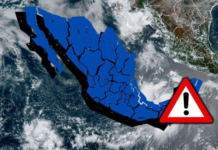


In light of the effects of rain and wind generated by various meteorological phenomena in the Yucatan Peninsula, the northeast, the east and the southeast of the country, mainly, the Government of Mexico, through the Secretariat of the Navy (SEMAR), the National Water Commission (Conagua) and the National Coordination of Civil Protection (CNPC), calls on state and municipal authorities, as well as the general population, to implement protective actions to safeguard the most important thing, people’s lives.
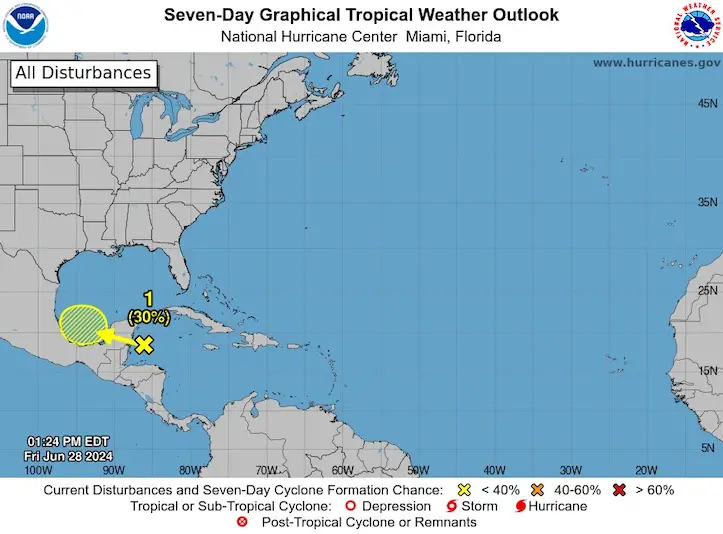
Civil Protection Tamaulipas reported that tropical disturbance 94L will cross the Yucatan Peninsula between today and tomorrow, then emerge to the southwest of the Gulf of Mexico during the course of Saturday. The NHC maintains a 30% probability of development into a tropical cyclone during the weekend.
In a press conference, the general coordinator of the National Meteorological Service (SMN) of Conagua, Alejandra Margarita Méndez Girón, explained that, at 09:00 hours, the center of the low pressure with a 30% probability of cyclonic development was located 335 kilometers (km) east of Puerto Costa Maya, Quintana Roo, moving west-northwest at an approximate speed of 24 kilometers per hour (km/h).
She explained that the interaction of the low pressure and the monsoon trough generates clouds in Campeche, Chiapas, Oaxaca and Tabasco. She said that it is expected that during the afternoon today the center of the low pressure will enter the south of the Yucatan Peninsula, and that its cloudiness will extend to the Yucatan Peninsula and the southeast of Mexico, generating very strong to intense rains in Campeche, Chiapas, Oaxaca, Quintana Roo, Tabasco and Yucatan.
IT WOULD MAKE LAND IN CENTRAL-NORTH VERACRUZ AND SOUTHERN TAMAULIPAS
On Saturday afternoon, the center of the low pressure is expected to be located off the coasts of Campeche and Tabasco, causing cloudiness and rain in the Yucatan Peninsula, the southeast, the east and central Mexico. On Sunday night or early Monday morning, it would make landfall in central-northern Veracruz and southern Tamaulipas.
Méndez Girón pointed out that, during its formation and movement, this system interacts with the monsoon trough, which is why it will leave intense to torrential rains in the Yucatan Peninsula, the southeast, the east and the northeast of Mexico, as well as very strong rains in central Mexico.
In this context, winds of 50 to 70 km/h, possible waterspouts and waves of 2 to 4 m are forecast for the coasts of Campeche, Quintana Roo, Tabasco, Tamaulipas, Veracruz and Yucatan.
In total, from June 28 to July 2, rainfall accumulations of 300 to 350 millimeters (mm) are expected in Querétaro and San Luis Potosí; 250 to 300 mm in Hidalgo; 200 to 250 mm in Guanajuato, Puebla and Veracruz; 150 to 200 mm in Campeche, Chiapas, Oaxaca, Quintana Roo, Tabasco and Tamaulipas, as well as 75 to 150 mm in Nuevo León and Yucatan.
OVERHEATING OF THE SEA FAVORS TROPICAL WAVES
The head of the SMN commented that there is currently an overheating of sea water in the Atlantic, a condition that has favored the development of low pressures in the Gulf of Mexico and tropical waves, in recent times.
At the time, the head of the department of the Center for Meteorological Analysis and Forecasting of SEMAR, Jorge José García Quiroz, announced that, according to the forecast for the next 24 hours, waves of 4 to 6 feet (1.2 to 1.8 meters [m]) are expected off the coast of Tamaulipas and the northwest of the Gulf of Mexico; of 8 to 12 feet (2.4 to 3.6 m) in the northeast of the Gulf of Mexico and the coast and north of Yucatan, as well as 10 to 16 feet (3.0 to 4.8 m) on the coast of Quintana Roo and the northwest of the Caribbean Sea.
Within 48 hours, waves of 7 to 9 feet (2.1 to 2.7 m) are expected off the coast of Tamaulipas and the northwestern Gulf of Mexico; 6 to 8 feet (1.8 to 2.4 m) on the north-central coast of Veracruz; 5 to 7 feet (1.2 to 2.1 m) on the southern coasts of Veracruz, Tabasco, Campeche, and Yucatan, as well as 8 to 12 feet (2.4 to 3.6 m) on the coasts of Quintana Roo and the northwestern Caribbean Sea.
Meanwhile, within 72 hours, waves of 10 to 14 feet (3.0 to 4.2 m) are expected on the coast of Tamaulipas, the north-central coast of Veracruz, and the northwestern Gulf of Mexico; from 5 to 7 feet (1.5 to 2.1 m) on the southern coasts of Veracruz, Tabasco and Campeche; as well as from 4 to 6 feet (1.2 to 1.8 m) on the coast of Yucatan, Quintana Roo and the northwest of the Caribbean Sea.
MAINTAINING VIGILANCE OVER RIVERS AND DAMS
From the Technical General Subdirectorate of Conagua, the deputy manager of Operational Hydrology, Daniel Arriaga Fuentes, stressed that Conagua maintains special surveillance in the rivers, dams and towns of Chiapas, Hidalgo, Puebla, Querétaro, Tamaulipas and Veracruz, entities with the main forecasts of rain.
The dams that are being monitored are those known as Chicoasén and Peñitas in Chiapas; La Soledad and Nexapa in Puebla; the Tamesí River Lagoon System in Tamaulipas; and Canseco and El Moralillo in Veracruz.
There are also 19 rivers in Chiapas that are being monitored in particular; the Usumacinta River basin and the Carrizal, De La Sierra, Grijalva, Puxcatán, Samaria and Tulijá rivers in Tabasco; those known as Arroyo Grande, Bravo, Guayalejo, Pilón, Purificación and Soto la Marina in Tamaulipas, and 21 in Veracruz.
Source: lacapital