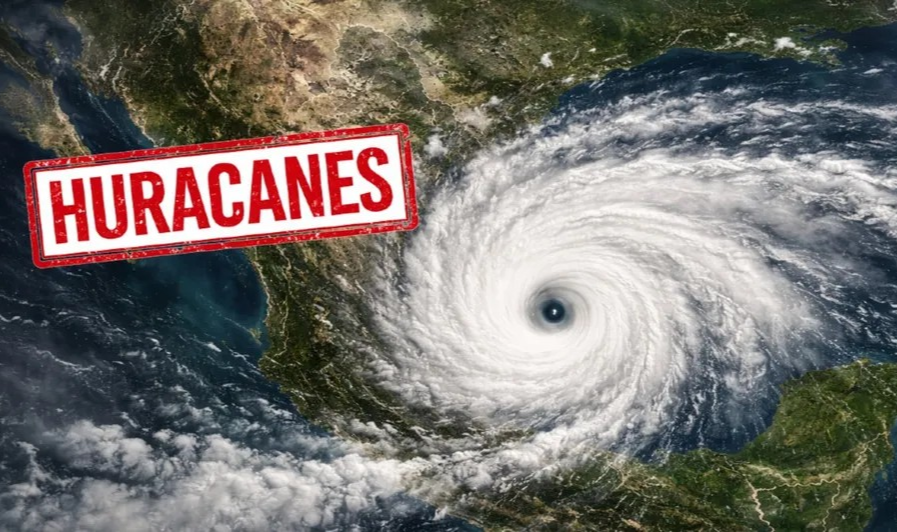

Every year, Mexico is affected by tropical cyclones that form in the Pacific and Atlantic Oceans. Some intensify significantly and can even make landfall. In 2026, the hurricane season is linked to these phenomena and also has an upcoming start date.
The intensity of hurricanes is measured by the Saffir-Simpson scale. Even if they don’t make landfall, if they approach the national territory, their effects can impact, especially the coastal states, but they also intensify rainfall in other regions.
When does hurricane season begin?
Hurricane season in Mexico is related to the rainy season and, therefore, to cyclone season, since it should be noted that the intensity of cyclones can determine whether a hurricane forms.
The National Meteorological Service (SMN) shared with MILENIO in a previous interview that the rainy season this year is expected to begin on May 15.
What is a hurricane?
A hurricane is one of the most powerful and destructive meteorological phenomena on Earth. However, it is not an isolated event, as it originates after the winds of a tropical cyclone exceed 120 kilometers per hour.
From that point, hurricanes are classified from Category 1 to Category 5 on the Saffir-Simpson scale, based on their wind speed.
Among their effects are the generation of extremely strong winds and torrential rains.
This, as explained, is linked to the onset of tropical cyclones in the Pacific Ocean. Hurricanes are, in fact, intensified tropical cyclones.
The 2025 hurricane season is expected to be more intense in Mexico, according to the National Meteorological Service (SMN), with a number of hurricanes and storms exceeding the annual average.

How many hurricanes and tropical storms are expected during the 2025 season?
For his part, Alejandro García Jiménez, head of the Meteorology and Climate Services Sub-Management at the National Meteorological Service (SMN), emphasized that Mexico is currently in a critical meteorological transition phase.
Will the hurricane and rainy season be intense in 2026?
According to his explanation, the El Niño and La Niña phenomena affect rainfall forecasts. Currently, the climate system is moving out of the La Niña phase.
Recent monitoring projects that the surface temperature of the tropical Pacific Ocean will continue to increase, positioning itself within the El Niño phenomenon toward summer, in June, July, and August.
This change is important, as the presence of these two phenomena promotes the formation of cyclones. To understand this:
However, the expert emphasized that it is still too early to give an accurate forecast for this season in Mexico.
Nevertheless, he did point out that the official rainy season is set to begin on May 15 and will extend until the end of November.
Finally, he announced that the number of tropical cyclones expected this season will be officially released at the end of April and the beginning of May, in order to reduce uncertainty and make the predictions more accurate.

Source: milenio