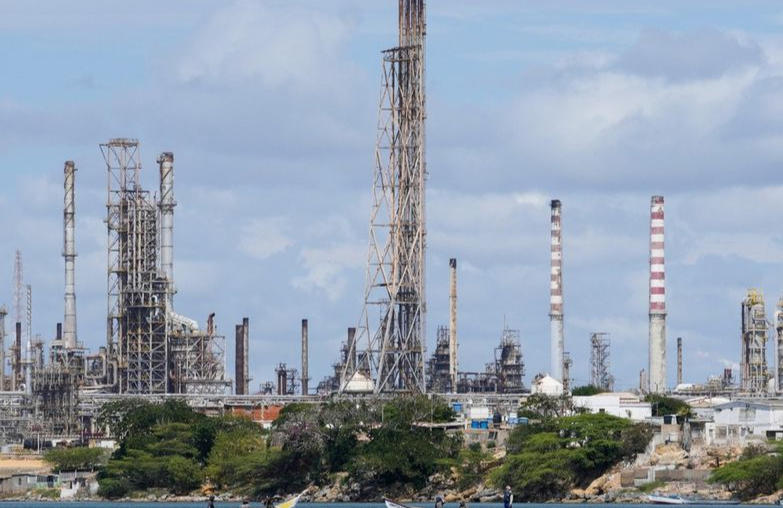

Following the United States’ intervention in Venezuela, the South American country is making significant changes to attract both American and European investment, posing a challenge for Mexico, where the tax and regulatory burden is less competitive. Experts warn that without swift adjustments, the country could lose foreign and domestic investment in the energy sector.
“Venezuela has already announced a goal of nearly tripling its production in the next three years. We really see this country as a magnet for investment,” said William Antonio, CEO of SLB in Mexico and Central America.
He noted that Venezuela’s oil industry, which stagnated for almost seven years after falling from 2.5 million to around 300,000 barrels per day, is beginning to recover thanks to the easing of restrictions and new licenses that allow the partial operation of international companies.
“Since the beginning of the year, the appetite for investment has increased significantly, driven by regulatory changes that make the country more competitive compared to emerging markets like Guyana and Namibia,” Antonio pointed out. “Although a massive influx has not yet materialized, the more attractive fiscal conditions position Venezuela as a key potential destination for global energy capital,” he added.
The impact of fuel theft in Mexico not only affects Pemex, but also represents a direct and growing burden on public finances, with losses already exceeding 126 billion pesos annually, according to Francisco Barnés de Castro, president of the Citizen Energy Observatory.
The expert highlighted that the difference between what is produced, exported, and sent to the National Refining System leaves a shortfall of approximately 53,000 barrels per day. “This deficit cannot be explained by inventory variations, which points directly to a problem of illegal hydrocarbon extraction,” he stated.
In the last three years, crude oil theft has increased significantly. Reports indicate that some of this oil is smuggled to the United States, where it is refined and subsequently returned to Mexico as gasoline and diesel, often illegally.
This scheme is highly profitable: crude oil is illegally extracted, processed in US refineries, and reintroduced into the country, evading taxes such as the IEPS (Special Tax on Production and Services) and VAT. This cycle makes fuel theft a double-edged business for the networks involved. The estimated impact of crude oil theft alone amounts to $1.2 billion, directly affecting Pemex.
The problem is not limited to crude oil. An analysis of official figures for fuel production, imports, exports, and sales reveals inconsistencies that point to a parallel market with evidence of theft or illegal trade in:
23% of LPG.
5% of gasoline.
10% of diesel.
This represented an approximate cost of 35 billion pesos for Pemex in the last year, while the Ministry of Finance reportedly lost approximately 26 billion pesos in tax revenue.

Source: milenio