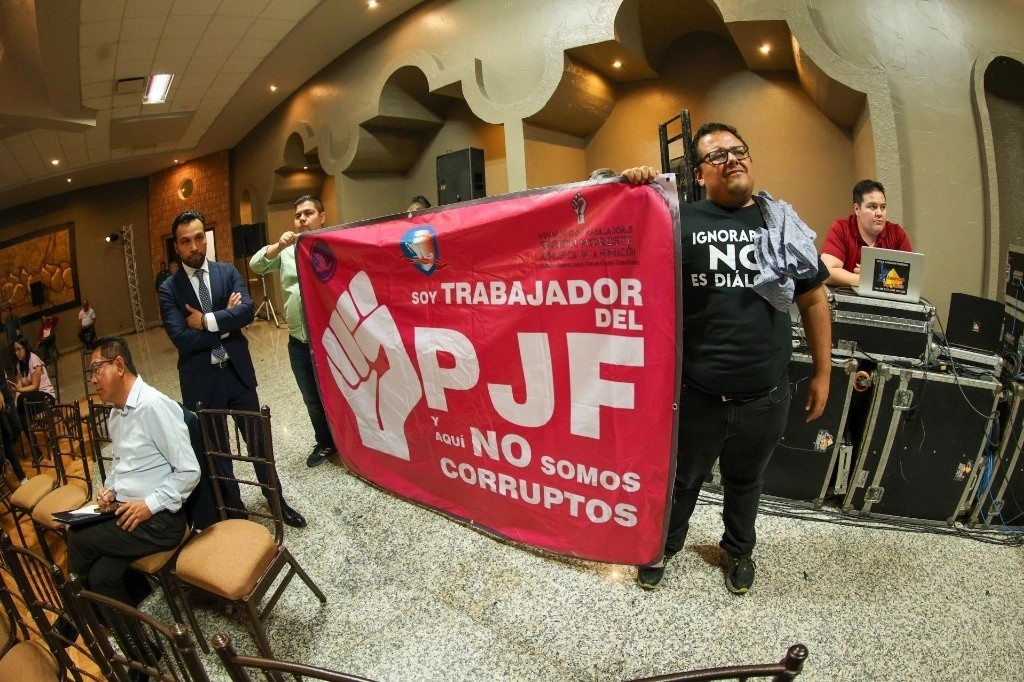

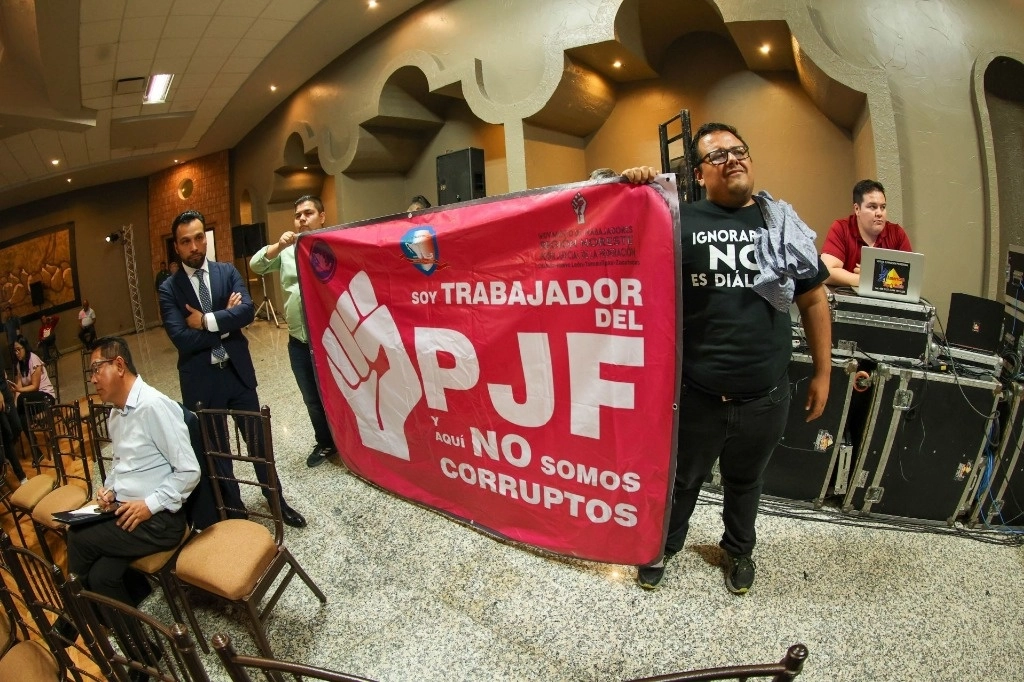
In a clear demonstration of discontent, workers of the Federal Judicial Branch in the northeast of the country demonstrated against the proposed reform of the Judicial Branch. The mobilization, led by the Workers’ Movement of the Northeast Region, brought together judicial employees from Coahuila, Nuevo León, Tamaulipas and Zacatecas, who expressed their concern about the possible negative effects of the reform on their benefits and wages.
The march took place along the Saltillo-Monterrey highway, starting from the José Narro Robles boulevard, and concluded in the Villa Ferré hall, headquarters of the Eighth Forum on the Reform of the Judicial Branch, where details and scope of the proposal were discussed.
The auxiliary judge, Miguel Ángel, one of the spokespersons of the demonstration, highlighted the exclusion of the worker base, as well as judges and magistrates, from the discussion forums on the reform. “It is worrying that we have not been given a space to participate in an issue that affects us directly,” he said.
Miguel Ángel called for the voices of representatives of the judiciary to be heard in the forums, and for their opinions to be considered in order to improve the reform proposal. He stressed the importance of preserving the independence of the Judiciary, warning that the election of judges and magistrates by popular vote could put this autonomy at risk by depending on political support.
The judge also pointed out that the current proposal does not address substantial changes in the administration of justice, which could limit its effectiveness in improving the judicial system.
The protesters hope that the forum in Saltillo will provide a space for constructive dialogue that will allow the reform to be adjusted in a way that benefits both workers and the judicial system as a whole.
Within the framework of the eighth national dialogue forum for the reform of the Judicial Branch, Miguel Mery Ayup, presiding magistrate of the Judicial Branch of the State of Coahuila (PJECZ), spoke out in favor of the judicial reform proposed by President Andrés Manuel López Obrador. Mery is the first head of a Judicial Branch to express his support for this initiative.
The event was attended by Senator Ricardo Monreal Ávila, president of the Morena coordination board at the national level, who stressed that the reform does not weaken the judiciary, but rather strengthens it, by improving access to justice for citizens. Monreal stressed that, if approved, the reform would be widely celebrated by the people.
The judicial reform, presented in February by President Andrés Manuel López Obrador, proposes that the ministers of the Supreme Court of Justice of the Nation, magistrates and judges be elected by popular vote and the creation of a disciplinary body for judicial proceedings. During her speech, Mery emphasized the importance of the reform, highlighting the need to transform the system of public defenders. She stressed that 72% of people linked to proceedings require a public defender, which underlines the urgency of having more resources and a better structure for these services.
Likewise, the presiding magistrate proposed a mediation and care scheme with a service approach to optimize the work of public defenders. “I am glad that we are dealing with the issue of the defender and the professional association,” he concluded.
The forums, which began on June 27 in Torreón, with the theme “What judicial power do we have? What judicial power do we want?”, are called to the current and future legislators, the eleven ministers of the Supreme Court of Justice of the Nation (SCJN), representatives of the Association of Magistrates and Judges of the Federal Judicial Power, as well as of the courts of justice of the 32 entities of the country, in addition to the union of administrative workers of the Judicial Power and the Attorney General of Justice of the Republic. The series of events seeks to build consensus and fine-tune the proposal for judicial reform for its eventual approval.
Source: jornada