
When the Japanese stock market had its worst fall in 37 years, shaking the markets of the rest of the world and the increase in unemployment in the United States, they would be “indicators that there is a recession in the making,” considered economic analyst Roberto Valero.
The economic slowdown in the US is already latent in Mexico, particularly in Baja California, where the latest economic data show lower growth, job losses and patterns in formality, in addition to inflation that does not yield and will be pressured by the rise of the dollar.
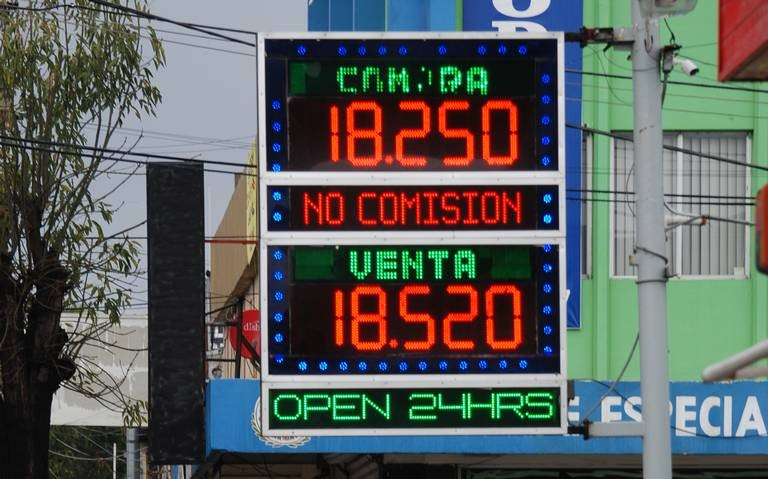
Last Monday, the American bill surpassed the barrier of 20 pesos in bank windows and reached 18.80 pesos in some exchange houses in Tijuana. Although in the subsequent days the peso managed to recover ground, before the close of Thursday, August 8, it was located at 18.90 pesos in financial markets.
The forecast, said Valero, is that the US currency could reach up to 22 pesos due to greater uncertainty over the US presidential elections next November, geopolitical conflicts in the Middle East and Ukraine, as well as legal changes in our country.
“There has been a lot of talk for months about a recession in the United States, in the end it is possible that it will happen, but we will see it more clearly until we know the revised GDP report and have more information towards the end of the third quarter,” explained the academic, to finally recommend the population to better manage resources and avoid debts in the face of volatile conditions: “If a recession comes, at least we will have a year of economic slowdown.”
LESS EMPLOYMENT
In July 2024, the unemployment rate in the United States rose to 4.3%, a figure higher than expected. While job creation was encouraged, since in the seventh month 114 thousand jobs were created, 65 thousand less than the revised figures for June.
As an example, in California the unemployment rate has remained above 5% since December 2023. From February to April it was 5.3%, and in May and June, 5.2%.
In our country, 12,344 jobs were created at the Mexican Social Security Institute (IMSS), which, although they broke the negative trend of the last two months, the number of formal jobs in the cumulative January-July 2024, of 307,402, is almost 40% lower than that reported in the same period of 2023.
In addition, the number of jobs registered in the first seven months of 2024 in the country is less than the positions that were lost in December 2023: 345,705.
In BC the outlook is even more worrying, since “it has accumulated four months with job losses.” In July, 6,969 jobs were lost. If we add up all the jobs lost in the last four months, we would be talking about 17,408, a figure that has not been seen since the 2008 crisis.
In July, 1,571 employers in Baja California stopped being registered with Social Security, “the highest figure in history,” according to Roberto Valero.
Another indicator that shows how the US economic slowdown is affecting Mexico and Baja California is the growth of the Gross Domestic Product (GDP). According to the Timely Estimate of GDP in the second quarter of 2024, the Mexican economy grew 1.1% at an annual rate and 0.2% compared to the first quarter. Recently, Banco Base and CitiBanamex cut their economic forecast for this year. The first predicts that the national economy will grow 1.3% compared to 2023, and the second, 2.1%.
In the opinion of the specialist, the “economic brake” for Mexico “may be stronger” if Donald Trump becomes President, “because he is trying to take companies to the United States, and lowering taxes will be a very strong argument to ask them to return.” In that sense, he predicted that other companies, in addition to Tesla, would not invest in our country.
In the first quarter of 2024, BC’s economic activity had a decline of -1.3% compared to the previous quarter, and at an annual rate there was a stagnation of 0.0%
In that comparison, primary activities (agriculture and animal husbandry) fell 17.7%, the second largest decline at the national level, and derived from the price of grains. Secondary activities (industry and commerce) fell -2.5%, according to the Quarterly Indicator of State Activity (ITAEE).
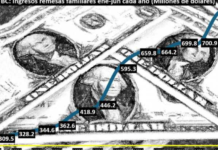
Remittances had been a spark plug in the face of the State’s economic “stagnation,” even though they lost purchasing power due to the appreciation of the peso in recent months. “The group of those employed in the United States, which numbers around 120,000, has been affected, and we see it in the local economy,” with fewer purchases and less consumption of services, such as restaurants.
In Valero’s opinion, this loss of purchasing power of remittances will hardly be reversed in the remainder of the year due to the lower generation of employment in the US, despite the fact that a stronger dollar is anticipated that will put pressure on inflation. This indicator does not yield and “continues to be a problem.”
On Thursday, August 8, the National Institute of Statistics and Geography (INEGI) reported that in July general inflation had a monthly increase of 1.05%, to reach 5.57% at an annual rate, due to the increase in the price of food (tomatoes, 33.34%; oranges, 18.57%; onions, 25.08%; avocado, 17.01%; eggs, 3.67% and pork, 4.77%).
As well as fuels (domestic LP gas, 6.70% and low-octane gasoline, 1.14%); of owning a home (0.34%) and cafeterias, inns, sandwich shops and taco shops (0.62%).
In Tijuana, inflation in July increased by 1.23%, reaching 6.46%. That is, it remained above the national average.
Despite this, the Board of Governors of the Bank of Mexico voted in favor of reducing the Interbank Interest Rate by 25 basis points, which went from 11 to 10.75%, a measure that is contrary when high rates are generally maintained as a strategy to stop inflation by making credit more expensive.
Source: zetatijuana