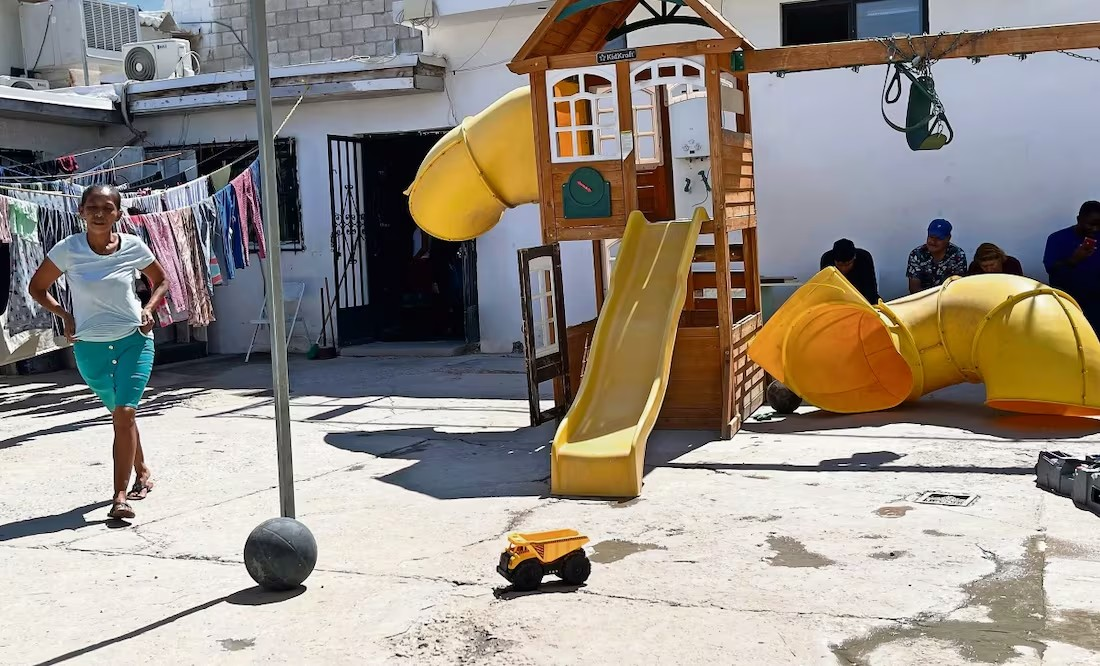


The patio of a migrant shelter in this border city has become the home of Gloria Ramírez, a woman who, along with her daughter, left their life in the municipality of Mapastepec, Chiapas, as a result of the violence and extortion of which she claims they were victims.
“I never even imagined that I would seek to go to the United States. Whoever is a parrot is green wherever they go and I wanted to stay in my country, but with the violence, that is no longer possible,” says Gloria, who preferred to be named that way for fear of being located by those who threatened her before arriving in Ciudad Juárez.
In recent weeks, families from Chiapas have arrived in this town seeking political asylum in the United States and a few others who intend to settle here, due to the violence that plagues their communities.
To date, the State Council for the Care and Protection of Migrants says it does not have an estimated number of Chiapas residents in Ciudad Juarez, however they recognize that in recent weeks a greater presence has been detected and that many arrive on direct flights to this border and then go to the shelters where they hope to get an appointment on the CBP One application and request political asylum and thus be able to start a new life now in the United States.
Gloria’s case is one of them, since a local shelter is her home while she gets the appointment and crosses to the neighboring country, because she says that staying here would be waiting for the cartel members who threatened and extorted her and her daughter in Chiapas to order them to be killed on the northern border.
The woman says that she is originally from Guatemala and lived in Chiapas for 18 years, however, it was in recent years and months when violence and extortion increased, forcing her and her daughter to leave there.
She has been living in the shelter for weeks with her two children and two grandchildren.
“I worked in Chiapas in a hotel and my daughter in a cheese factory, but we had to travel in an emergency. It was not in our plans because we were about to buy a small patio [house], we were very happy, but two years ago things got very bad in Chiapas, they started to extort money from businesses. My bosses did pay the rent and my daughter’s did too, but the time came when they raised [the fee] and decided to close the cheese factory,” says the woman.
It was then that Gloria’s daughter was left in charge of the business, which led to a second attack against her, since the extortionists were looking for her to kill her in retaliation for not paying the rent.
“They told my daughter ‘if your boss is not there, you will pay, but first we will rape you.’ My daughter struggled with the man and managed to escape the attack because we handed over the money and cell phones we were carrying.”
After reporting the incident, they suffered another attack, as they went to the business where her daughter worked and tried to kill her again, forcing them to ask for help from acquaintances to be able to leave the state.
Initially they were trying to get to Tijuana to cross into the United States from there, but since there were no flights available they had to travel to Ciudad Juárez.
Upon arriving in Juárez they took refuge in a shelter where they have been for several weeks and little by little they are learning the process to request political asylum and adapting to what is now their new life.
“We didn’t know anything about here, we didn’t know there was an application, our plans were not to travel, our plans were not to emigrate to the United States. I told my daughter, ‘anyone who is a parrot is green wherever they want’ if we want to do something in life, we will do it wherever we want. I had that concept and if I left my state, it was to protect my life,” she adds.
Now, more than 2,600 kilometers from her home, she is waiting to be able to make a decision, whether to cross illegally or wait for the CBP One appointment, since staying is not an option for her.
“This is something I wouldn’t wish on my worst enemy. Many say it’s the American dream, but for me it’s not. My dream was in Chiapas. This has come as a very strong blow,” he says.
During tours carried out by this newspaper, it was possible to verify how some of the displaced are at intersections asking for money, including children, to be able to sustain the food for the day, even with the high temperatures that continue to be recorded in Ciudad Juárez. At the Simona Barba and Plutarco Elías Calles crossing, this newspaper found a family from Chiapas who said they arrived at the border two weeks ago fleeing violence.
Not having a place to live and a job, the couple takes turns asking for money from drivers who pass by the crossing.
“Hello friend, I come from Chiapas. Help me with a coin to buy food or groceries,” says one of the signs.
Source: eluniversal