
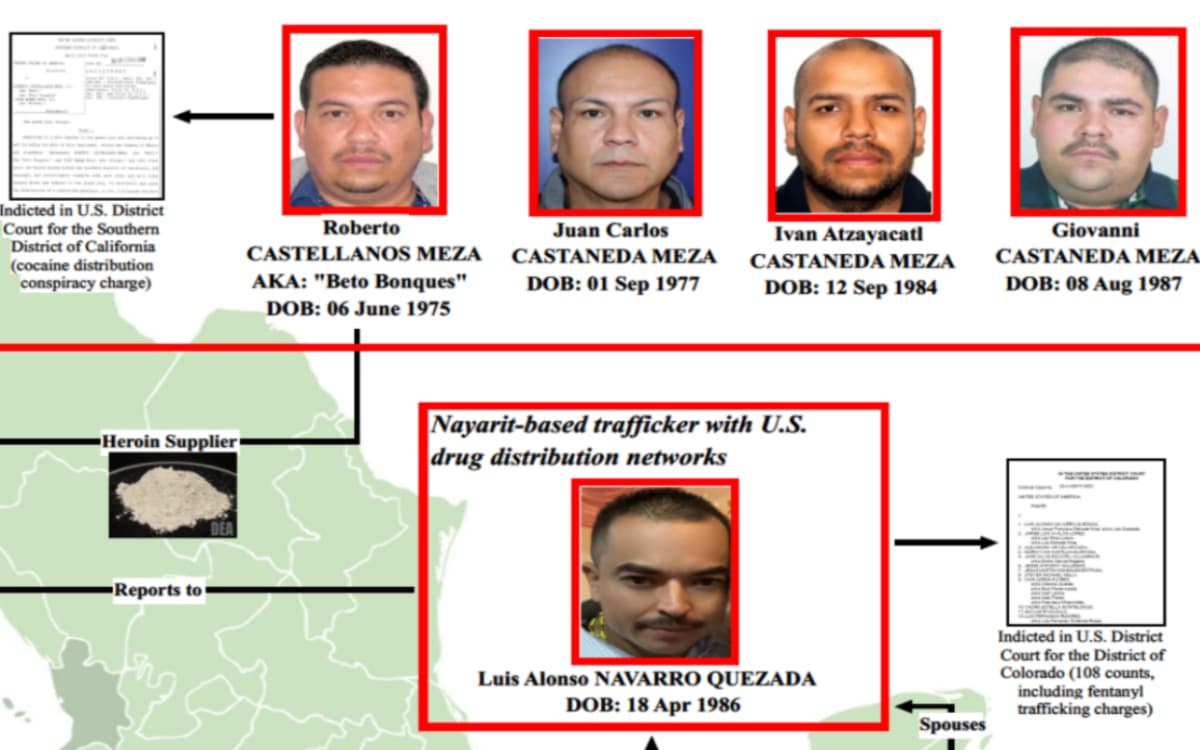
The United States Treasury Department announced sanctions and criminal charges against the “Bonques Brothers” and five other people from the state of Nayarit who are part of a criminal cell of the Jalisco New Generation Cartel (CJNG) dedicated to trafficking fentanyl, heroin and cocaine from Mexico to the United States.
For this reason, through the Office of Foreign Assets Control (OFAC), it included nine members of that criminal group in a list of people sanctioned for their criminal activities, so no company or individual in the United States should establish any type of commercial relationship with them, in addition to the fact that any property or money they have in North American territory will be “frozen” from this moment on.
The four “Bonques Brothers” are commanded by Roberto Castellanos Meza, alias “Beto Bonques,” who also heads money laundering and human trafficking operations in the mountainous area of Nayarit, making him one of the main regional operators of the CJNG.
Roberto Castellanos Meza is only below the top leader of this criminal group, Rubén Oseguera Cervantes, alias “El Mencho,” and Audias Flores Silva, alias “El Jardinero,” regional commander of the Jalisco Cartel in Nayarit and one of its most violent and bloodthirsty elements of the criminal group.
The US authorities consider the “Bonques Brothers” to be “an influential group of heroin and cocaine traffickers from Xalisco, Nayarit,” which is made up of Roberto Castellanos Meza, alias “Beto Bonques,” and his three brothers Iván Atzayacatl Castañeda Meza, Giovanni Castañeda Meza, and Juan Carlos Castañeda Meza.
According to OFAC, the “Bonques Brothers” have played “a prominent role” in drug trafficking since the opioid crisis began in the United States after the trade in OxyContin pills, which were marketed as “non-addictive pain treatments,” was banned, thus laying the groundwork for the fentanyl crisis that currently affects millions of American addicts.
The Acting Undersecretary of the Treasury for Terrorism and Financial Intelligence, Bradley T. Smith, warned that the sanction against nine Mexicans, seven men and two women, is intended to dismantle “the networks of suppliers and facilitators that allow the illicit flow of lethal drugs into the United States, endangering the lives of our citizens.”
Over the past two years, the Treasury Department has sanctioned more than 300 Mexican targets “for their involvement in drug trafficking activities at every stage of the supply chain,” from top cartel leaders to hidden laboratories, as well as transportation and sales networks for chemical precursors used to manufacture synthetic drugs such as fentanyl.
The U.S. government said the sanction against the “Bonques Brothers” criminal network, family members, and operators was carried out in coordination with the Attorney General’s Office for the District of Colorado, the DEA, and the Mexican government’s Financial Intelligence Unit.
Xalisco Cartel in Nayarit
According to investigations by the DEA and the United States Treasury Department, the “Bonques Brothers” began trafficking heroin to the United States in 1990 through the state of California, quickly becoming a prominent drug trafficking family and began to exploit the US market of people addicted to opiates who could no longer be filled with legal prescriptions.
Roberto Castellanos Meza, alias “Beto Bonques,” is considered the owner of poppy fields in the mountains of Nayarit, a flower from which opium gum is extracted and from which heroin is later produced.
Together with his three brothers, he dominates the production and trafficking of heroin trafficked in the municipality of Xalisco, Nayarit, and they supply supplies to other families in the region who are dedicated to the same activity, which is why they are also identified as the main responsible for the shipment and distribution of heroin in the states of Colorado, California and Nevada in the United States.
Following their involvement in heroin trafficking, the “Bonques Brothers” also began to venture into cocaine and fentanyl trafficking to the United States, managing to mediate and transport cocaine from Colombia, with the support of boats and planes.
As for Iván Atzayacatl Castañeda Meza and Juan Carlos Castañeda Meza, both were arrested in 2007 after participating in an armed confrontation with Mexican authorities who were dismantling a clandestine drug laboratory in Xalisco, Nayarit.
The partners of the “Bonques Brothers”
Five people associated with the Castañeda Meza brothers were sanctioned by the OFAC in the action against their criminal network: José Adrián Castillo Lopez, one of the main buyers and distributors of heroin for “Beto Bonques” and the CJNG’s plaza boss in the municipalities of Tepic, Xalisco and Pantanal in Nayarit.
Luis Alonso Navarro Quezada, Castillo López’s operator, and Navarro’s wife, Erandiny Jazmín Arias Ponce, who is accused of money laundering, since she collects the drug profits through money transfers, are also named.
For fentanyl trafficking, the “Bonques Brothers” were associated in Sinaloa with Araceli Castillo Peinado and her husband José Sinué Castro Álvarez, who transport and distribute several drug shipments, including fentanyl, to the United States.
Source: aristeguinoticias