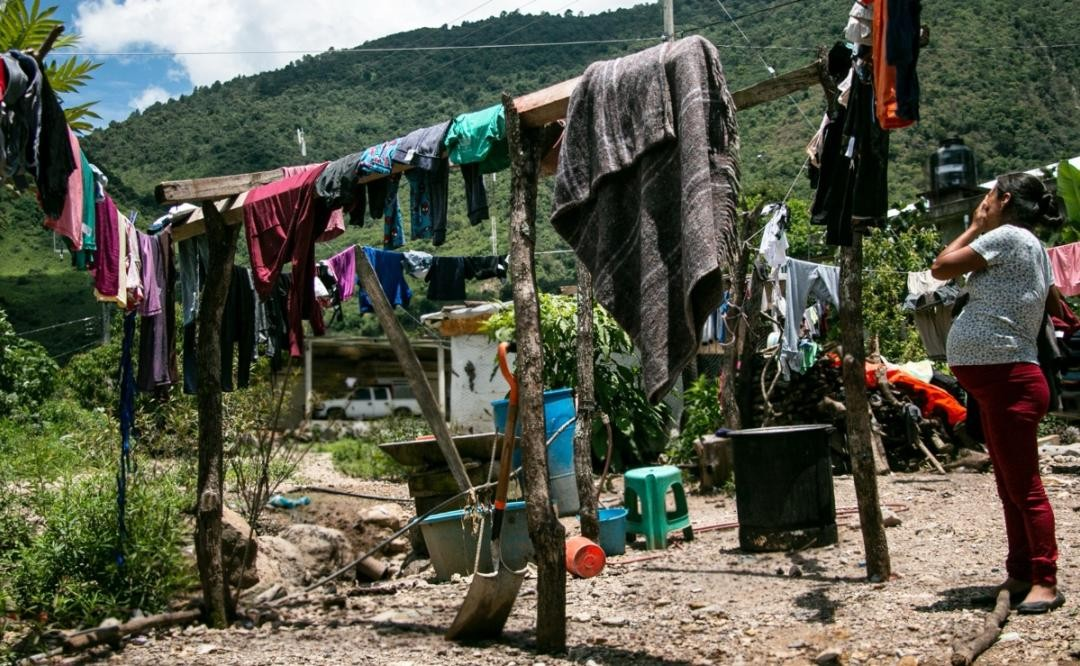


More than three decades have passed and the bullets do not stop in the lower Triqui nation, which have left more than 40 people killed from 2020 to date alone. Sons and daughters have been orphaned, widowed women, homes without a mother or father, hundreds have been displaced from communities and many others have been victims of violence, without justice reaching them.
The root of the conflict
The Triqui region, located in the Mixteca of Oaxaca, comprises about 45 communities located in three municipalities: Santiago Juxtlahuaca, Putla de Guerrero and Constancia del Rosario. In these municipalities, there are three organizations: MULT, UBISORT and MULTI who are fighting for political and territorial control.
According to the Mexican Commission for the Defense and Promotion of Human Rights (CMDPDH), violence in Triqui communities has historical origins and is related to the dispute for political and territorial control of the area.
In 2007, based on the principle of self-determination of indigenous peoples, San Juan Copala was declared an autonomous municipality, independent of the state government and the PRI. “However, the autonomy project failed to put an end to the conflict, which ended up intensifying as different groups tried to defend their interests and take control of the territory, as the autonomy project was diluted,” says the CMDPDH.
“Let the people rise up and demand justice.” Triqui children’s trainer murdered in Oaxaca bid farewell
Since at least November 2009, the Triqui people have been subjected to various armed attacks, restrictions on freedom of movement and the interruption of basic health care and education services. In addition, there are some 380 thousand people in a situation of forced internal displacement. After almost 3 decades, the authorities have not been able to find a solution to this conflict.
Recent violence
“There are five people that the State Attorney General’s Office has arrested this year, linked to homicides in the region,” said Jesús Romero López, head of the Oaxaca Government Secretariat at a press conference on Friday, in response to the wave of violence of the last two weeks, in which three members of the Triqui Unification and Struggle Movement (MULT) have been murdered.
Although on various occasions, Oaxaca officials from different six-year terms of the PRD, PRI and now Morena governments, as well as the federal government, in addition to the justice system such as the Oaxaca State Attorney General’s Office (FGEO) and the Attorney General’s Office (FGR) have declared that they will proceed against the perpetrators of the crimes committed in the Triqui Baja region, little has been reported.
“Of the 34 murders, there are no detainees so far that have been brought to the attention of our organization or the relatives,” says Octavio de Jesús Díaz, current leader of the MULT political table.
In 2020 alone, the MULT, one of the three internal organizations in this subregion located in the Mixteca region of Oaxaca, reports 34 murders: 13 women and 21 men. In addition to 17 wounded: eight men and nine women. Added to this are 49 attacks on communities affiliated with the organization.
Meanwhile, the Independent Triqui Movement for Unification and Struggle (MULTI) points out that, on this same date, from 2020 to November 15 of this year, a total of nine people have been murdered: three women and six men. In addition to six wounded: five men and one woman. However, there are more than 20 murders in previous years.
Added to this are the displacements of Triqui villages such as San Miguel Copala, San Juan Copala and, finally, Tierra Blanca, where at the end of 2020 and at the beginning of 2021, 144 families fled from the bullets to take shelter in an indigenous shelter in Yosoyuxi Copala.
By the end of 2023, there were more than 380 thousand people in a situation of forced displacement, according to estimates by the Mexican Commission for the Defense and Promotion of Human Rights (CMDPDH).
Violence has touched each of the communities in this region of Oaxaca, so much so that before 2010, the Union for Social Welfare of the Triqui Region (UBISORT) also reported at least five indigenous people and members of their organization murdered in San Miguel Copala, belonging to Putla de Guerrero.
In these cases, the Attorney General’s Office has not specified or reported on the status of the investigation processes of the victims and the exact number of deaths due to violence in these towns in Oaxaca is unknown.
They demand justice and peace in Triqui communities
“We ask that the meeting be with the three organizations and that there be no preference on the part of the state or federal government, in order to work on the pacification of our people,” demand the members of MULTI, who have demanded the safe return of 144 families displaced from Tierra Blanca Copala since the end of 2020.
And this Friday, Jesús Romero announced that it will be next Tuesday, November 19, when they will have a working table with the Ministry of the Interior to give more details about the latest murders of the members of the MULT. He has also summoned the organizations for this day.
“The invitation folder will be held by the President of the Republic, surely by the Prosecutor’s Office,” he indicated. And, he added, “we will be with the Ministry of the Interior, to make very clear the origin of these three homicides,” thus ruling out the statements of Emelia Ortiz, one of the members of the MULT who points out that there is a state crime in allowing the murders.
In this context, the Sego has denied the accusations: “This is not a state crime, for it to be a state crime there must be conclusive evidence, the government of engineer Salomón Jara or the institutions cannot be held responsible for this situation, so lightly. It is an irresponsible statement, it seems more political, I understand the pain of our colleague from the Mult organization, to whom we fraternally extend our condolences, but there cannot be light accusations.
Two Triqui women shot dead in the city of Oaxaca; there are 93 victims of femicide violence
Source: oaxaca.eluniversal