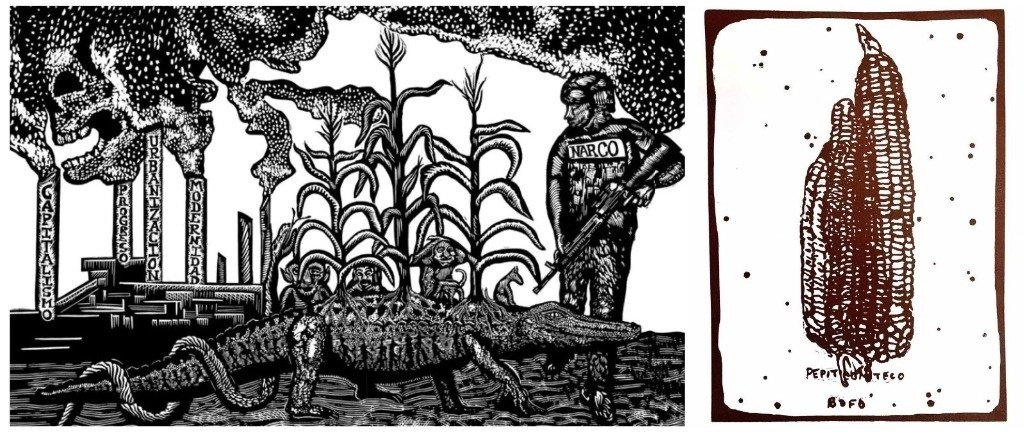

A balance of voices, points of view, styles and perspectives characterizes the 32 artists who participate in the folder Maizal Gráfico, produced in the engraving workshop of the Complejo Cultural Los Pinos (CCLP).
In the works they express their opinion regarding corn, especially about the risks and dangers that transgenic seeds represent, or about the link of this crop with the cultural history of Mexico.
The pieces will be presented starting today in the Art Hall of the Mercado Gastronómico 20 de Noviembre, in the Historic Center of the city of Oaxaca.
There are 32 engravings by the same number of creators with a proven track record, as well as emerging ones.
The original project consisted of preparing the folders to distribute them to the 32 states of the country, through the federal Ministry of Culture, with the purpose of exhibiting them in museums and cultural centers.
The exhibition in Oaxaca is part of an initiative promoted by the Oaxacan artist César Villegas.
The CCLP engraving workshop has several lines of work, says its coordinator, Fernando Gálvez. One consists of inviting artists to make engravings and lithographs “with specific themes of interest to contemporary Mexico.
“When we started producing Maizal Gráfico, the dispute regarding the prohibition issued by the Mexican government to plant genetically modified corn was hot, in the context of the Free Trade Agreement, since the seed is central to our culture and food.”
Daniel Lezama, Demián Flores, Alberto Castro Leñero, Érik Pérez, Joel Rendón, Coral Revueltas and Patricia Soriano were invited to do this work, although there are also younger and emerging artists, such as Sergio Sánchez Santamaría, Lucio Santiago, Isabel Mendoza and Ana Rojas.
For Gálvez, the portfolio offers “a very great aesthetic richness. There are pieces that address, for example, legends, oral traditions, myths that come to us from pre-Columbian times to the current living indigenous peoples. Then there are very idyllic demonstrations that deal with the subject in a festive way.
Others, however, approach it in a critical way and with a perhaps harsher expression, since the agroindustry and toxic elements are making society sick, not only in Mexico, but on a global scale.
The folder Maizal Gráfico has already been exhibited in Morelos and Veracruz. Jorge Rubio and Ramón Durán are the printers of the workshop where techniques such as lithography, linoleum, xylography, drypoint and etching are worked on.
A site with meaning
For Fernando Gálvez it is significant that the folder is presented in Oaxaca because this was the first state to prohibit transgenic crops. In addition, it is one of the centers of origin of corn. The prehistoric caves of Yagul and Mitla, in the Central Valleys of Oaxaca, have been designated a World Heritage Site by the United Nations Educational, Scientific and Cultural Organization since 2010, due to the presence of seeds of different species, as well as fragments of corn cobs, one of the oldest testimonies of the domestication of this plant.
Regarding César Villegas’ space in the Oaxaca Gastronomic Market, Gálvez reports that he has so far held nine exhibitions that are accompanied by a newspaper that provides further information. There, all the exhibits revolve around themes of food, gastronomy and agriculture. Currently, Villegas exhibits a hundred works with the title Axis mundi. Profane shrines, in the José María Velasco gallery.
The Maizal Gráfico exhibition will remain on display until February 18, 2025 in the Art Hall of the 20 de Noviembre Gastronomic Market in the Historic Center of the city of Oaxaca.
Source: jornada