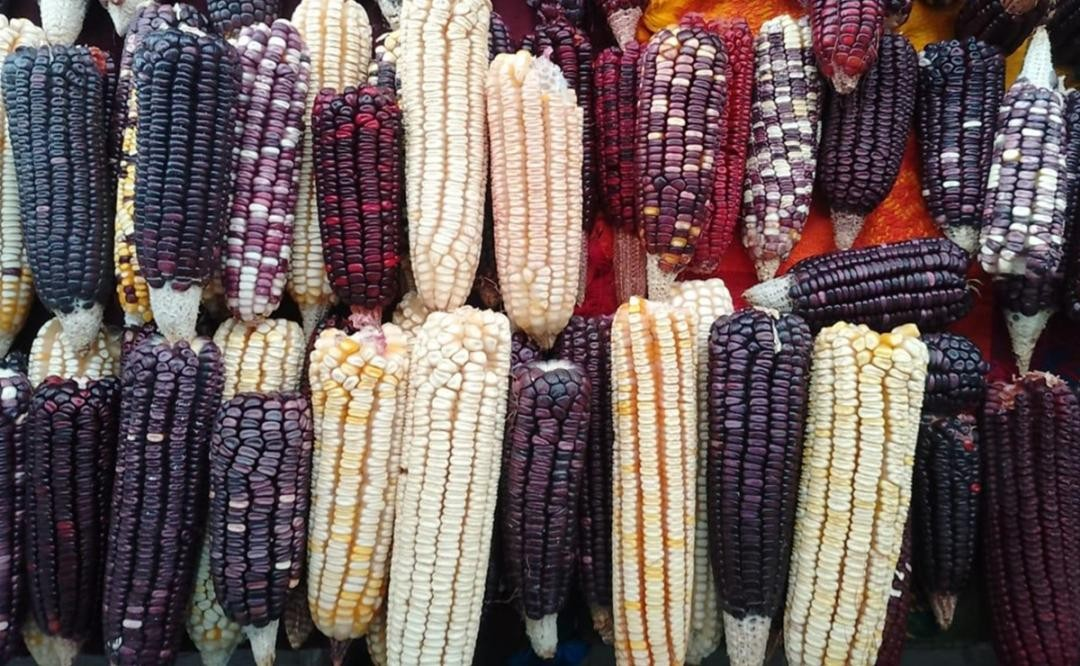

In Oaxaca there are 35 of the 64 native corn seed races, but at least 50 percent of them are at risk of disappearing from the species that exist in the state, warned José Manuel Sernas Carmona, a technical specialist of the Community Native Seed Banks of the Secretariat of Agro-Food Promotion and Rural Development (Sefader).
The crops that were adapted to a region, he explained, are losing the adequate conditions for their sowing due to the lack of rain, the infestation of pests or diseases, the cultivation of transgenic corn or transgenes, and climate change.
Additionally, he said that currently the Oaxacan countryside suffers from a “great old age” because most of the producers are elderly and there is not much generational replacement when a producer dies.
“After a short time, their seed is also lost because there is no generational replacement that continues to cultivate the same seeds. We must pay attention to them, at least those 35, if not 50% are in danger.”
The loss of native corn seeds occurs mainly in the Central Valleys and Mixteca regions due to prolonged droughts, and in the Coast region because the seasons of storms, tropical cyclones and hurricanes hit crops hard.
But they are not the only species that are in danger of extinction, there are also native or creole seeds of beans, squash, chili peppers and fruit plants, among others, that are from Oaxaca and that are also at risk of being lost.
Sernas Carmona mentioned that seed banks emerged as an alternative for communities throughout the state to conserve, reproduce and protect native seeds, mainly in crops such as corn, beans, chili peppers, plants and fruit trees, as well as endemic medicinal plants, or those that are dedicated to the preparation of some typical dish of the regions.
Currently, there are 50 seed banks in Oaxaca that have measuring equipment, containers, metal shelves and a weather station to monitor the weather.
Regarding the study by the National Institute of Ecology on the presence of transgenic corn or the contamination of Oaxaca corn with genetically modified molecules, the Sefader specialist explained that the first news item in which it was reported that there was already contamination of native corn by transgenics appeared in 1995.

“Corn has a cross-pollination plant in all types of corn regardless of color, that is why we have a lot of variation, but it is also a disadvantage because by having, for example, a native corn together with a transgenic corn, through pollen the fertilization will contaminate the other genes and a transgenic will come out.
“The characteristic of transgenic corn is that it has a gene that is not a plant, but can be from some bacteria or another organism that will give it resistance, whether it is a pest or a product. So the native corn will be contaminated.”
José Manuel Sernas pointed out that among the main consequences of the loss of native corn seeds or other crops that exist in the state, is that 90 percent of the population of Oaxaca sows for their own consumption and does so by sowing native or criollo corn; therefore, by losing a seed, they will lose the possibility of obtaining a harvest and face a crisis of access to food.
This, he said, is a matter of food security and, consequently, also a matter of national security because there would be no food available. And the second serious consequence is the loss of diversity.
“I lose a great diversity of different materials, we have a diversity of native or criollo seeds of different crops, but we are only using seven or eight races. We have not exploited the rest to their full potential, so we would lose a great resource to be able to alleviate the issue of the deficiency in corn production.”
Finally, he warned that the southern states are importing a lot of corn from the northern states of the country or from outside the country, which does not have the same quality as the native corn of Oaxaca.

Source: oaxaca.eluniversal