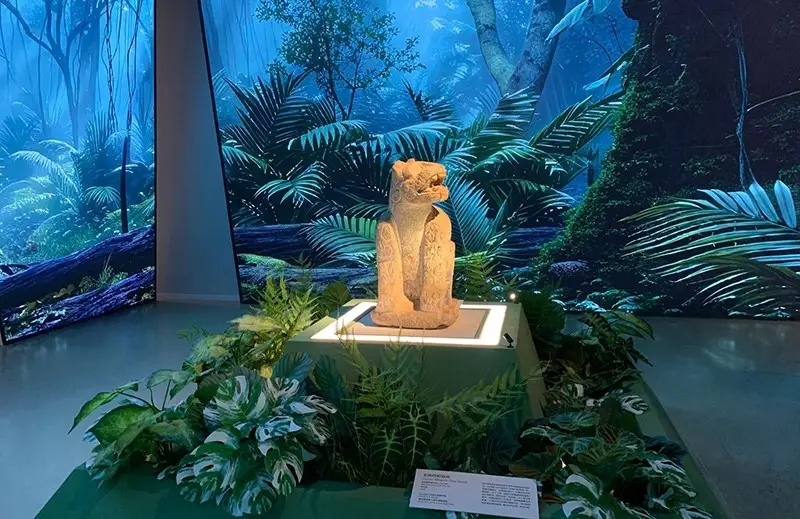

From the heart of Tabasco to the world. Thus, with strength and dignity, 95 archaeological treasures emerged from Chocó lands to tell the story of the great Mayan culture in one of the most impressive international venues: the Henan Museum in the city of Zhengzhou, China.
From this Thursday until October of this year, Tabasco is “present” in Asia as one of the protagonists of the international exhibition Mayas: Ceiba and Cosmos, an exhibition that connects the art, spirituality, and identity of a civilization that lives on through its symbols, its objects, and its cultural power.
And note: of the more than 200 pieces on display, 95 were on loan from the Carlos Pellicer Cámara Regional Museum of Anthropology in Villahermosa. Tabasco pride. Mexican pride.
From Villahermosa to Zhengzhou: Tabasco culture breaks boundaries
In an age where digital technology travels faster than emotions, this exhibition is a reminder that history also has legs. And heart. Because there is nothing more powerful than a piece of the past walking toward the future with a Tabasco passport.
The Tabasco State Secretariat of Culture announced it with emotion: our archaeological collection is now Mexico’s ambassador in Asia. The Carlos Pellicer Museum, that temple of knowledge that so many Tabasco residents have known since childhood, now shines in the display cases of one of the most important venues on the Asian continent. It’s as if Villahermosa has slipped onto the world’s cultural map, with the ceiba tree as its banner and the Mayans as its flag.
And what’s in Tabasco’s cultural suitcase?
Nothing more and nothing less than figurines from the island of Jaina, incense burners from Palenque, polychrome vessels, braziers, decorated bowls and plates, Mayan faces with elaborate headdresses and cranial deformations, a throne with glyphs from El Tortuguero, Atlantes from Chichén Itzá, and reproductions of the emblematic Calakmul mask. All selected with the precision of a cultural watchmaker.
Curated by three leading experts—anthropologist Alejandro González Villarruel, anthropologist Natalia Gabayet González, and archaeologist José Luis Rojas Martínez—the exhibition revolves around a symbol as powerful as it is beautiful: the ceiba tree, a sacred tree for the Mayans, whose roots touched the underworld, its trunk embraced the earthly world, and its canopy reached the heavens.
In short, the ceiba tree was their bridge between dimensions. And now, it is our bridge between cultures.
An exhibition with a Tabasco soul and a universal perspective
The exhibition unfolds along four thematic axes:
The sky: cosmic entities and movements.
The earth: the human and everyday space of the Maya.
Xibalbá: the underworld and its watery mirror.
The calendar: a cyclical vision of time that still leaves us breathless.
This narrative—as poetic as it is rigorous—is supported by high-caliber institutions: the National Institute of Anthropology and History (INAH), the Beijing KYUN Exhibition, and museums in Henan, Hebei, and Shanxi, which will host the exhibition on a tour that will extend until May 2026.
Also participating are the National Anthropology Museum, the Yucatán Canton Palace, the Amparo Museum of Puebla, and, of course, our Carlos Pellicer Cámara Regional Museum, the cultural jewel of Tabasco.
More than artifacts, they are the voices of our ancestors.
These types of events remind us of something essential: we are not isolated. Tabasco is not just cacao, oil, or the jungle. Tabasco is also art, history, and wisdom. And now, these values are proudly displayed on the other side of the world, provoking glances, reflections, and admiration for a culture that never stopped beating.
In a time when the names of influencers and artists come and go like TikTok fads, how refreshing it is to know that the true protagonists of the moment are the Mayans, the objects that once rested in the Chontal soil, and the artisan hands that shaped them centuries ago.
Tabasco is no longer hidden on the map
If we’ve sometimes felt that our state is invisible on the national scene, today is the time to say the opposite: Tabasco no longer remains silent. Thanks to this exhibition, we have conquered China without armies or treaties: we did it with culture. With clay. With symbols. With roots.
And best of all: we did it with local talent, with a museum that has been a breeding ground for generations of students, archaeologists, artists, poets, and dreamers.
So if any Tabasco native is traveling through Asia, let them know that their homeland is present. And if you’re in Villahermosa, feel proud knowing that a part of you now also flourishes in China… like an endless ceiba tree that never forgets its roots.

Source: ahoratabasco