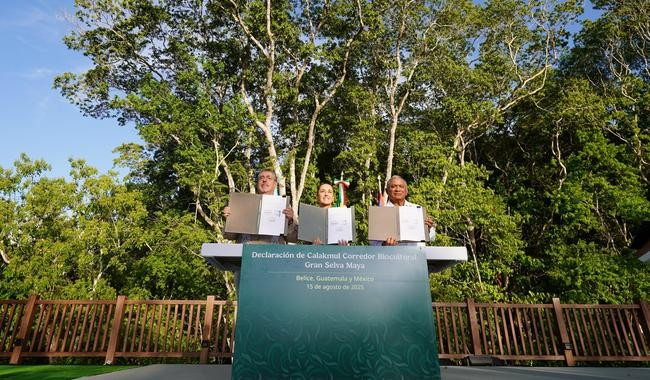

In a historic meeting, Mexican President Claudia Sheinbaum Pardo signed a trilateral agreement with her counterparts from Guatemala, Bernardo Arévalo de León, and Belize, John Antonio Briceño, to preserve 5.7 million hectares of the heart of Mesoamerica through the creation of a new Biocultural Corridor of the Great Maya Forest (CBGSM). This agreement aims to strengthen environmental cooperation on conservation and ecological integrity to benefit approximately 7,000 species: 200 at risk, 50 priority species, and 250 endemic to Mexico.
“We should be proud to be able to tell the world: we have joined forces to preserve and restore the legacy of this extraordinary biological and cultural heritage. Today’s agreement is historic and beautiful. Thank you, President Arévalo, and thank you, Prime Minister Briseño. Long live Belize! Long live Guatemala! And long live Mexico!” emphasized President Claudia Sheinbaum Pardo.
Furthermore, the Chief Executive announced that the Mexican government has decided to move on to the second phase of the Sembrando Vida program in regions of Guatemala and Belize as a concrete form of cooperation that promotes rural development, protects ecosystems, and improves the living conditions of the area’s inhabitants: regenerating soils, recovering forest cover where it has been degraded, promoting food self-sufficiency, and, above all, improving community well-being.
Guatemalan President Bernardo Arévalo asserted that the agreement protects invaluable heritage and promotes a sustainable development model that generates well-being for the communities of the three countries.
“The three countries possess this immense jungle, an immense heritage, and consequently we have an immense responsibility, in which today Guatemala, Mexico, and Belize, our three governments, are taking a step forward. Because by protecting the Great Mayan Forest, we are protecting life and diversity, and honoring history to protect the future,” he added.
Belizean Prime Minister John Antonio Briceño emphasized that this agreement is a bridge to the future and a permanent seed of cooperation between the three nations. He also invited the world to join the vision of universal environmental protection and cultural respect.
“We are not only protecting an ecosystem, but also honoring the legacy of the civilization that once flourished in these territories. Mexico, Guatemala, and Belize demonstrate once again that our political borders do not divide, but rather unite efforts to preserve one of the last lungs of the planet and the living heritage of the Mayan people,” he emphasized.
The large trinational reserve will guarantee the ecological continuity of the characteristic ecosystems of the Yucatán Peninsula, such as the lowland, mid- and highland tropical rainforests, the peten forests, and the mangroves. This connectivity will be key to the protection of emblematic species such as the jaguar, the tapir, the spider monkey, and the quetzal. As the second largest tropical rainforest in the Americas—and the largest in all of Mesoamerica—its preservation is strategic for addressing the climate crisis, regulating the water cycle, and conserving regional biodiversity.
The “Great Maya Forest Biocultural Corridor” is made up of 11 Protected Areas in Belize, 27 in Guatemala, and 12 in Mexico. These include: the Calakmul Biosphere Reserve and the Balam Kú Flora and Fauna Protection Area in Mexico; the Mirador-Río Azul National Park and Dos Lagunas Biotope in Guatemala; and the Río Bravo Conservation and Management Area and Aguas Turbias Natural Protected Area in Belize.
The joint declaration between Guatemala, Belize, and Mexico recognizes the living cultures of the area, the indigenous Mayan and Afro-descendant communities, as guardians of nature, without which ecosystems could not be preserved and threats such as illegal logging, environmental pollution, and fires could not be curbed. Therefore, it promotes social participation through the involvement of indigenous and Afro-descendant communities, as well as the academic and private sectors.
The cooperative actions include: sharing information, technology, and training in integrated fire management, illegal logging, and deforestation; and managing the use of timber and non-timber resources from the forests in an inclusive manner for the benefit of the communities living there.
The authorities designated for the coordination and implementation of this Declaration are: the Ministry of Environment and Natural Resources, for the Government of the United Mexican States, through the National Commission of Natural Protected Areas; the National Council of Protected Areas, for the Government of the Republic of Guatemala; and by the Government of Belize, to the Ministry of Sustainable Development.
Likewise, with the purpose of recognizing and thanking those who contribute to the sustainable use and protection of its species and ecosystems, starting in 2026, August 15th will be commemorated as “Great Mayan Forest Day” and recognition will be established for “Merit for the Conservation of the Great Mayan Forest.”
The Government of Mexico reaffirms its commitment to establishing international coordination and cooperation mechanisms that allow for the conservation of Protected Natural Areas for the benefit of the rural community and the country as a whole.

Source: gob