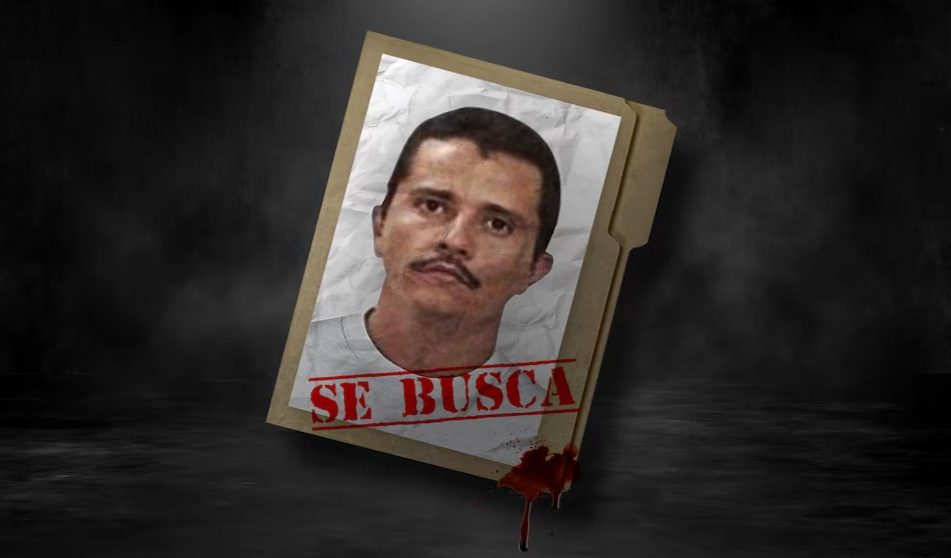

Nemesio Oseguera Cervantes, alias “El Mencho,” leader of the Jalisco New Generation Cartel (CJNG), has been one of the most wanted fugitives by Mexican and U.S. law enforcement agencies for years. The U.S. State Department is offering a $15 million reward for information leading to his arrest or prosecution.
Investigated for various crimes, including drug trafficking, ties to organized crime, and illegal firearms possession, Oseguera Cervantes tops the list of priority targets, but despite multiple operations against him, his whereabouts remain unknown.
During YouTuber GAFE 423’s most recent podcast, “Zona de Guerra,” a former member of the Mexican Army Special Forces, identified simply as “Gafe,” recounted a key chapter in the fight against the CJNG.
According to his testimony in the three-hour-plus podcast, a military operation aimed at capturing the so-called “Lord of the Roosters” ended in a flight after a series of planning failures and possible leaks. The account reveals previously unpublished details of that early morning in the mountains of Nayarit, where, under direct orders from the high command, soldiers were on the verge of apprehending Mexico’s most wanted criminal leader.
An improvised operation under pressure
According to Gafe, the operation to capture El Mencho “was not planned” and everything was executed “hastily.” The interviewee did not specify the year in which the operation took place, but noted that the direct order to participate came from the then head of the Ministry of National Defense, Salvador Cienfuegos Zepeda (2012-2018).
The former military officer explained that the troops were assigned to advance by air and land toward a destination that suddenly changed from Jalisco to Nayarit, without a clear deployment strategy or a defined chain of command for the terrain. “We didn’t know who was going by land and who was going by air, only ‘those who were needed,’” he described.
The movement took place during the early morning hours; the units advanced in the dark, crossing rural roads and mountainous areas to avoid detection. According to Gafe, upon reaching the designated location, they found signs of recent occupation: food, belongings, tactical gear, designer boots and vests, an antenna, and even a luxury mattress. They didn’t find anyone, only signs of a hasty evacuation.
“We found screens, tactical gear, 5.11 boots, vests… and there was no one there. Only bags of urine, like dialysis, ammunition, and a nursing tube. Everything was luxurious,” the former Gafe recounted in an interview.

It should be noted that, according to official reports and newspaper reports, Nemesio Oseguera Cervantes suffers from chronic kidney failure. For years, investigations have indicated that El Mencho requires specialized medical care, and he relies on private facilities for treatment in rural areas of Jalisco, even going so far as to build a hospital for treatment in the community of El Alcíhuatl.
At the instruction of the operation’s commander, the group was ordered to search the surrounding area because “everything was very fresh” and it was likely that the targets were still nearby. Divided into several platoons, they advanced on foot, penetrating the undergrowth, while finding signs of recent advances: high-caliber weapons, vests, and cartridges, often visibly discarded, which they interpreted as a deliberate attempt to distract them.
“We saw weapons lying around, an American Browning, another modern one… all scattered, .50 caliber, with CJNG markings,” Gafe recounted, adding that the discovery of these objects reinforced the impression that the criminal group was moving away, leaving false trails and distracting those pursuing them.
In the middle of the search, they encountered a man feeding his chickens. He said, “Again? What did you forget? Oh, you’re not wearing sneakers, but they are, because they’re wearing boots, and I saw them pass,” he said, at which point the soldiers noticed that the criminals were already on the other side of the road, which was the only way out of the community.
Suspicions of infiltration and punishments in the mountains
The former military officer noted that, from the beginning, there was disorganization in the handling of information. All personnel were required to hand over cell phones and electronic devices by order of their commanders, who feared leaks. Gafe maintains that, despite these measures, “the leakers were other people, the commanders themselves.”
After failing to find the criminals, the higher-ups withdrew and left the group of Gafes and conventional troops in the mountains, punished under precarious conditions for two months, waiting for orders that never arrived. During that time, the contingent located abandoned weapons, ammunition, and movement records, as well as symbols and remains of satanic rituals, including pentagrams marked on trees.
Among the most unusual discoveries were several buried drums in the shape of a pentagram. What looked like dirt turned out to be “black gum,” presumably opium gum, camouflaged among the vegetation.
According to his account, despite the findings, the command ordered everything to be returned to its original place and reburied, without analysis or official report: “The general arrived and, instead of rewarding us, ordered us to rebury it just as it was.” Shortly after, new rounds of investigation and accusations followed within the barracks.
Punitive Investigation and Life After Discharge
After the failed operation in Nayarit, the officers were subjected to investigations for alleged information leaks. Military judicial police interrogated them under pressure and offered benefits in exchange for the names of alleged perpetrators, even with physical threats. “They offered you a swap for your status, even a car,” he described.
The consequence was the immediate discharge of several soldiers, including Gafe, who not only lost his active service in the Armed Forces, but also all recognition, seniority, and official records of courses or service completed.
After the leak, several military personnel
The former Gafe said that when he tried to work for private security companies and police forces, he discovered he was listed as “registered” on Plataforma México, a registry of people with criminal records or institutional problems.
He also highlighted the administrative difficulties involved in any legal claim. “When I went to get my papers… nothing appeared. ‘And who are you? I don’t know you,'” Gafe stated about his experience trying to recover documents from his time in the Mexican Army.
Gafe’s testimony details that, after discharge, many former soldiers face an intentional institutional void: their records, courses, and ranks disappear from the archives, preventing them from proving their careers. This “administrative disappearance” affects both the recognition of seniority and access to any type of benefits or legal defense.
During the interview, Gafe insists that meritocracy does not exist in the promotion system. He pointed out that promotions often depend on influence, payments, or favoritism, and that for years those without support or resources were sidelined, even without access to official records to support subsequent claims.
Gafe explained that life outside the military can be even more hostile than military rigor. Despite the training and discipline they receive, former military personnel face discrimination and stigmatization in the civilian world, where they are often viewed as corrupt or violent.
“The environment is cruel; far from helping you, they turn their backs on you. I didn’t figure anywhere. I wanted to sue… you’ll never win against the army, much less the secretary.”

Source: infobae