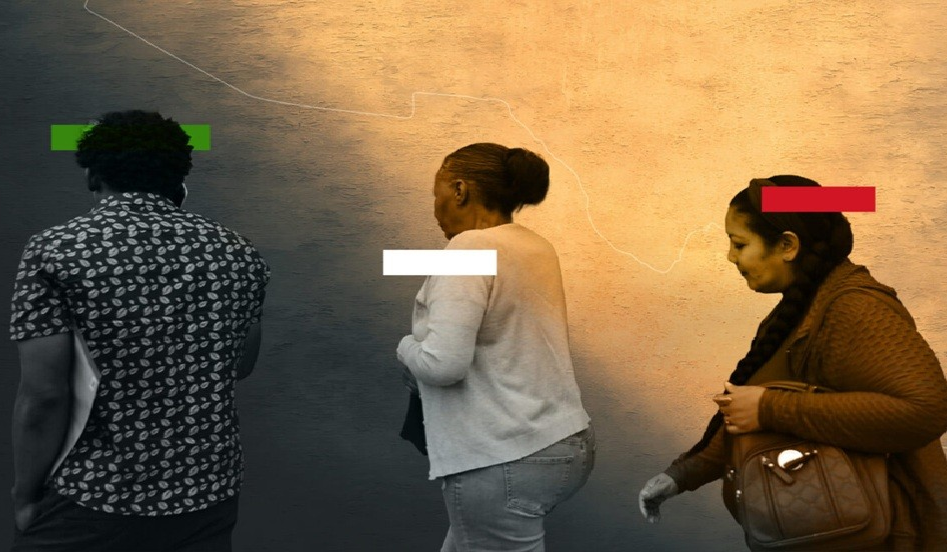

Mexico is the final destination for thousands of migrants who have no other option now that the United States has sealed its borders. However, Mexican bureaucracy is becoming a bottleneck, suspending the issuance of humanitarian cards and prolonging the asylum application process.
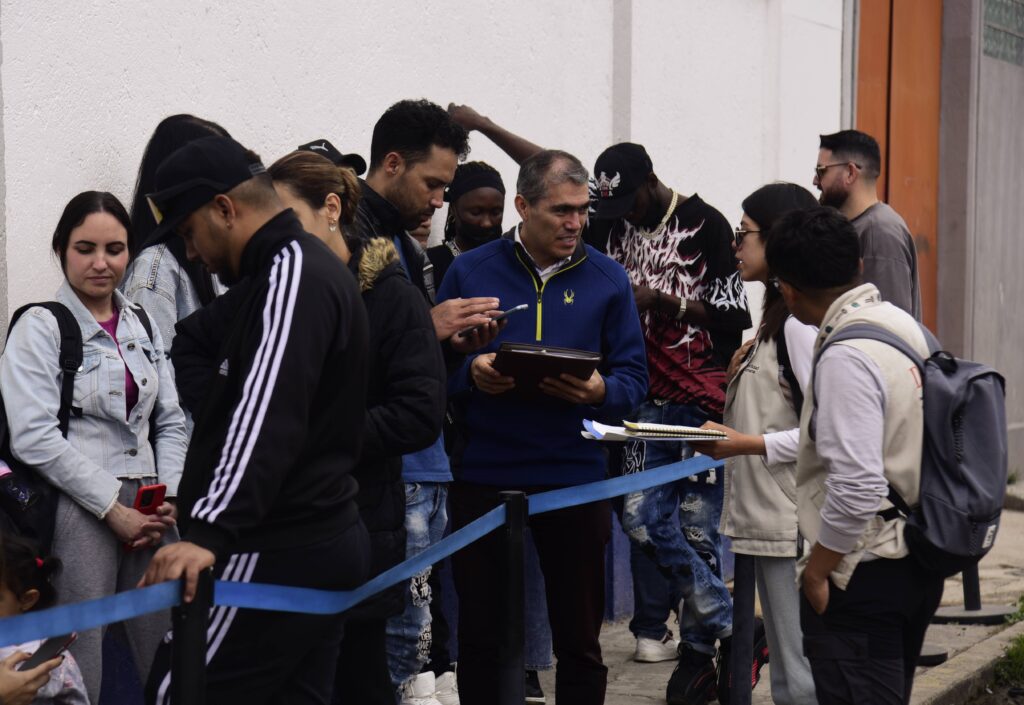
Upon arriving in the morning at the office of the Mexican Commission for Refugee Assistance (COMAR) on the outskirts of Mexico City, it is highly likely to encounter a line of people who arrived the night before, waiting to be assured of their arrival.
Everyone is pressed against the wall. Those who are Haitian gather in one place because “someone” told them in line that they would be served by a translator, so they form a separate line. In another line, mothers with children, families with fathers, mothers, and children gather.
During the hours of waiting, some since the early morning, everyone shares a part of their journey. Rafael, a 50-year-old Venezuelan, says that when he crossed the Suchiate River, he was met on the Chiapas side by hooded men with guns who forced him and those on the raft to follow them.
They locked them up, asked for the phone numbers of their relatives in the United States, extorted anyone they could, took their money, and then put them on public transportation to reach Tapachula, just half an hour from the river, on the border with Guatemala.
A tall, dark-skinned Cuban citizen who calls himself Octavio says he did manage to cross the border into the United States once, twice, and even three times in 2024, before Donald Trump’s arrival, but was deported to Mexico each time.
The last time, he was warned that the next time he would go to jail for attempting to enter illegally. So, he gave up on the “American dream” and sought refuge in Mexico, where he has been trying to regularize his status, so far without success. His traveling companion wasn’t so lucky: he remains imprisoned in an immigration detention center in the United States.
There are also people who aren’t clear why they’re there. They only came to COMAR because they were told it was a way to regularize their stay in Mexico through refuge, although they must first convince authorities that they fled their country because their lives were at risk or they were victims of political persecution, even if that’s not true.
In July 2025, at the entrance to COMAR, there are two lines: one for asylum seekers who scheduled their appointment via cell phone and another for people who arrive without knowing they had the option to do so or who were unable to schedule their appointment electronically. / Photos: María Ruiz
COMAR is the agency responsible for analyzing and granting refugee status to a person in Mexico, under the conditions of international agreements. The number of asylum applications began to increase after the COVID-19 pandemic and reached an all-time high of 140,000 in 2023, according to the UN Refugee Agency (UNHCR).
Refugee Applications by Year
People seeking protection come primarily from Honduras, Cuba, and Haiti.
A bar chart showing the number of asylum applications in Mexico per year. In 2023, there was a record number of more than 140,000 applications.
Mexico received nearly 141,000 asylum applications in 2023, the highest number in its history.
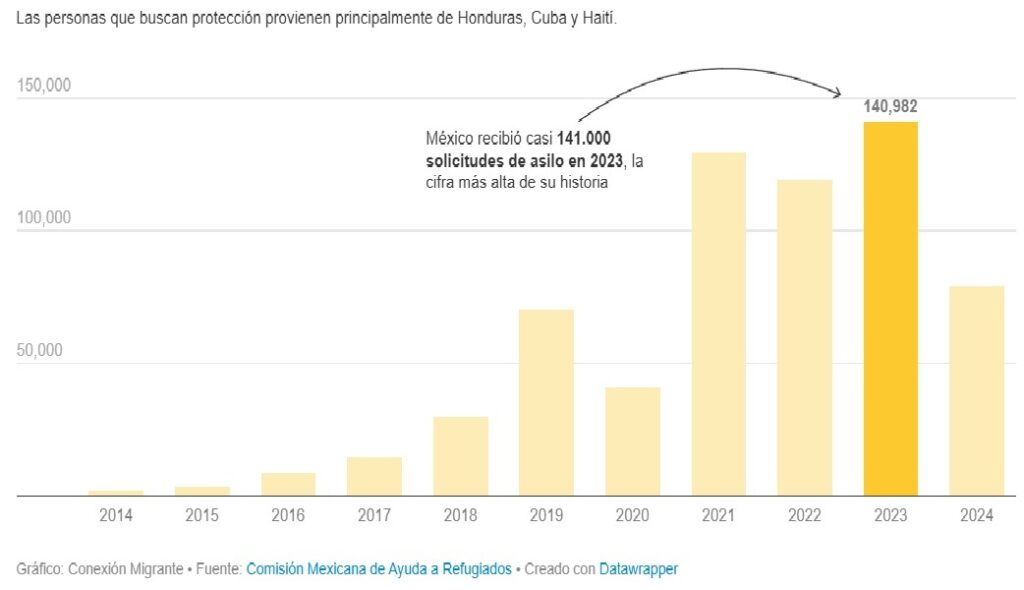
In 2024, the Mexican government tried to stem the flow of migrants and officially only served 80,000 asylum seekers.
Andrés Ramírez, former COMAR coordinator from 2018 to 2024, explains in an interview that many of these people were not necessarily seeking refuge in Mexico, but came to the Commission advised by human traffickers (coyotes) to obtain a document that would allow them to travel within the country to the northern border.
This document is the Visitor Card for Humanitarian Reasons (TVRH, in Spanish) and is issued by the National Migration Institute (INM).
“What they wanted was to use the refugee claim form from the Refugee Commission and then head north,” says Ramírez.
The Mexican government recognized this mechanism as a way to get closer to the United States, and starting in 2024, the INM stopped issuing the cards and stopped complying with the law. Article 52 of the Immigration Law establishes that “authorization of residence for humanitarian reasons must be immediate and may not be denied.”
The Federal Public Defender’s Office detected a considerable decrease in the issuance of cards in 2024: in the first four months of 2023, 51,393 TVRHs were issued, and in the same period of 2024, the number dropped dramatically to 887.
“This generated concern in the Federal Legal Advisory Office, as the trend reflects a clear obstruction in the protection of the rights of persons subject to international protection. Carrying a TVRH protects the individual against refoulement by foreign authorities,” states the report “Opening Paths for Justice,” prepared by the Legal Advisory Unit and published in July 2025.
Lorena Cano, a lawyer who heads the Legal Clinic of the Institute for Women in Migration (IMUMI), warns that the INM should issue the cards for humanitarian reasons during the process, as required by law, and that as long as a person does not have a COMAR resolution, “they are undocumented.”
“The law establishes that applicants should have a provisional document for humanitarian reasons until their procedure is concluded. Therefore, Immigration is not issuing these documents; they are telling them: Well, I’ll accept the application, but I won’t resolve your case until COMAR resolves yours,” Cano points out.
As of July 31, 2025, at least 39,497 asylum applications were registered in the various COMAR offices across the country.
Tapachula, on the southern border, has the largest number with 18,647 applications; followed by Mexico City, with 6,950 registrations, according to data obtained through a request made through the Transparency Law.
The asylum recognition process takes longer than the 45 business days required by law, and COMAR has a significant backlog of cases, warn organizations that serve migrants.
Tere, a young, white-skinned Cuban woman, went to COMAR last March and by early July had still had no news regarding her application.
Octavio has been signing up to follow up on his application since late March, and by August, he still hadn’t had his eligibility interview.
Like them, thousands of people remain in Mexico in an irregular immigration status, working informally to earn an income and deprived of free access to their rights.
Source: bllieparkenoticias