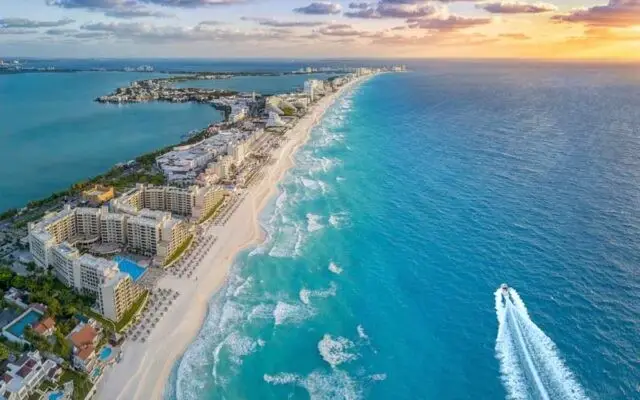

Cancún reaffirms its position as Mexico’s leading tourist destination, according to the Tourism Sector Program published in the Official Gazette of the Federation. The assessment indicates that this tourist destination accounts for 43.8% of international visitor arrivals by air, placing it well ahead of Mexico City (17%), Los Cabos (10.8%), and Puerto Vallarta (8.8%).
This leadership, however, also reflects the uneven distribution of tourists across the country, as four destinations together account for more than 80% of arrivals.
Mexican Caribbean, with the largest hotel offering
The official document highlights that Cancún and the Mexican Caribbean in general have the highest concentration of hotel offerings and maintain the highest occupancy rates. Added to this is its advantage in air connectivity, making it the most important gateway for international tourism in Mexico. In 2024, Quintana Roo, along with Baja California Sur and Nayarit, captured 75.1% of the country’s tourism Foreign Direct Investment (FDI), totaling $2,870.9 million.
The Other Side of Tourism
Although Cancún is a driving force of the national economy, the assessment also warns of the concentration of benefits. According to the study, almost half of the hotel room supply in Mexico is located in just seven states, led by Quintana Roo.
Inland cities, in contrast, are registering hotel occupancy rates of just 47.3% so far in 2025, reflecting the need to boost other regions with tourism potential but less development.
A New Promotion Model
The Tourism Sector Program proposes that overcoming these inequalities requires a new promotion model, with specific public resources and public-private partnerships, inspired by the experiences of countries such as Spain and Australia.
The six core objectives include diversifying destinations, fostering regional development, promoting infrastructure investments, strengthening competitiveness and innovation, and ensuring the sustainability of tourist destinations.
Thus, although Cancún remains the symbol of tourism in Mexico, the challenge is to extend this dynamism to other regions of the country.
Source: msn