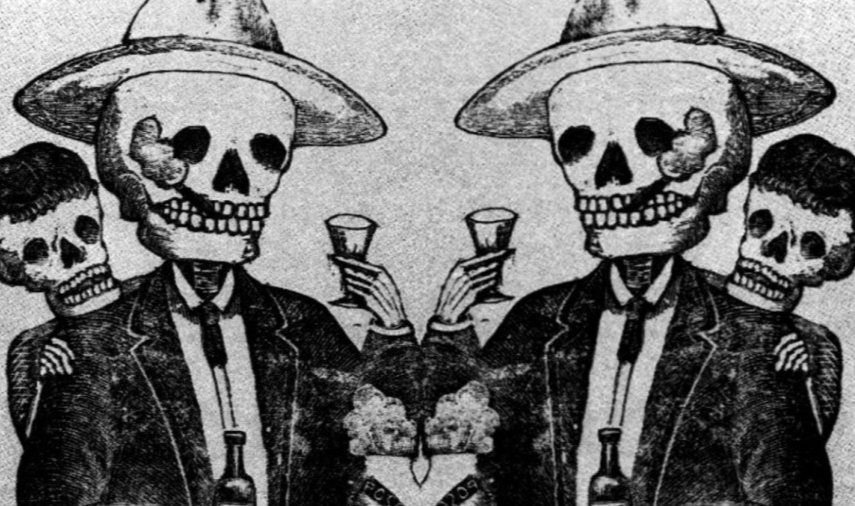

History has recognized José Guadalupe Posada as the artist to whom we owe the joyful living skulls that give a face to the celebration of the Day of the Dead in Mexico, forgetting that before him there was another engraver who began this graphic tradition: Manuel Manilla.
The reason why the former gained notoriety and the latter was forgotten is not entirely clear, although we can intuit that it began because Posada’s caricatured skeletons were replicated in Diego Rivera’s paintings, as in the case of Dream of a Sunday Afternoon in the Alameda Central.
Another factor that possibly led to Manuel Manilla’s neglect is his vague biography. The exact place and date of his birth are unknown, although it is believed to have been in Mexico City in 1830, but this is merely a belief.
There is no information on the names of his parents, siblings, or other possible relatives. The only thing about which there is a certain degree of accuracy is the year and cause of Manuel Manilla’s death: 1895, typhus.
Manuel Manilla’s first recorded engravings appeared in 1873, in a popular publication called La edad feliz (Happy Age). The rough outline of his first lines is evident, suggesting that he had only recently taken up the burin. But what he lacked in European technique and finesse in his drawings, he made up for with something very valuable: the depiction in his lines of rural Mexico.
It is said that Manilla’s drawings were an early warning of the Mexican Revolution, because figures such as his charros on horseback prophesied the rise of Emiliano Zapata. For this reason, his work has come to be called “enlightened socialism.”
Manilla arrived at Antonio Vanegas Arroyo’s workshop and met Posada.
He engraved to make small advertisements, flyers, and pamphlets for small and medium-sized businesses seeking to attract more customers. His illustrations for El Globo, Vinos y Licores Importados, and La Botita Elegante, among other posters, still exist in some collections.
His talent led him to become one of the illustrators at Antonio Vanegas Arroyo’s printing house, where José Guadalupe Posada also worked. It was there that he first saw Manilla’s festive skulls. But that would come later.
“Little Skulls of Love”
The first cheerful skeletons by the engraver Manuel Manilla appeared in a collection of poems titled “Calaveritas del amor” (Little Skulls of Love), in which the bony characters were said to have been companions on the adventures of people afflicted by life, heartbreak, and passion. These early drawings were recurring elements in the celebration of the Day of the Dead.

People passed them from hand to hand and from mouth to mouth. Manuel Manilla’s production of skeletons continued for several years. José Guadalupe Posada took up Manilla’s illustrations to create his own work.
However, it was Manilla’s skeletons that gained the most notoriety, and as we have already mentioned, there is no evidence of any rivalry between the two at the time.
Source: mexicodesconocido