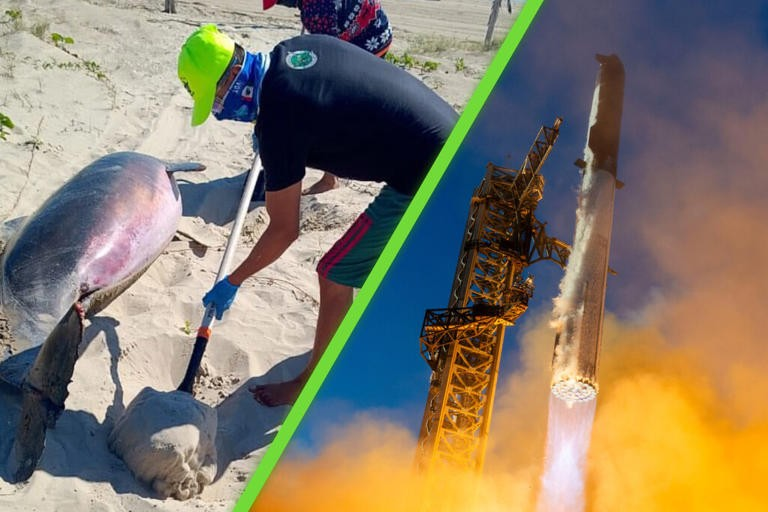

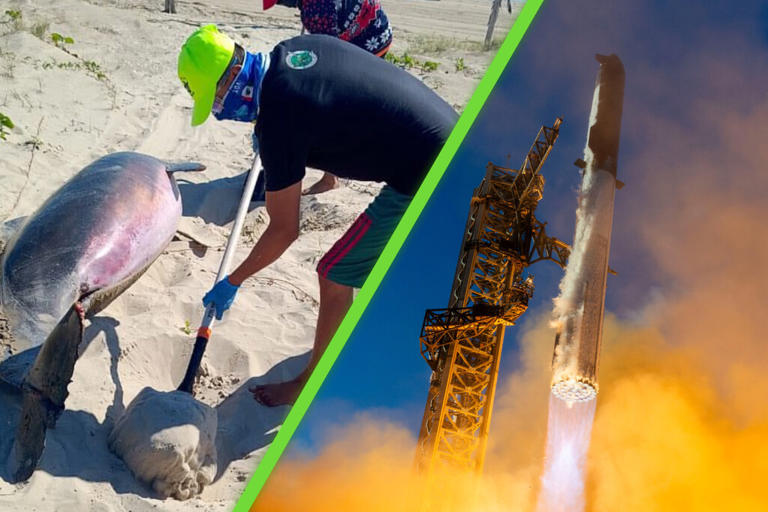
SpaceX’s eleventh test launch not only represents a step forward in the development of the space vehicles Elon Musk wants to use to reach the Moon and Mars. It also represents a pollution problem for Mexico, manifesting not only as space debris on the nation’s coasts but also causing harm to wildlife, with dolphins found dead.
The information comes from Conibio Global A.C., an environmental organization that reported that, following the launch of Starship on Monday, October 13, 2025, various debris from the SpaceX rocket began to be documented on the morning of Wednesday, October 15, at Playa Bagdad, in Tamaulipas.
According to the association, two dead dolphins have been found so far, one on the beach and another still floating in the water. One of the specimens showed signs that did not correspond to a natural death, so the Conibio team, along with a veterinarian, decided to perform a necropsy to, among other tests, examine the animal’s body and confirm whether its death was related to the rocket explosion and its shock waves.
Additionally, other pieces of space debris have been discovered. Among them are black solid residue resembling plastic rubber, as well as white fragments of synthetic material that possibly formed part of the rocket’s thermal coating.
That’s not all. The association reported that a cylindrical metal tank also washed ashore, preliminarily identified as part of the propulsion or firefighting system of SpaceX’s Starship 11 rocket. This object was seized by PROFEPA in coordination with municipal authorities and Civil Protection for safekeeping at facilities belonging to the Secretariat of the Navy.
Due to the large amount of debris and to avoid collateral damage, the Matamoros Harbor Master’s Office issued a “nautical advisory” for the possible presence of rocket debris in national waters off Playa Bagdad. The advisory requested vessels reduce their speed to avoid maritime accidents.
A recurring problem with potential legal consequences
This is not the first time Conibio Global has documented spacecraft debris. The organization already did so during the ninth failed Starship test, which on that occasion was destroyed during its re-entry to Earth. At that time, debris also began washing up at Playa Bagdad after the booster crashed and exploded in the Gulf of Mexico.
On that occasion, after an exploration of the area, “millions of fragments” of debris were documented over a surface area of just 40 kilometers. This raised the possibility of an entire marine ecosystem being contaminated, in addition to the impact on fishing and vessels.
Following the widespread evidence of pollution, Mexico has explored the possibility of taking legal action against SpaceX. Mexican President Claudia Sheinbaum has already indicated that the government is studying which international laws these activities may be violating in order to file the corresponding lawsuits, as the test launches have indeed generated pollution on the coast of Tamaulipas.
Although no final resolution has yet been reported, some of the regulations that may be violated include the Outer Space Treaty, which mandates the prevention of harmful contamination of space and the terrestrial environment. Other agreements are also being considered, such as the Convention on International Liability for Damage Caused by Space Objects and the international environmental law principle that “the polluter pays.”
Meanwhile, according to Alberto Granados, mayor of Matamoros (one of the affected locations), SpaceX has contacted them to share its intention to hire a company to handle the beach cleanup.
Source: msn