
The airport projects of the self-proclaimed Fourth Transformation, which have struggled to get off the ground, face perhaps their worst turbulence this fall of 2025.
The Donald Trump administration dealt a severe blow this week to the Felipe Ángeles International Airport (AIFA), which was just beginning to meet its passenger targets, by canceling its 13 air routes to the United States, a move that the Mexican government has described as “political.”
In addition, the Tulum International Airport, another project inaugurated by former President Andrés Manuel López Obrador, is not faring well, dragged down by the tourism crisis affecting that municipality in Quintana Roo.
In 2018, following a controversial public consultation in which individuals could vote more than once, then President-elect López Obrador announced the cancellation of the flagship project of the Peña Nieto administration, the New International Airport of Mexico (NAIM).
Among the reasons for canceling the project, López Obrador cited corruption, the embezzlement of public funds, its environmental unviability, and the intention to build another Santa Fe—a financial district with luxury housing—on the land adjacent to the remains of Lake Texcoco.
Almost four years later, thanks to accelerated efforts, even amidst the COVID-19 pandemic, President López Obrador fulfilled his objective of inaugurating a new airport on Benito Juárez’s birthday: the Felipe Ángeles International Airport (AIFA) opened on March 21, 2022.
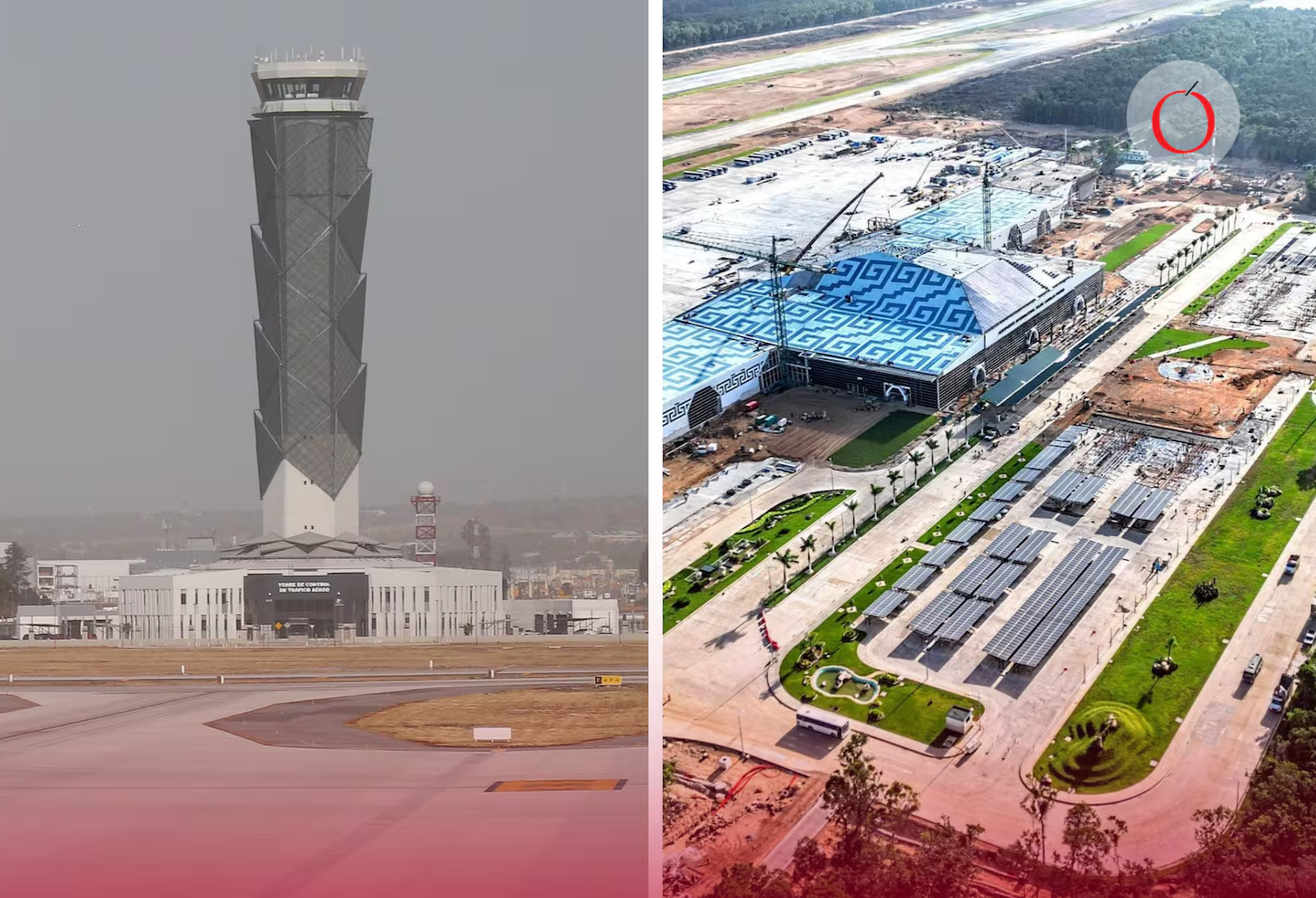
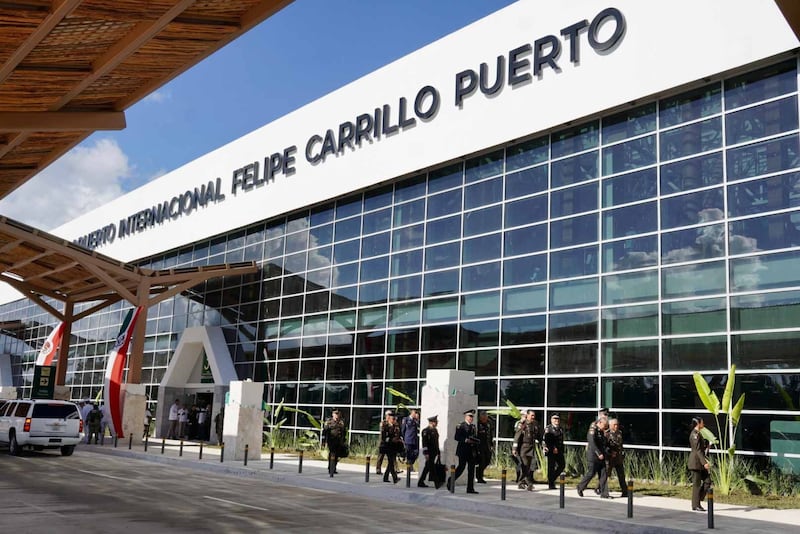
The AIFA (Felipe Ángeles International Airport) is a feat in itself: despite the speed with which it was built, it boasts modern, clean, and even quite beautiful facilities. It’s no wonder it was awarded the Versailles Prize in 2024 as one of the most beautiful airports in the world.
Furthermore, it has a couple of impressive museums: the Mammoth Museum, which houses invaluable pieces of creatures that inhabited the area during the Ice Age; and the Aviation Museum, which features former presidential aircraft, as well as planes that participated in World War II against the Axis Powers: Japan, Italy, and the Third Reich.
However, its distance from Mexico City and the lack of connectivity—the Suburban Train is still under construction—have meant that this airport, despite its beauty and low prices (a Volaris flight to Cancún can cost less than 1,000 pesos), has not yet reached its full potential.
According to the Federal Civil Aviation Agency, as of June 2025, the Felipe Ángeles International Airport (AIFA) handled 5,172,000 passengers from January to September, a 15.7 percent increase compared to the same period of the previous year.
Of these passengers, 4,869,000 were Mexican nationals, while only 303,000 were international.
In contrast, the Mexico City International Airport (AICM) handled 33,154,000 passengers during the same period in 2025, of which 20,284,000 were Mexican nationals and 12,869,000 were international nationals.
In 2024, AIFA handled a total of 6.3 million passengers, while AICM served as a destination and departure point for 45.3 million. This represents a difference of 719 percent.
Therefore, Felipe Ángeles International Airport met its passenger target last year of 6.3 million users; however, it is still far from its goal of handling up to 20 million passengers in its first phase, planned for the airport’s first 10 years.
Regarding cargo transport, Felipe Ángeles International Airport (AIFA) has established itself as the leading airport in this area: from January to September 2025, it transported 292,697,000 tons; while Mexico City International Airport (AICM), which ranks second, handled 184,256,000 tons.
Although Felipe Ángeles has modestly increased its passenger numbers, even meeting its initial targets, it has not yet resolved the saturation of Mexico City’s main airport. The airspace situation is clear: a review conducted by CRÓNICA confirmed that, at the same time of day, there were only two aircraft at Santa Lucía Airport, one on the runway and the other in the airspace. Conversely, at Benito Juárez there were 17 simultaneous operations, both of aircraft on the runway, in the boarding areas, and in the sky.
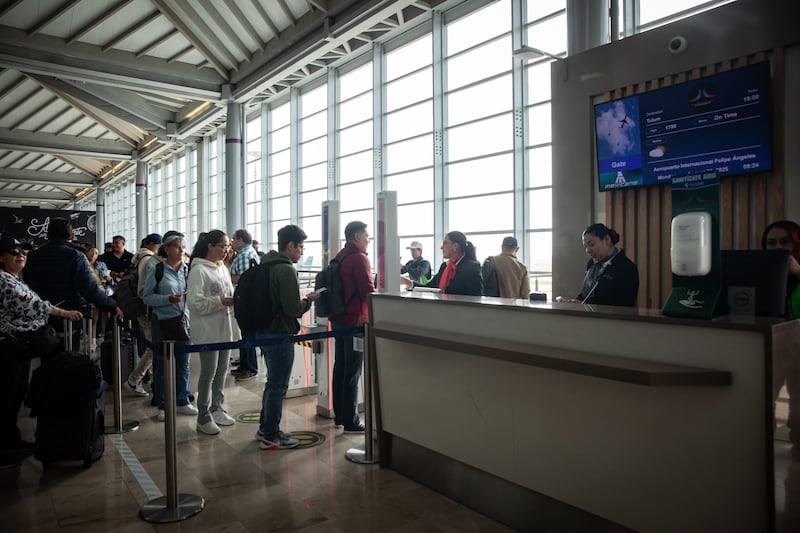
The director of Felipe Ángeles International Airport, Isidro Pastor, announced last July that his airport has handled approximately 152 daily operations in 2025.
In contrast, so far this year, Mexico City International Airport has seen 234,172 operations, averaging 857.7 operations per day.
Although 2026, with the FIFA World Cup being held in Mexico, looked set to be a good year for AIFA, the cancellation of flights to the United States by the Trump administration could dash Santa Lucía’s World Cup dreams.
In Mexico, there is an airport in paradise: located in the middle of the jungle, Tulum International Airport opened in 2023 as a way to alleviate pressure on Cancún International Airport, the country’s second largest airport after AICM.
Like AIFA, the Tulum airport was built in record time: although announced in July 2021, the project was completed, with military support, in December 2023.
The Tulum International Airport started strong, not only being considered one of the 25 best in the world, but also handling around 1.3 million passengers and registering 10,100 operations in its first year.
In August and September, the Tulum Airport dropped out of the Top 10, handling only 64,646 passengers, both domestic and international, in September—a 27.88 percent decrease compared to September 2024, when 89,627 passengers were handled. Meanwhile, images of empty beaches and businesses in this important Mayan tourist destination have gone viral on social media.
Due to the decline in tourism in Tulum, partly due to high prices and restricted beach access, Governor Mara Lezama announced a series of actions to boost the municipality’s tourism recovery.
The governor has also toured the municipality, including the recently inaugurated Jaguar Park, another of AMLO’s flagship projects, and met with local business owners, hoteliers, and merchants to strengthen the destination’s promotion.
During AMLO’s six-year term, not only were the AIFA (Felipe Ángeles International Airport) and the Tulum Airport inaugurated, but another airport was also opened by the Chihuahua state government in the historic municipality of Creel, on the northern border.
Although modest in size, the Barrancas del Cobre Airport, also known as the Copper Canyon Airport, opened in January 2024 and, as of August 2025, had handled 3,199 passengers in 1,284 operations.
Almost four years after the AIFA, an emblematic project of the Obrador administration, began operations, Mexican aviation, which was barely recovering from its downgrade, now faces another titanic challenge, one that has a name and surname: Donald Trump.
Source: cronica