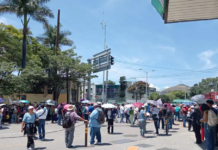
Since September 15, assaults on truck, passenger, and tourism transport drivers on the Cuacnopalan-Oaxaca highway have been reduced to zero reported cases thanks to the implementation of Operation Escalón along an 84-kilometer stretch. Previously, up to three assaults were reported daily, totaling nearly 90 robberies per month, which resulted in the deaths of two drivers. The nighttime escort system operates without the National Guard joining the effort, despite the fact that this federal highway has a history of violence against transporters.
The operation runs from kilometer 0 to kilometer 84 of the highway, departing at 11:00 PM from the Miahuatlán tollbooth in Puebla state, where a convoy of trucks and heavy vehicles assembles. Drivers register with the authorities and wait until the joint departure, with state and municipal police patrols leading and trailing the convoy to reduce the risk of attacks in the most dangerous sections.
Ángel Navarro Estrada, president of the Mexican-American Federation of Freight, Passenger, and Tourism Carriers (Fetramex), explained that the convoys cross the Palmar de Bravo security checkpoint around 1:00 a.m. and that the routes are repeated throughout the early morning, departing at 3:00 a.m. and returning at 5:00 a.m. He detailed that, on each trip, the vehicles travel in groups to prevent any one vehicle from being isolated, which previously facilitated robberies against freight and passenger transport on the Cuacnopalan-Oaxaca highway.
The leader stated that the demand for this escort arose due to the high crime rate along this stretch of road. He emphasized that the escort service is free of charge for the carriers, as it relies on the collaboration of state and municipal police.
Navarro stressed that, since the implementation of the security plan on September 15, no robberies of transport vehicles have been reported on the routes and times covered by the convoy.
He explained that, on each deployment, authorities report the names of participating personnel, patrol unit numbers, type of weaponry, and the locations of the points where they provide escort. This traceability allows for monitoring of nighttime patrols and maintaining direct communication with drivers in case of any incident on the highway.
The president of Fetramex emphasized that some nighttime drivers are still unaware of the operation and therefore seek to publicize it among more organizations and drivers.
The leader stated that the federation’s objective is for this convoy model to be permanent and extended into Oaxaca through coordination with the state’s authorities.
The transportation leader lamented that the National Guard refused to join the operation, despite its formal responsibility being the surveillance of federal highways.
“The National Guard was asked to join as well, and we saw a refusal,” he noted, adding that the agency tends to be wary when state and municipal police participate in escort operations. He emphasized that, in this case, the uniformed officers’ role is to assist and safeguard the well-being of the drivers, not to penalize them or issue citations.
He criticized the National Guard for not “getting its act together” to respond to the complaints and requests of the truckers, who continue to be exposed on highways with a history of violence.

Source: lajornadadeoriente