
Mexico’s business history is replete with figures whose path to success was marked by humble beginnings, perseverance, and a bold business vision.
Many of the leaders of the country’s largest conglomerates have origins that demonstrate the importance of personal effort and academic achievement.
This is the case of a prominent Mexican businessman whose origins in Tampico are intertwined with a formative period in the United States, where he demonstrated an early commitment to work to finance his university studies. Learn the story of Emilio Azcárraga Vidaurreta.
The history of one of the most influential television networks in Mexico and Latin America began in the 1950s. At that time, Emilio Azcárraga Vidaurreta, grandfather of the current owner of Televisa, decided to venture into the media sector by investing in Channel 2 XEW-TV. This station would later consolidate into Televisa after merging with other channels in the television landscape.
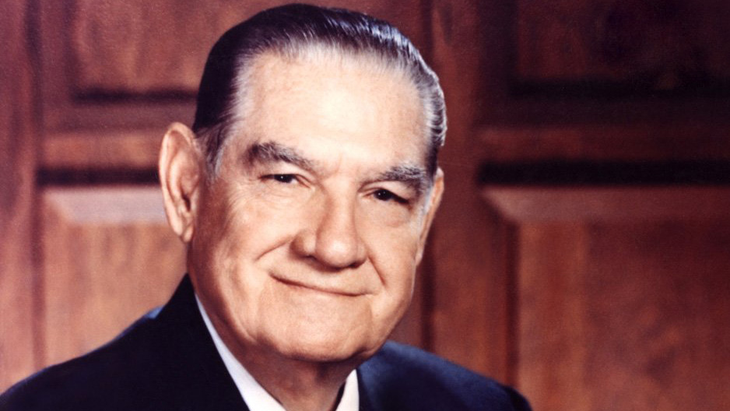
Azcárraga Vidaurreta was born in Tampico, Tamaulipas, on March 2, 1895. He completed his early schooling in Piedras Negras, Coahuila, and San Antonio, Texas. It was in the latter state that he earned a degree in Economics and Business from San Eduardo College in Austin.
His entry into the business world was early: at 17, he had his first job as a street vendor of Mexican shoes and merchandise. Eventually, a Boston-based company hired him to represent them in Mexico.
According to data from the National Institute of Anthropology and History (INAH), in 1925 he married Laura Milmo Hickman, the daughter of a wealthy Irish businessman who had settled in Mexico and was considered one of the richest people in Monterrey. The couple had three children: Laura, Carmela, and Emilio Azcárraga Milmo, who would later become the successor to the conglomerate.
By 1927, Azcárraga had founded a record label. Three years later, he made history by creating XEW, the first radio station with national coverage in Mexico. In the early 1940s, he built Churubusco Studios in southern Mexico City, considered fundamental to national film production during the Golden Age of Mexican cinema.
However, the most significant project of his business career came to fruition in 1955. He partnered with Rómulo O’Farrill Jr., founder of Channel 4 XHTV (the first television station in the country), and also with Guillermo González Camarena, who was in charge of operations at Channel 5 XHCG. This merger of channels gave rise to the company Telesistema Mexicano, which would later be renamed Televisa.
In 1961, a group of investors led by Azcárraga Vidaurreta, Emilio Nicolás, René Anselmo, Frank Force Jr., and Julián Kaufman acquired station KCOR-TV in San Antonio, Texas. This made it the network’s first affiliate in the United States, with the goal of offering Spanish-language programming to the Latino population.
Five years later, the businessman diversified into the telecommunications sector by founding Cablevisión, focused on the installation, operation, and distribution of cable television. This was one of his last ventures, as he passed away in Houston in 1972 at the age of 77.
That same year, his son, Emilio Azcárraga Milmo (nicknamed “El Tigre”), assumed the chairmanship of the board and inherited the burgeoning empire. Finally, in 1973, Telesistema Mexicano merged with XHTMTV Canal 8 “Televisión Independiente de México,” officially giving birth to Televisa.
Source: ambito