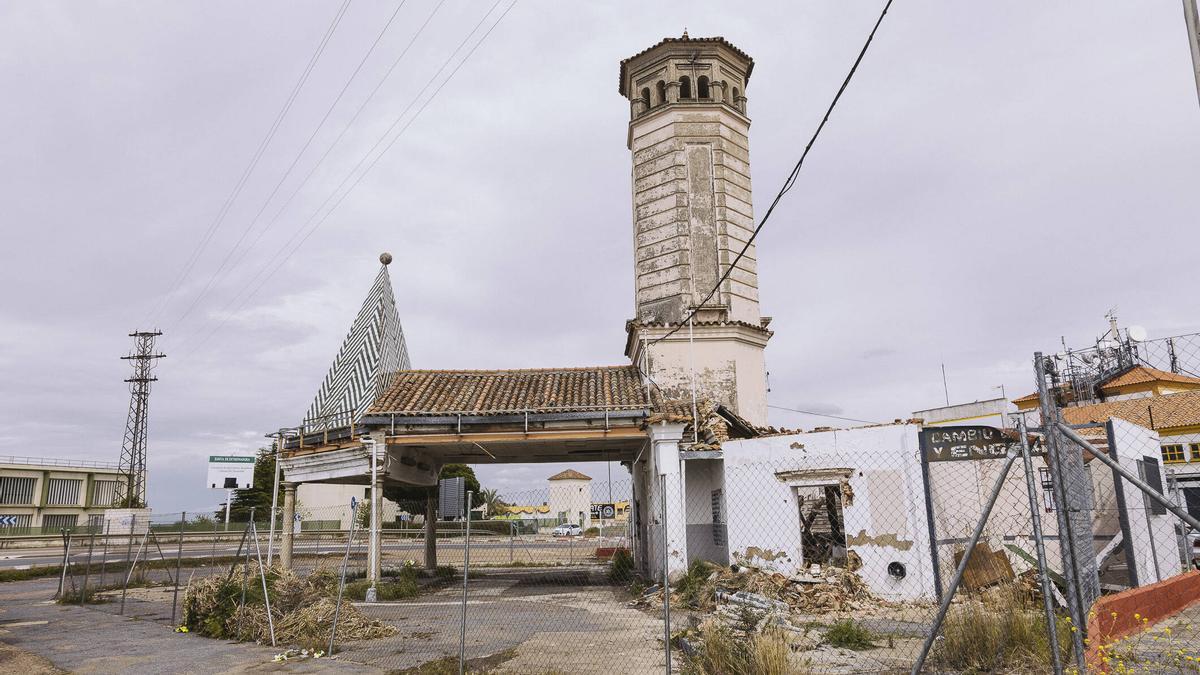
The former Cepansa gas station (also known as the Tiro Pichón station) can now be considered a Site of Cultural Interest and is one of Mérida’s most significant buildings. The Governing Council of the Regional Government of Extremadura approved the decree on Tuesday declaring the striking building a Site of Cultural Interest, with the category of Monument, granting it the highest level of heritage protection due to its great industrial value. It was the first service station in the city, designed by the Badajoz architect Luis Morcillo Villar, and began operating in 1953 to meet the needs of the ‘Badajoz Plan’. Its strategic location, at the intersection of the N-V and N-630 highways, justified its unique design. In this way, Mérida not only consolidates another part of its historical legacy but also opens a new chapter in which its protection and enhancement will finally be commensurate with its architectural grandeur.
Fondenex had requested its declaration as a Site of Cultural Interest from the regional government. The building (the only one of its kind remaining in the region) is a testament to an era when such structures, given their importance and rarity, could achieve a monumental appearance. In this case, its exceptional nature is remarkable even at the state level. The structure is composed of elements from diverse styles, combining neo-historicist and regionalist characteristics. It has a trapezoidal floor plan and consists of a central section, which serves as a lobby, and two lateral wings that were used as a waiting room, office, and meeting room. It also included a storage area and a room for the engines and compressors.
The façade features three semicircular arches typical of 1950s architecture and of the colonization villages. The canopy is covered by a ceramic spire with a geometric design based on broken green and white lines, topped by a small granite sphere in the neo-Herrerian style, common in Spanish construction since the end of the Civil War. The gas station is crowned by an octagonal tower, a striking feature composed of two parts: a prismatic volume with grooved bands and a Neo-Mudéjar upper section with windows and a ceramic roof. This long-awaited step is finally a reality.
Source: elperiodicoextremadura