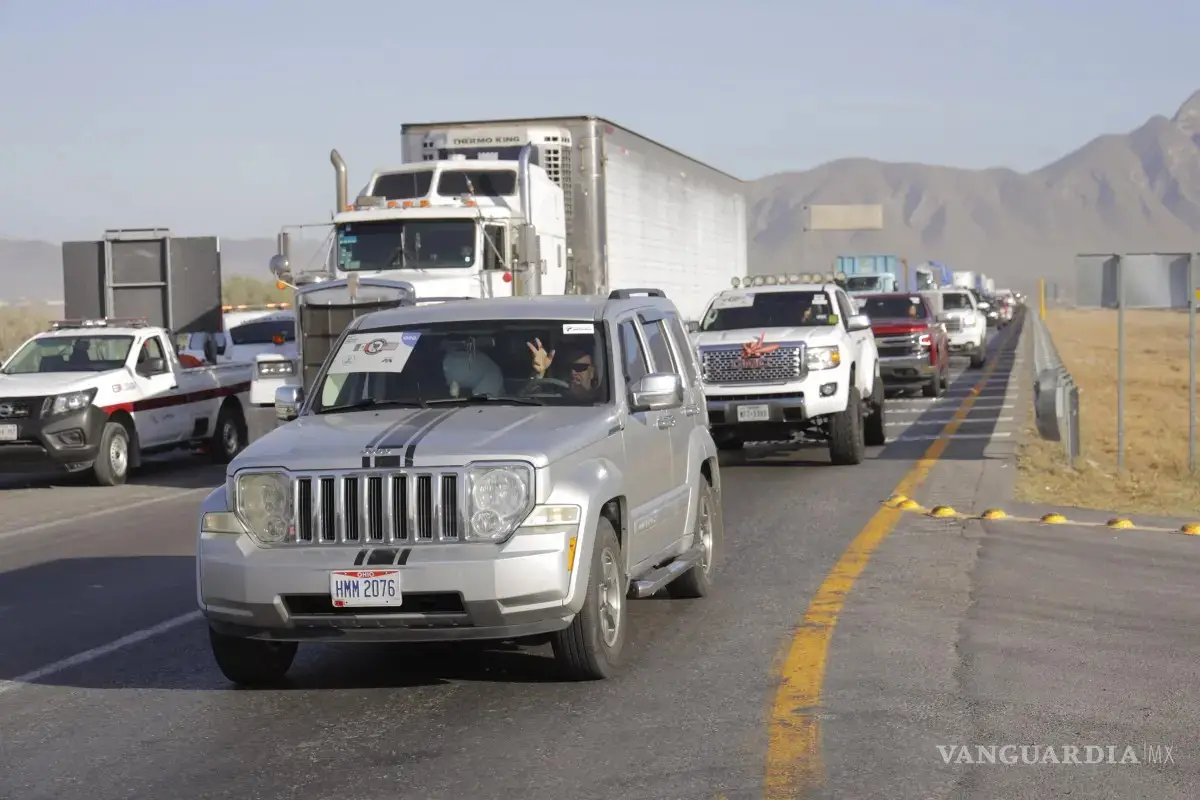

Starting this Wednesday, caravans of Mexican nationals returning from the United States will begin passing through Coahuila, with approximately 3,000 traveling between 10:00 a.m. and 6:00 p.m., to celebrate the Christmas holidays with their families in Mexico, the National Migration Institute (INM) reported.
The INM delegate in Coahuila, Susana Rosales, indicated that this flow is part of the special Paisano Program operation, which will accompany the transit of thousands of Mexican nationals traveling through the state during the holiday season.
She specified that the passage of more than 3,100 vehicles has been confirmed, representing the passage of more than 12,400 Mexican nationals along the 468 kilometers of Federal Highway 57, considered one of the main transit routes in the state.
Among the scheduled caravans is the “United Migrants” caravan, originating from Querétaro and expected to arrive on December 17, with more than 3,000 vehicles; as well as the “Zacatecas Caravan,” which will cross Coahuila on December 19, comprised of between 100 and 200 vehicles.
Rosales explained that, given the increase in migration, the Paisano Program activated its special winter operation, which anticipates providing assistance to over 50,000 Mexican nationals as they pass through Coahuila alone. Although the National Migration Institute (INM) provides services year-round, he emphasized that during this season the priority is protecting and guiding Mexicans returning from abroad.
To assist them, the INM has deployed eight strategically located service points at International Bridges One and Two in Piedras Negras, the “Puerta de México” bridge in Acuña, and at vehicle entry points, where guidance is provided on procedures such as the temporary importation of vehicles.
The operation is being carried out in coordination with the National Guard, state and municipal police forces, as well as the Green Angels (roadside assistance service) and the Red Cross, with the goal of ensuring safe, orderly, and humane transit.
The INM (National Migration Institute) delegate stated that no formal complaints of abuse or extortion have been registered in Coahuila in the last two years, although she reiterated that any attempt at abuse of authority, discrimination, or mistreatment can be reported through the official Paisano Program hotlines, available 24 hours a day.
Finally, she emphasized that the massive influx of Mexican nationals returning from abroad has a positive impact on the local economy, primarily in the hotel, tourism, and commercial sectors, and urged them to travel with their documentation in order and complete their paperwork in advance. The winter operation of the Paisano Heroes Program will be in effect until January 8, 2026.
It was detailed that the circulation of more than 3,100 vehicles has been confirmed, representing the passage of more than 12,400 Mexican nationals along the 468 kilometers of Federal Highway 57, considered one of the main transit routes in the state.
Among the scheduled caravans is the one called “United Migrants,” coming from Querétaro and expected on December 17, with more than 3,000 vehicles; as well as the “Zacatecas Caravan,” which will cross Coahuila on December 19, made up of between 100 and 200 vehicles.
Rosales explained that, given the increase in mobility, the Paisano Program activated its special winter operation, which anticipates providing assistance to more than 50,000 Mexican nationals as they pass through Coahuila alone. Although the National Migration Institute (INM) provides services year-round, it emphasized that during this season, the priority is protecting and guiding Mexicans returning from abroad.
To assist them, the INM has deployed eight strategically located information booths at International Bridges One and Two in Piedras Negras, the “Puerta de México” Bridge in Acuña, and at vehicle entry points, where guidance is provided on procedures such as the temporary importation of vehicles.
The operation is being carried out in coordination with the National Guard, state and municipal police forces, as well as the Green Angels (roadside assistance service) and the Red Cross, with the goal of ensuring safe, orderly, and humane transit.
Source: vanguardia